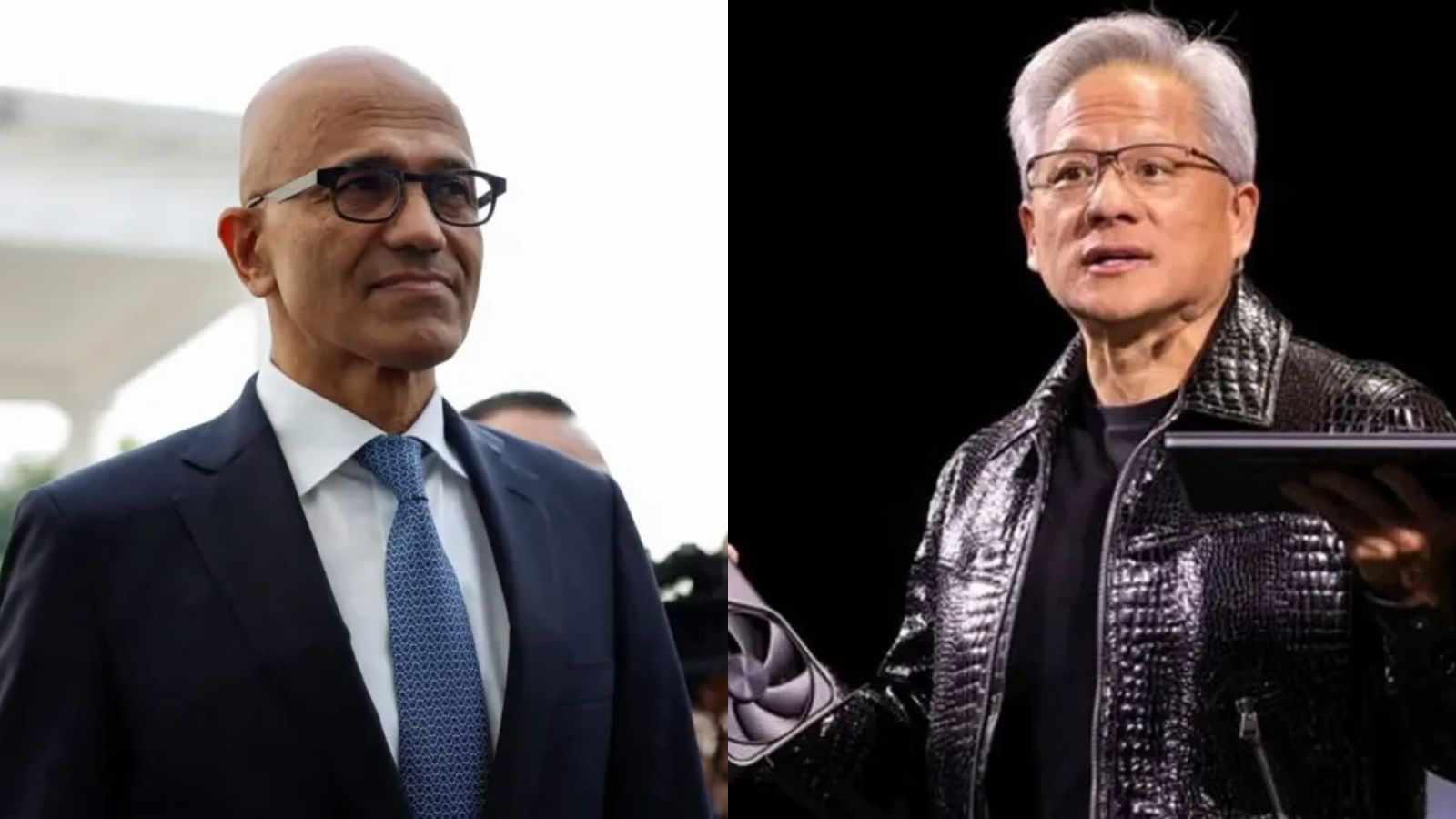
When Satya Nadella told an audience that Nvidia’s historic rise to the top of the global market was "not up to me," he was not offering false modesty. He was stating a brutal structural reality of modern computing. Microsoft did not manufacture Jensen Huang’s comeback from near-bankruptcy in the late 1990s to a multi-trillion-dollar artificial intelligence juggernaut; instead, Microsoft’s massive capital expenditures for Azure data centers collided with decades of Nvidia’s proprietary software lock-in, leaving Nadella with no choice but to buy every processor Huang could ship.
That simple four-word dismissal cuts through years of Silicon Valley mythology. Tech observers often frame the AI boom as a cozy partnership between two friendly executives who mutually rescued each other from stagnation. The truth on the balance sheets looks far more like a high-stakes standoff between a dominant software monopolist and an unassailable hardware gatekeeper.
The Myth of the Benevolent Kingmaker
Wall Street loves a clean narrative. In the standard telling of the generative AI explosion, Microsoft spotted the potential of OpenAI early, wrote a massive check, and single-handedly turned Nvidia’s graphics processing units into the most sought-after commodity on Earth. Under this theory, Nadella is the kingmaker who pulled Huang out of the volatile gaming and cryptocurrency cycles and handed him permanent enterprise legitimacy.
Nadella knows better. Having spent three decades inside Microsoft—watching Windows lose mobile to Apple and Google while Azure fought a bloody, margin-crushing war against Amazon Web Services—he recognizes what real architectural power looks like. When asked about Nvidia’s staggering valuation and market dominance, his shrug was an admission of market physics. Demand from enterprise customers, foundational model labs, and sovereign governments dictated the hardware stack, not executive fiat in Redmond.
If Microsoft had refused to buy Nvidia’s H100 and Blackwell clusters, OpenAI would have simply trained its models on Google Cloud, Oracle, or Amazon infrastructure. Nadella’s only real decision was whether Microsoft wanted to own the primary distribution layer for intelligence or watch from the sidelines while another cloud provider captured the next generation of enterprise software.
Jensen Huang’s Twenty-Year Trap
To understand why Nadella had zero control over Nvidia’s resurgence, you have to look past the silicon and examine the software moat Huang began digging in 2006.
Back then, Nvidia was a cyclical graphics card vendor surviving on PC gamers and fighting existential battles with ATI. Huang made a bet that nearly got him fired by his own board and relentlessly punished by institutional investors. He decided to dedicate precious silicon real estate on every consumer GPU to CUDA—Compute Unified Device Architecture—a parallel computing platform and programming model that allowed researchers to use graphics chips for general-purpose scientific math.
For nearly a decade, Wall Street hated the expense. Margins compressed while university researchers used cheap gaming cards to run fluid dynamics simulations and neural network experiments. Then came 2012, when Alex Krizhevsky used two consumer Nvidia GTX 580 cards to crush the ImageNet visual recognition competition, sparking the modern deep learning revolution.
By the time ChatGPT detonated across the corporate world, CUDA was no longer an optional toolkit. It was the native language of artificial intelligence. Millions of developers, thousands of academic papers, and entire libraries like PyTorch and TensorFlow had been optimized down to the bare metal for Nvidia’s architecture.
When Nadella needed tens of thousands of chips to stand up Azure’s AI supercomputers, he could not simply call Intel or AMD and ask for a discount alternative. Even if a rival chip offered superior raw floating-point operations per dollar on paper, migrating an enterprise-scale training run off CUDA meant rewriting years of low-level kernel optimizations and risking catastrophic delays in model releases.
Huang did not experience a sudden "comeback" engineered by Microsoft. He simply waited for the rest of the computing industry to arrive at the exact destination he had been paving since the George W. Bush administration.
The Prisoner’s Dilemma of Hyperscale Capex
Inside the boardrooms of Microsoft, Alphabet, Meta, and Amazon, capital expenditure budgets have ballooned to levels that dwarf historic industrial buildouts like the interstate highway system or the telecommunications fiber boom of the late 1990s. Tens of billions of dollars flow out of Redmond every single quarter, and a massive slice of that capital goes straight into Nvidia’s gross margins, which have routinely hovered above 70 percent.
This dynamic exposes the uncomfortable asymmetry in the Nadella-Huang relationship.
- Nvidia captures the immediate cash. Every time Microsoft builds a new data center region to satisfy Copilot or OpenAI demand, Nvidia books high-margin hardware revenue upfront.
- Microsoft carries the depreciation risk. Redmond puts tens of billions of dollars of depreciating physical servers onto its balance sheet, betting that software subscriptions and cloud consumption will pay back the infrastructure over a five-to-six-year lifecycle.
- Supply scarcity eliminates buyer power. In normal enterprise procurement, a buyer spending tens of billions of dollars dictates pricing, custom specs, and payment terms. In the AI buildout, Nadella had to publicly reassure investors that supply constraints were easing just to prove Microsoft could fulfill its own cloud backlog.
Consider a hypothetical scenario illustrating this trap. Suppose Microsoft decided tomorrow to pause Nvidia orders for two quarters to force a 20 percent price cut. Within forty-eight hours, Elon Musk’s xAI, Meta, or sovereign wealth funds in the Middle East would happily absorb every single canceled wafer allocation at full list price. Nadella has zero monopsony power in a supply-constrained market. Saying "it’s not up to me" is the most accurate summary of vendor lock-in ever uttered by a Fortune 500 CEO.
How Microsoft Is Quietly Fighting Back
Public diplomacy requires Nadella to praise Jensen Huang as a visionary partner on stage at developer conferences. Private capital allocation tells a completely different story. No CEO who survived the mobile operating system wipeout intends to remain permanently dependent on a single component supplier that extracts software-like margins from hardware sales.
Beneath the polite handshakes, Microsoft is executing a multi-front campaign to break Nvidia’s stranglehold on its infrastructure costs.
Custom Silicon in the Shadows
Microsoft unveiled its in-house Azure Maia AI accelerator and Cobalt ARM-based CPU specifically to stop paying the "Nvidia tax" on predictable workloads. Training frontier models still requires Nvidia’s brute-force interconnects and CUDA maturity, which is why Redmond continues to buy flagship Blackwell racks in massive volumes. Inference, however, is a completely different economic equation.
Once a model like GPT-4 or a specialized enterprise agent is trained, running queries against it millions of times per day is an exercise in cost-per-token efficiency. By routing internal workloads like Microsoft 365 Copilot, Bing, and GitHub Copilot onto custom Maia silicon, Nadella can bypass Nvidia’s gross margin stack without forcing external Azure customers to rewrite their code.
The AMD and Open-Source Hedge
Microsoft has also served as the primary anchor customer for AMD’s Instinct MI300X accelerators, giving Lisa Su the validation needed to challenge Nvidia in the data center. At the same time, Microsoft engineers contribute heavily to Triton—an open-source GPU programming language originally developed at OpenAI—and compiler layers designed to decouple AI models from proprietary CUDA code.
The goal is simple. If developers write models in high-level abstractions that compile efficiently onto any backend hardware, CUDA stops being an impenetrable wall and becomes just another driver layer.
Model Routing and Distillation
Perhaps the sharpest weapon in Microsoft’s arsenal has nothing to do with silicon at all. Nadella has consistently pushed the idea that intelligence is becoming commoditized and that not every enterprise task requires a massive, frontier-scale model burning megawatts of Nvidia compute.
By developing smaller, specialized models like the Phi family—which can run locally on PCs or on cheap commodity server hardware—Microsoft reduces the total compute intensity required to deliver an AI feature. Every query handled by a small language model on an edge device is a query that never touches an expensive Nvidia GPU cluster in an Azure data center.
The Structural Tension Defining the Next Decade
The friction between Microsoft and Nvidia is not a personal rivalry between Satya Nadella and Jensen Huang. Both leaders have delivered historic returns by understanding where value migrates when computing architectures shift.
Huang is attempting to turn Nvidia from a chip company into a full-stack AI factory, selling not just GPUs, but networking gear via Mellanox, proprietary enterprise software via Nvidia AI Enterprise, and entire pre-configured supercomputing systems. He wants to own the platform layer directly, bypassing the cloud hyperscalers whenever enterprises deploy on-premises infrastructure.
Nadella is fighting the exact opposite battle. He wants to commoditize the underlying hardware layer so that compute becomes an interchangeable utility, allowing Microsoft to capture the high-margin application, security, and data-governance layers sitting on top of the cloud.
History suggests neither executive will win an absolute victory. During the PC revolution, Intel and Microsoft formed the "Wintel" duopoly—a tense, mutually dependent alliance where both companies constantly probed the other’s margins while presenting a united front to customers. Today, Nadella and Huang occupy those exact positions in the artificial intelligence stack.
When Nadella brushed off credit for Nvidia’s triumph, he was acknowledging that the market forces driving silicon demand are bigger than any single software executive. Microsoft built the distribution engine that brought generative AI to millions of corporate desktops, but Jensen Huang spent twenty years building the only tollbooth on the highway leading into the data center. Until Microsoft’s custom chips and software abstraction layers mature enough to pave an alternate route, Nadella has no choice but to keep paying the toll.