A silk sash is supposed to mean something.
In the quiet rituals of diplomacy, it is an unspoken treaty—a strip of woven fabric that tells the world you come with the weight of capitals, passports, and centuries of protocol behind your back. You do not wear it to stop a metal bar. You wear it so people remember that behind your face sits an embassy, a ministry, a parliament thousands of miles away.
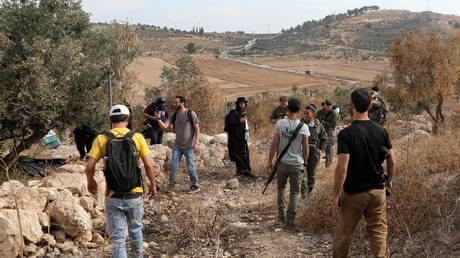
Yet in the rocky hills outside the West Bank village of Taybeh in mid-October 2026, a French mayor put on his tricolor sash and watched it fail in real time.
Three vehicles pulled up. Masked men stepped out carrying metal bars. The sash did not slow them down. Bernard Baudoux, the mayor of Aulnoye-Aymeries in northern France, was struck with iron bars, kicked, and thrown to the ground alongside European diplomats from Belgium, France, and Poland, as well as Catholic representatives who had traveled to formalize a twinning agreement and join the local olive harvest. A vehicle belonging to the Belgian consulate took damage.
For decades, headlines about West Bank violence have followed a familiar, numb rhythm. A village is raided. Olive trees are vandalized or seized. A farmer is beaten. Foreign ministries issue brisk statements from air-conditioned offices in Brussels, Paris, or London, expressing "deep concern" and urging restraint. Most readers scroll past. The distance between a dusty hillside near Ramallah and a living room anywhere else feels wide enough to ignore.
That distance collapsed when the people on the ground were carrying diplomatic immunity and foreign passports.
The Illusion of Untouchability
Think of diplomatic protocol like a theater curtain. When it works, everyone plays their part: the actors speak their lines, the stagehands stay out of sight, and the audience believes in the world on stage because everyone agrees to honor the boundary between fiction and force.
For a long time, foreign envoys and local mayors visiting the occupied West Bank operated behind that curtain. They assumed their official status—and the cameras or consulate plates nearby—created a buffer. Even when Palestinian residents warned that hardline settlers acted with impunity, visiting officials often believed their own presence served as a shield, a way to bear witness without becoming the target.
The attack near Taybeh shattered that assumption. One day earlier, near Abu Falah northeast of Ramallah, American photojournalist Heidi Levine had already been beaten with sticks and kicked while covering the olive harvest. Together, those two days exposed a chilling reality: the boundary of intimidation was no longer stopping at Palestinian farmers or lone reporters. It was swallowing anyone standing in the orchard.
(Note: The following vignette is a hypothetical scenario constructed to illustrate the human tension experienced by observers and residents during harvest-season flashpoints, grounded in documented patterns of olive harvest clashes.)
Imagine Nadia, a fictional olive grower in her fifties whose family has tended the same terraced slopes for four generations. October is supposed to smell like crushed leaves, warm earth, and diesel from tractors—the one month of the year when work feels like celebration rather than survival. Instead, Nadia checks the ridge line every twenty minutes. When a convoy of foreign visitors arrives to help pick fruit and sign a friendship pact, she feels a brief surge of relief. Maybe today, she thinks, the shouting from the neighboring hill will stay on the hill. Then she hears tires crunching gravel too fast, sees masks where faces should be, and realizes that even guests with foreign flags are running for their doors.
That is the invisible stake behind a headline that reads WATCH Israeli settlers attack European diplomats in West Bank. It is not merely a clash between two groups in a contested territory. It is a stress test of whether international norms mean anything when confronted with raw, localized force.
Why October Always Burns
To understand why these moments erupt with such ferocity, you have to look at the calendar.
Every autumn, the Palestinian olive harvest turns fragile agricultural land into a flashpoint. Olives are not a quick cash crop you can replant in the spring; mature trees take years to bear fruit and generations to replace. When access to groves is blocked, cut short, or met with violence, the loss hits both household income and family memory.
Between October 1 and November 16, 2026, the Israeli rights group Yesh Din documented 446 incidents targeting Palestinian people and territory connected to the olive harvest across the West Bank, including 219 violent assaults and 209 cases of theft or property damage, with over 100 reported while security forces were present. Those figures were compiled by Yesh Din and represent reported incidents rather than an exhaustive state tally, yet they point to a relentless seasonal pattern rather than an isolated flare-up.
When foreign diplomats, mayors, and journalists show up during the harvest, they step directly into that pressure cooker. To supporters of settlement expansion, outside observers walking through disputed terrain with Palestinian villagers look like political interference. To residents and rights advocates, those visitors are lifelines and witnesses.
When fists and metal bars fly in front of consular officials, the shockwave travels faster than any press release.
A Mirror Held Up to Every Capital
What happened next revealed just how deeply this single incident fractured political narratives—both inside Israel and across Western capitals.
Belgian Foreign Minister Maxime Prevot linked the assault to Israel's settlement policy, vowed to push for further European Union sanctions, and declared that impunity for violent settlers had to end. French officials demanded arrests, and Mayor Baudoux spoke of the gratuitous nature of the aggression. Across the Atlantic, U.S. Ambassador Mike Huckabee called the attack on the photojournalist a "despicable act of terror carried out by masked cowards" and argued perpetrators deserved years in prison.
Inside Israel, reactions split sharply. Foreign Minister Gideon Saar condemned "severe acts of violence by Israeli rioters", and the military issued a statement denouncing the assault on diplomatic representatives. Police opened investigations and subsequently announced ten arrests tied to the weekend's wave of violence, seizing vehicles and items linked to alleged offenses. Opposition figures warned that criminal behavior by extremists was destroying Israel's international standing. Meanwhile, statements from the prime minister's office urged caution and demanded compelling evidence before drawing conclusions, warning of reputational damage from premature judgments.
Watch that tug-of-war closely.
On one side sits a demand for accountability, sanctions, and an end to perceived lawlessness. On the other sits an insistence on evidentiary proof, sovereign scrutiny, and pushback against outside condemnation. Arrests happen, investigations open, and yet the underlying dispute over land, outposts, and state enforcement remains fiercely contested.
I have to admit something as someone who has followed conflicts like this for years: it is easy to become cynical when you read the same cycle of outrage, denial, and cautious pledges repeating month after month. You start wondering whether words from foreign capitals change anything on a rocky road at noon.
Honesty requires saying I don't have a neat formula that resolves decades of grievance and competing claims. Anyone promising a simple fix is selling comfort, not clarity.
Why You Should Care Even From Far Away
You might ask why an altercation near a West Bank village involving a handful of European officials and local farmers matters to your life.
Consider what happens when rules lose teeth in one place. International law and diplomatic norms do not enforce themselves with police sirens; they survive because governments and citizens decide they are worth defending consistently. If assaulting accredited diplomats and journalists during a civilian harvest becomes just another Monday story—met with a statement, a few arrests, and business as usual—then the guardrail weakens everywhere.
That is why watching a short video clip of an attack isn't enough. Short clips give you adrenaline and anger, then leave you hollow five minutes later. Real understanding asks harder questions: Who was protected, and who was left exposed? What changed after the cameras turned off? Are sanctions, arrests, and diplomatic protests altering behavior on the ground, or merely rearranging the talking points?
Look at the broader picture around that same week: debates over sanctions on settlement-linked firms, elections looming, military operations, and families trying to bring in a harvest before winter rains. Every thread connects. A single assault on a diplomatic delegation is a flare sent up into a dark sky—illuminating not just the people struck in the dust, but the political architecture holding the whole region in tension.
The Weight Left Behind
When the dust settled around Taybeh, the diplomats went back to their briefings and embassies. The news cycle rolled forward toward the next crisis, the next vote, the next statement.
Yet somewhere in an olive grove, a branch snapped under hurried footsteps still holds a few unpicked olives, waiting for hands that aren't sure whether tomorrow will bring peace or another shadow on the ridge.


