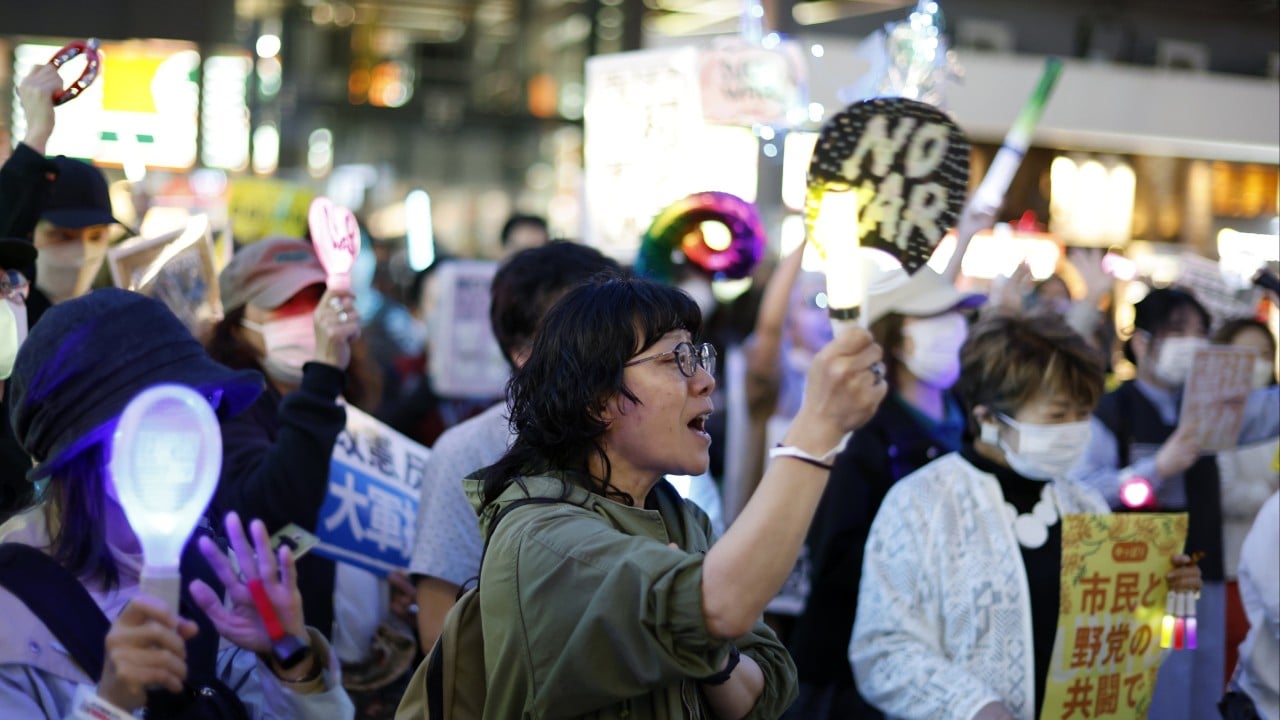
The media narrative surrounding Sanae Takaichi is a masterclass in projection. Pundits and legacy publications are currently hyperventilating over her supposed "women-led backlash" regarding constitutional reform and Japan’s defensive posture. They paint her as an extremist, a disruptor of peace, and an outlier in her own party. They have it exactly backward.
What the mainstream misses is that Takaichi isn't the problem; she is the only politician in Tokyo finally acknowledging that the post-war status quo has effectively expired.
The Myth of the Pacifist Consensus
For decades, the standard take has been that Japan’s Article 9—the "peace clause"—is a sacred, unchangeable bedrock of national identity. This is comfortable, but it is dead wrong. Japan’s security is currently tied to a brittle arrangement that relies on the assumption that regional actors play by the rules of 1945. They do not.
When Takaichi pushes for constitutional reform, she isn't "militarizing" a nation. She is formalizing reality. The Self-Defense Forces already exist, they are highly capable, and they are already operating in a state of ambiguity that would baffle any other sovereign nation. Refusing to name them properly in the constitution isn't a commitment to peace; it is a commitment to strategic dishonesty.
The "women-led backlash" you read about in the soft-focus press is less about a groundswell of grassroots activism and more about a desperate cling to a comfortable, decaying order. Critics love to frame this as Takaichi being "out of touch" with Japanese women. I have spent enough time in Nagatacho boardrooms to tell you the real story: the elite establishment is terrified because Takaichi treats voters like adults. She doesn't offer the platitudes of "stability." She offers the grim arithmetic of a neighborhood that is becoming increasingly violent.
The Strategic Arithmetic
Let’s talk numbers, not feelings. Japan is sandwiched between a nuclear-armed rogue state, an increasingly aggressive regional hegemon, and a Russia that has fully abandoned international norms.
The current fiscal and security policy is a relic. Maintaining a status quo that ignores these variables is not "prudence." It is negligence. Takaichi’s push for an arms build-up is not a choice; it is a defensive necessity born from the recognition that the security architecture of the last century is rusting away.
Imagine a scenario where the security umbrella currently provided by the United States faces a moment of political volatility or localized failure. In that vacuum, what happens? If Japan is still tied to the legal knots of the 1940s, it isn't "peaceful"—it is defenseless. Takaichi understands that deterrence is cheaper than reconstruction. If you don't like the costs of an upgraded defense budget, you are going to absolutely loathe the cost of being a satellite state in someone else's sphere of influence.
Why The Establishment Hates Realism
Why does the press hate her? Because she breaks the rhythm of the political theater. In Japan, the game is usually played through consensus, hushed meetings, and an agonizingly slow pace of change. It is designed to minimize risk for the incumbent class.
Takaichi is a blunt force object in a system that rewards soft edges. She doesn't hide her views to curry favor with the legacy media or the tired, old-guard bureaucrats who view "reform" as a dirty word. She is arguably the most ideologically consistent figure in the LDP. That makes her dangerous to those who have built careers on ambiguity.
The backlash from other women in politics isn't a moral stance against conflict. It is a political stance against a rival who threatens to expose the hollowness of their own platforms. They lack a vision for a strong Japan that doesn't involve being a passive participant in regional history. Takaichi is the only one who has decided that if Japan is going to have a future, it needs to stop apologizing for its own existence.
The Cost of Playing Nice
Admitting that Takaichi has a point comes with a price. It means admitting that the last 70 years of Japanese diplomacy were largely predicated on a fantasy of permanent American protection and regional apathy. It’s a bitter pill to swallow. It makes people uncomfortable to acknowledge that the world is inherently anarchic and that diplomacy without hard power is just a suggestion.
I have seen companies, institutions, and entire nations collapse because they were too polite to acknowledge the changing tide. They spent their remaining capital on public relations campaigns designed to preserve an image rather than build an actual defense.
Takaichi is forcing the issue. She is stripping away the pretense. If you find her rhetoric aggressive, you are focusing on the tone because you cannot handle the content.
Stop Searching for a Middle Ground
People ask, "Is there a way to modernize Japan’s military without causing domestic instability?" This is a classic trap. It assumes that there is a "safe" version of reality where you can wait for everyone to agree before you protect your borders.
There is no middle ground. You are either a state that defines its own security, or you are a state that has its security defined for it. Takaichi has chosen the former. The "backlash" is just the noise of people realizing the music has stopped and they are nowhere near a seat.
She isn't an aberration. She is a wake-up call. The sooner the electorate realizes that the alternative to her "militarization" is a slow slide into irrelevance, the better off they will be. History is never written by the people who insisted on keeping the status quo while the world burned around them. It is written by the people who had the spine to pick up a pen and change the script.