The wood did not groan before it gave way. It screamed.
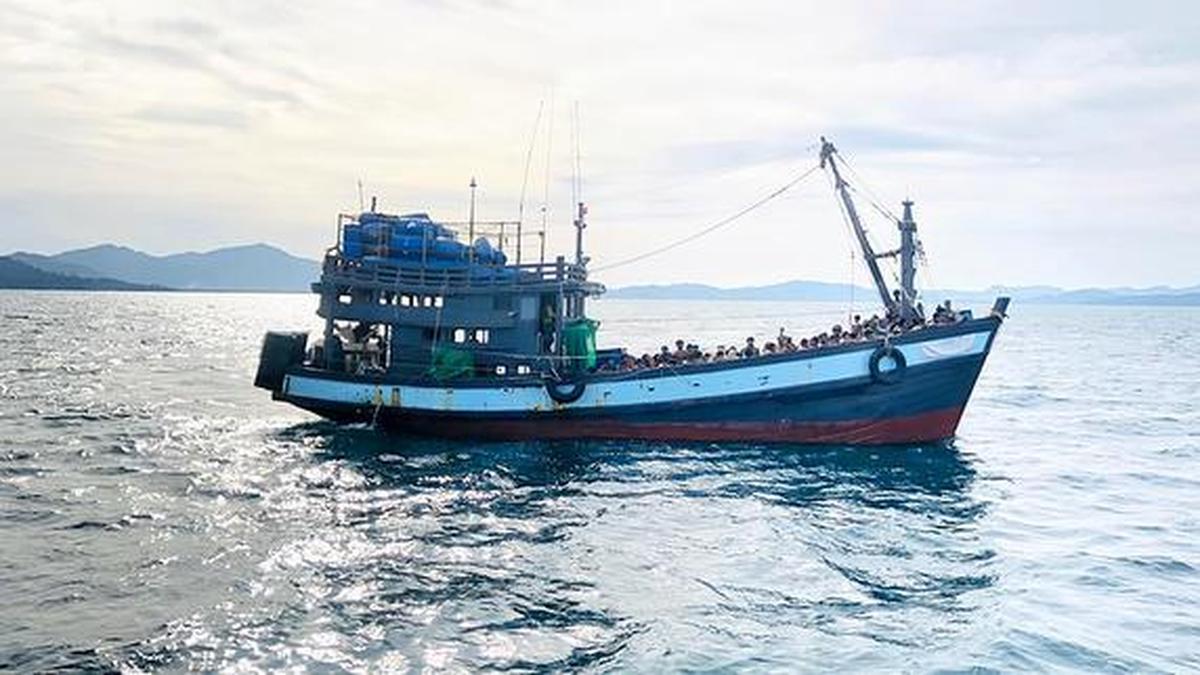
It was a sharp, splintering sound that cut through the rhythmic slap of the Andaman Sea against the hull of a vessel never meant for the open ocean. For the 250 souls packed into the hold—men with calloused hands, women clutching infants to damp chests, and teenagers chasing a phantom of safety—that sound was the end of the world. In the dark, cramped belly of the boat, the first sign of disaster wasn't the sight of the water. It was the sudden, terrifying weight of it pressing against their ankles.
Then came the cold.
We often talk about the "migrant crisis" in the sterile language of statistics and maritime coordinates. We speak of "vessel intercepts" and "repatriation protocols." But the Andaman Sea doesn't care about protocols. It is a vast, turquoise indifference that swallows the desperate and the hopeful alike, leaving nothing but a few drifting flip-flops and a silence that haunts the coastlines of Southeast Asia.
Consider a man we will call Amin. He is not a statistic. He is a father from a dusty camp in Cox’s Bazar, Bangladesh. For years, he watched the horizon, knowing that the land beneath his feet offered nothing but a slow erosion of dignity. When the middleman promised him a deck spot on a ship bound for Malaysia, Amin didn't see a rickety wooden trawler. He saw a classroom for his daughter. He saw a table with actual meat on it. He saw a life where he wasn't a "displaced person," but just a man at work.
He paid the smugglers with the last of his family’s jewelry and a debt that would take three lifetimes to clear. He stepped onto that boat with 249 others, a mix of Rohingya refugees fleeing systemic erasure and Bangladeshis fleeing the crushing weight of poverty. They were bound by a singular, jagged hope.
The boat was built for fishing, not for human cargo.
Survival on these journeys is a matter of brutal physics. To fit 250 people on a craft designed for twenty, you must stack them. Shoulders against ribs. Knees against spines. The air becomes a thick, humid soup of salt, sweat, and the metallic tang of fear. For days, the sun beats down with a predatory heat, peeling the skin off noses and foreheads. Then the engine fails.
When the engine dies in the middle of the Andaman, the silence is heavier than the noise. The boat begins to wallow. Without forward momentum, it loses its ability to cut through the swells. It becomes a cork. A plaything for the currents. The passengers, weakened by dehydration and the meager rations of dry rice, can only watch as the sky turns a bruised purple and the waves begin to climb.
The sinking of this particular vessel wasn't an isolated tragedy. It was a mathematical certainty. When the hull finally buckled under the pressure of the sea and the weight of too many dreams, the transition from "passenger" to "victim" happened in seconds.
Water is heavy. It doesn't just fill a boat; it claims it. As the vessel tilted, the center of gravity shifted violently. Bodies tumbled. The screams were swallowed by the roar of the surf. In those final moments, the distinctions between the Rohingya and the Bangladeshi, the dreamer and the desperate, vanished. There was only the instinctive, frantic reach for the surface.
But the surface offers no mercy when you are miles from the nearest shore.
The Andaman Sea is beautiful from the balcony of a resort in Phuket or the deck of a live-aboard dive boat. To a tourist, the water is a playground of coral and limestone karsts. To the 250 people on that boat, it was a liquid desert. There are no landmarks. There is no shade. There is only the horizon, a flat line that refuses to show a single ship.
Rescue, when it comes, is often a matter of luck rather than policy. Regional navies often play a grim game of "human ping-pong," pushing boats back into international waters rather than allowing them to land. It is a calculated cruelty, born of political convenience and the fear of a "pull factor." The logic is simple: if you make the journey deadly enough, perhaps they will stop coming.
Yet they keep coming.
This is the part the policy briefs miss. They assume the choice to board a sinking ship is a rational economic calculation. It isn't. It is an act of total, crushing necessity. You do not put your child on a boat unless the water is safer than the land. You do not risk the sharks unless the monsters on the shore are more certain to kill you.
Imagine the sensation of treading water as the sun goes down. The deep blue shifts to an obsidian black. Every ripple feels like a predator. Every breath is a struggle against the salt that stings your throat and burns your eyes. You think of the jewelry you sold. You think of the daughter who was supposed to go to school. You realize that the "better life" you were promised was just a ghost, a story told by a man who took your money and stayed on the shore.
The search and rescue operations for these vessels are often hampered by a lack of coordination. While satellite technology can track a lost smartphone to within a few meters, a boat carrying hundreds of people can vanish for weeks. The vastness of the ocean provides a convenient shroud for the world’s indifference. When a boat sinks, the "problem" disappears. There are no bodies to bury on land, no wreckage to clog the ports. Just a few more names added to a list that no one reads.
But the families in the camps and the villages don't forget. They wait for a phone call that will never come. they listen for a voice that has been silenced by the pressure of fifty meters of seawater.
The real tragedy isn't just the sinking. It is the predictability of it. We know the routes. We know the months when the seas are roughest. We know the names of the brokers who fill the holds. And yet, the cycle continues. The Andaman Sea remains a graveyard because it is easier to let the water handle the "migrant problem" than it is to address the reasons why a man like Amin would look at a rotting wooden boat and see a lifeboat.
The water is still now. The ripples have smoothed over the spot where the hull went down. The colorful plastic bags and the scraps of clothing have drifted away, carried by the same currents that doomed the passengers. On the surface, there is no sign that 250 lives were just extinguished. The sun rises over the Andaman, casting a brilliant, mocking gold across the waves.
Somewhere, thousands of miles away, a policy maker sips a coffee and looks at a map. To them, it is a blue space. To Amin, it was the sky, the earth, and the end of everything.
The ocean remains perfectly, horrifyingly blue.