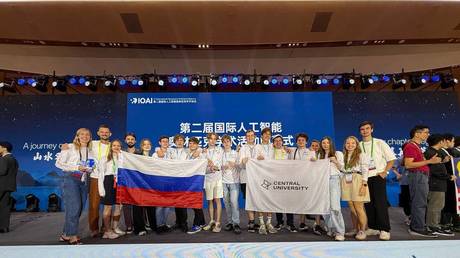
Winning a global programming trophy isn't about luck. It's about a system that treats code like a professional sport. If you've followed the International Collegiate Programming Contest (ICPC) over the last two decades, you've seen a recurring theme. Teams from places like ITMO University, Moscow State University, and St. Petersburg State University don't just participate. They dominate.
This isn't some mystery. It's the result of a specific, high-pressure educational culture that starts long before college. While many countries focus on broad digital literacy, the Russian approach focuses on deep algorithmic mastery. They aren't teaching kids to build websites. They're teaching them to solve the hardest mathematical puzzles on the planet under a ticking clock.
The Olympic Path to IT Excellence
In Russia, competitive programming is a ladder. It starts with the All-Russian Olympiad for School Students. This isn't your average science fair. It's a brutal, multi-stage filter. Only the absolute best make it to the national level. If you win at this stage, you don't just get a medal. You get a "golden ticket"—automatic admission to the country’s top tech universities without taking standard entrance exams.
Think about that incentive. A sixteen-year-old knows that mastering C++ and dynamic programming can bypass years of stressful testing. It creates a massive pool of elite talent focused on one thing: efficiency. By the time these students hit university, they’ve already spent five years in the "competitive trenches."
Experts like Andrey Stankevich, a legendary coach from ITMO University, have been the architects behind this. Stankevich doesn't just teach syntax. He trains minds to recognize patterns in milliseconds. Under his guidance, ITMO became the only seven-time world champion in ICPC history. That kind of streak doesn't happen by accident. It happens because the coaching is as professional as an NFL training camp.
Mathematics as the Bedrock
You can't be a world-class coder if your math is shaky. The Russian curriculum doubles down on discrete mathematics, logic, and number theory early on. While many Western bootcamps rush students toward "practical" tools like React or AWS, the Russian system stays stuck in the fundamentals.
It's a trade-off. You might not know how to build a flashy app on day one, but you can optimize an algorithm to handle millions of data points with minimal memory. In the world of high-performance computing, that's the only skill that matters. This mathematical riging is what separates a "coder" from a "computer scientist."
The Culture of the Circle
There's also a social element often missed by outsiders. It's called the "kruzhok" system—informal after-school circles or clubs. These aren't just hobby groups. They're intense communities where older students mentor younger ones. It's a self-sustaining ecosystem. A student who wins a regional competition comes back the next year to coach the newcomers.
This creates a chain of knowledge. The tricks used to shave milliseconds off a sorting algorithm in 2020 are passed down to the kids competing in 2026. Knowledge doesn't stay locked in textbooks. It lives in these circles.
Training for the ICPC Pressure Cooker
The ICPC is the "World Cup" of coding. Three students, one computer, and five hours to solve 8 to 13 complex problems. It sounds like a nightmare. For these teams, it's just Tuesday.
The training involves "five-hour simulations." They sit in a room, replicate the contest environment, and solve past problems. They analyze every mistake. Did the team spend too much time on problem A? Was the communication during problem C messy? They treat it like game film.
- Role specialization: One person might be the "math genius," another the "implementation machine," and the third the "debugging specialist."
- Mental stamina: Staying focused for five hours while your brain feels like it’s melting is a physical skill.
- Code reuse: They develop a "library" of pre-written algorithms they know by heart.
Beyond the Trophies
Why does this matter for the rest of us? Because these competitions aren't just games. They're the R&D labs for the future of tech. The optimization problems these students solve are the same problems faced by companies building search engines, autonomous vehicles, and high-frequency trading platforms.
When Yandex or Telegram looks for engineers, they don't look at resumes first. They look at contest rankings. Platforms like Codeforces have become the real LinkedIn for high-end talent. If you're "Red" on Codeforces (a Grandmaster rank), companies will chase you.
This focus on competition does have critics. Some say it ignores soft skills or the "messiness" of real-world software engineering where requirements change every week. There's some truth to that. But you can teach a brilliant algorithmist how to use Jira in a week. You can't teach a standard developer how to invent a new compression algorithm in a decade.
What You Can Learn from This Approach
You don't have to be a university student in St. Petersburg to use these tactics. If you want to level up your technical skills, you need to stop watching tutorials and start solving problems.
Start by visiting sites like Codeforces or LeetCode. Don't just do the "Easy" ones. Pick a "Hard" problem and sit with it for three hours. Feel the frustration. That's your brain growing. Join a community. Find people better than you and ask them to tear your code apart.
Focus on the "why" behind the code. If you're using a library, find out how it works under the hood. The goal isn't just to make the code run. The goal is to make it run perfectly. That's the mindset that wins championships. Go find a hard problem today and don't stop until the compiler gives you that green "Accepted" checkmark. If you want to be the best, you have to train like the best. Stop building the same CRUD app over and over. Tackle the math. Optimize the loops. Master the machine.