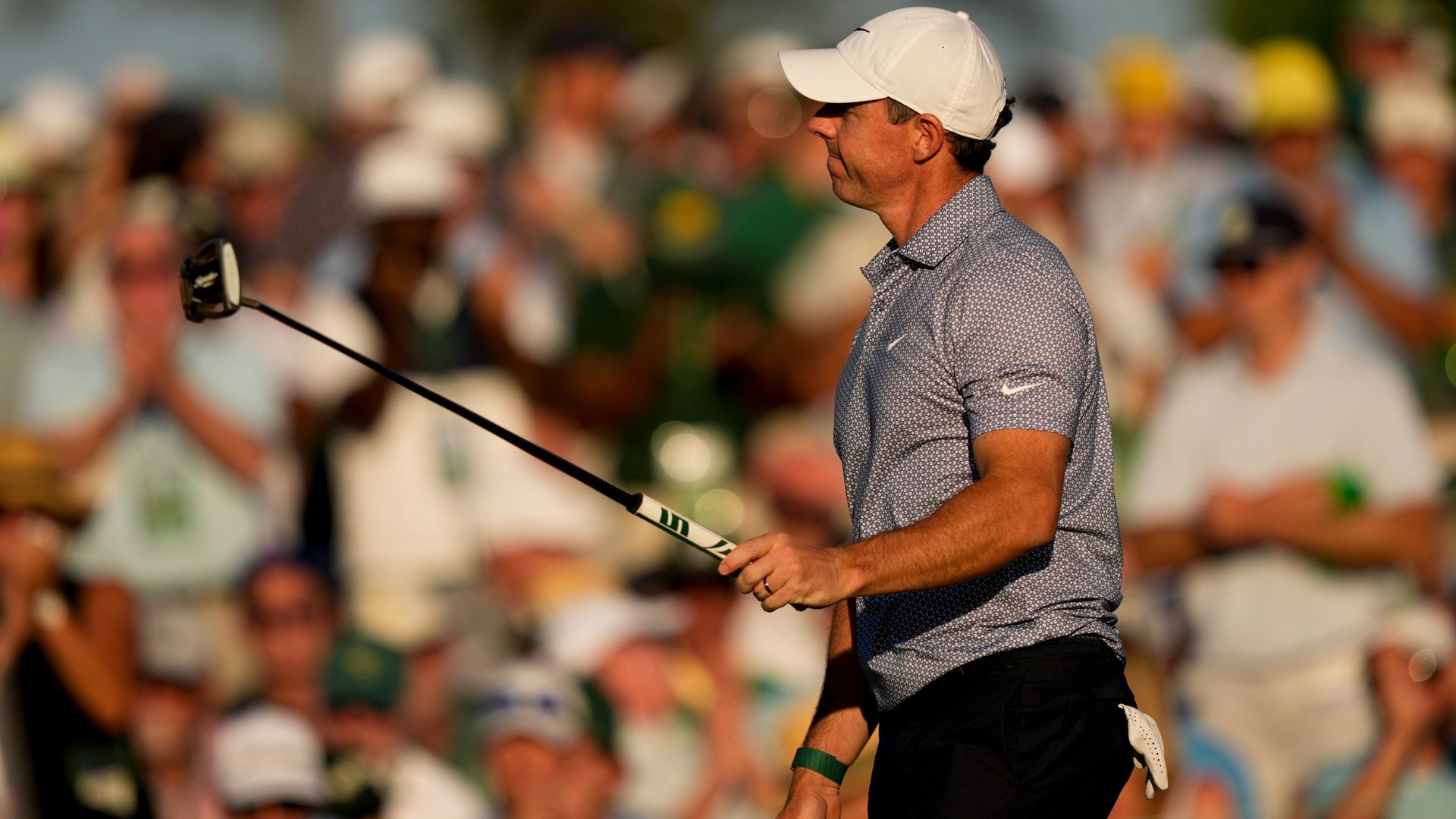
The Sunday shadows at Augusta National do more than just stretch across the fairway. They weigh on the shoulders of the men walking them. For Rory McIlroy, the 2026 Masters represents more than a golf tournament or a pursuit of a green jacket. It is a confrontation with a decade of scar tissue. As he enters the final round within striking distance of the lead, the narrative isn't about his swing speed or his putting stroke. It is about the psychological tax of chasing the final leg of the career Grand Slam, a feat only five men have ever achieved. The pressure is visible in every cautious chip and every hesitated breath before a crucial putt.
To understand why this Sunday feels different, one has to look past the leaderboard. The physical mechanics of McIlroy’s game have rarely been the issue. He remains one of the most gifted drivers of the ball in the history of the sport. However, Augusta National does not reward raw power alone. It demands a specific brand of emotional discipline that has, at times, eluded the Northern Irishman when the stakes are highest. This is the "why" behind the struggle. Every year he returns to Georgia, the ghost of 2011—where a four-shot lead evaporated on the back nine—looms in the background. It is a haunting that the sports world watches in real-time, turning a golf tournament into a public interrogation of a man’s resolve. Discover more on a similar subject: this related article.
The Architecture of a Mental Barrier
Augusta National is a golf course designed to provoke mistakes. It is a masterpiece of deception. Alister MacKenzie and Bobby Jones created a layout that offers generous landing areas off the tee but punishes a miss of just three feet on the approach. For a player like McIlroy, who thrives on momentum, this creates a paradox. If he plays too aggressively, the course bites back. If he plays too conservatively, he allows the field to bypass him.
Critics often point to McIlroy's wedge play as his Achilles' heel. While it is true that his proximity to the hole from 100 yards has statistically lagged behind peers like Scottie Scheffler or Jon Rahm, the deeper issue is decision-making under duress. When the pressure mounts, McIlroy has a documented tendency to "aim small" and miss big. He tries to force the ball into tight windows rather than accepting a safe par and moving on. At the Masters, where the greens are essentially polished glass, a one-degree error in judgment results in a ball rolling forty yards back down the hill at the 15th or into the creek at the 12th. More reporting by CBS Sports highlights similar perspectives on the subject.
The career Grand Slam is a club so exclusive it makes the billionaire's row look like a crowded subway. Gene Sarazen, Ben Hogan, Gary Player, Jack Nicklaus, and Tiger Woods are the only residents. Each of them possessed a "closer" instinct that bordered on the sociopathic. They didn't just play the course; they demoralized their opponents. McIlroy, by contrast, is often described as a "feel" player. He rides waves of emotion. When he is on, he is untouchable. When the tide turns, he has historically struggled to build a levee.
Breaking Down the 2026 Field
McIlroy isn't playing against a ghost; he is playing against a generation of golfers who do not fear him. The 2026 leaderboard is packed with young talent that grew up watching Rory but no longer feels intimidated by his resume. Players in their early twenties now possess the same ball speed and analytical tools that once gave McIlroy a distinct edge.
The Scheffler Standard
Scottie Scheffler remains the primary obstacle. His game is built on a foundation of boring excellence. He rarely makes the spectacular errors that characterize McIlroy’s bad rounds. If Rory is a lightning bolt, Scheffler is a rising tide. To beat him, McIlroy cannot rely on a single burst of brilliance. He has to match Scheffler's consistency for eighteen holes, something that requires a level of focus that can be exhausting over four days of competition.
The Rise of the Power Fader
Modern equipment has changed how Augusta is played. We are seeing more players adopt a "power fade"—a shot that starts left and peels back toward the target—to navigate the doglegs at holes like 10 and 13. McIlroy’s natural shot shape is a draw. While he has worked to incorporate a reliable fade into his repertoire, under the extreme pressure of a Masters Sunday, players often revert to their natural tendencies. If Rory’s draw becomes a hook, his tournament is over by the time he reaches Amen Corner.
The Financial and Cultural Distortion
We cannot ignore the elephant in the gallery. The professional golf world has been fractured by the emergence of competing leagues and massive payouts. While the Masters remains the pinnacle of prestige, the atmosphere surrounding the sport has shifted. There is a sense of urgency for traditional stars like McIlroy to validate the "old guard" of the PGA Tour.
This adds a layer of representative pressure. He isn't just playing for himself; he is playing for the legacy of the sport as he believes it should be. This is a heavy mantle to carry while trying to judge the wind on the 12th tee. The "Definitive Rory" that the public wants to see is a man who plays with freedom, but the reality is a man who feels the weight of an entire industry on his spikes.
The Technical Fix That Isn't Happening
Much has been made of McIlroy’s recent coaching adjustments. There are rumors of swing tweaks and putting grip changes. But at this level, and at this stage of his career, a new grip is just a placebo. The Greats don't win because of a thumb position; they win because they have mastered the art of the "internal reset."
Think about Tiger Woods in 2019. He wasn't the fastest or the strongest player on the course that year. He won because he stayed in the "center of the movie." He let everyone else make the mistakes. McIlroy’s path to victory involves a similar surrender. He has to stop trying to win the Masters and start letting the Masters happen. This sounds like abstract philosophy, but it translates to a very concrete strategy: hitting to the fat part of the green and trusting that his talent will provide enough birdie opportunities without him having to hunt for them.
The Impact of Course Conditions
Reports from the grounds indicate that the sub-air system is running at full tilt. The greens are firming up faster than expected. This favors the high-ball hitters, of which McIlroy is the king. If the wind stays down, his height advantage allows him to land balls on "shelves" that other players simply cannot reach.
However, if the wind picks up, the advantage flips. High ball flights are harder to control in the swirling gusts of the Georgia pines. The 2026 tournament has been a masterclass in weather management. Those who have stayed patient through the morning lulls and afternoon gusts are the ones still in the hunt.
The Strategy for the Back Nine
If McIlroy is within two shots when he makes the turn at hole 10, the real test begins. The stretch from 11 to 13, known as Amen Corner, is where tournaments are lost.
- Hole 11 (White Thorn): The hardest par 4 on the course. The miss is always right. If Rory pulls his approach left into the water, it’s a sign that his timing is off.
- Hole 12 (Golden Bell): A short par 3 that has ruined more careers than any other hole in golf. The wind here is a liar. It says one thing on the tee and another over the creek.
- Hole 13 (Azalea): A par 5 that invites an eagle but threatens a disaster. This is where McIlroy must decide if he is playing for a green jacket or playing for the fans.
The tragedy of McIlroy’s quest is that the closer he gets, the harder the air becomes to breathe. He is fighting his own history as much as he is fighting his opponents. Every leaderboard update is a reminder of the time that has passed since his last major victory in 2014. Twelve years is an eternity in professional sports. It is long enough for a prodigy to become a veteran and for a veteran to become a question mark.
Success on Sunday requires a total divorce from the "Grand Slam" narrative. He cannot think about the trophy presentation or the history books. He has to think about the blade of grass three inches in front of his ball. If he allows his mind to drift to the 18th green while he is still on the 14th, the course will find a way to punish that arrogance.
The reality of the 2026 Masters is that Rory McIlroy is the most talented player in the field, yet he remains the underdog. He is the underdog because he is fighting a war on two fronts: the physical game on the grass and the mental game in his head. Whether he wins or loses, the result will be a definitive statement on his career. A win cements him as an all-time legend. A loss, especially a close one, will start the conversation about whether he will ever win a major again. There is no middle ground at Augusta.
Stop looking at the swing and start looking at the eyes. The tension is in the jaw. The story is in the silence between shots. Rory McIlroy is walking into the fire, and this time, there is nowhere left to hide.