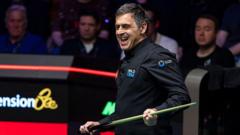
The sports media is currently obsessed with a fiction. They call it "dominance." They watch Ronnie O’Sullivan dismantle He Guoqiang at the Crucible and they use words like "mastery," "genius," and "composure."
They are wrong.
What you are witnessing isn't the peak of a sport. It is the slow, agonizing strangulation of a professional ecosystem that has forgotten how to evolve. While the headlines scream about O’Sullivan’s march toward another world title, the reality is far more grim: snooker is trapped in a chronological loop where the same man has been the "future of the game" for thirty years.
If snooker were a healthy, meritocratic sport, a 48-year-old would not be the heavy favorite to win the most grueling physical and mental marathon on the calendar. In any other high-performance discipline—tennis, football, even golf—the physical and cognitive decline associated with nearly five decades of life would have seen the old guard ushered into the commentary box by a wave of hungry, more efficient youngsters.
Instead, we have the "Rocket" coasting against the next generation of Chinese talent like He Guoqiang, not because O'Sullivan is an immortal god, but because the sport's structure has become a protection racket for aging legends.
The Myth of the Unstoppable Genius
The narrative after the first session was predictable: O'Sullivan’s "aura" overwhelmed the young debutant. Commentators pointed to He’s missed pots as evidence of "Crucible nerves."
This is lazy analysis.
He Guoqiang didn't lose because he was scared of the rafters or the history of the room. He lost because snooker’s tactical evolution has hit a brick wall. For two decades, the blueprint for beating O'Sullivan has been "safety first, wait for the error." It is a cowardly strategy that has failed 90% of the time.
The "contrarian" truth is that O’Sullivan is more beatable now than he was in 2012. His long potting percentages have dipped. His concentration flickers. But his opponents—terrified by the media-driven myth of his invincibility—play into his hands by trying to out-maneuver him in a tactical game he perfected before they were born.
To beat the legend, you have to disrespect the legend. You have to turn the match into a street fight. Instead, we see players like He Guoqiang trying to play "proper snooker" against the man who wrote the textbook. It’s like trying to out-debate a philosophy professor using only his own lecture notes. It’s a guaranteed path to failure.
The Crucible Curse: Why History is Holding the Game Back
We need to talk about the venue. The Crucible Theatre in Sheffield is treated like a cathedral. In reality, it’s a cramped, outdated claustrophobia-chamber that serves O’Sullivan’s brand of psychological warfare perfectly.
The media argues that the "intimacy" of the Crucible is what makes it special. Nonsense. The intimacy is a bottleneck. It limits the crowd, it limits the revenue, and most importantly, it creates a stagnant atmospheric pressure that favors experience over raw, explosive talent.
Look at the table itself. The modern game is played on cloths that are faster and pockets that are arguably more consistent than in the 1980s. This should favor the high-scoring, aggressive style of the new generation. Yet, because the World Championship is held in a 980-seat theater with "history" dripping from the walls, the mental weight favors the man who has walked that floor a thousand times.
If you moved the World Championship to a 10,000-seat arena in Shanghai or Riyadh, the "O'Sullivan Factor" would evaporate by 30%. The silence of the Crucible isn't respect; it’s a vacuum that sucks the life out of challengers. O’Sullivan knows how to breathe in that vacuum. Nobody else does.
The "China Wave" is a Ripple
Every year, we hear the same tired trope: "The Chinese players are coming for the crown."
I have watched the tour for years, and I’ve seen millions of pounds poured into academies in Sheffield and Beijing. We were told Ding Junhui was the chosen one. Then Yan Bingtao. Now we’re looking at He Guoqiang and Si Jiahui.
The "China Wave" is a failure of coaching, not talent. These players are produced in "snooker factories" that prioritize technical perfection over competitive grit. They have the most beautiful cue actions in the world, but they lack the "dark arts."
O’Sullivan doesn’t just play the balls; he plays the opponent’s heart rate. He plays the clock. He plays the referee. He plays the crowd. The young Chinese contingent is playing a video game version of snooker where they think if they pot everything, they win.
The scoreline against He Guoqiang wasn't a reflection of potting ability. It was a reflection of a veteran identifying a "technical" player and dragging him into the mud. Until the new generation learns that snooker is a psychological demolition derby, the trophy will continue to reside in the hands of a man who is closer to a pension than he is to his prime.
The Retirement Tease: A Marketing Masterclass
Let’s address the elephant in the room: Ronnie’s constant threats to quit.
- "I don't really enjoy it anymore."
- "I'm only doing it for the money."
- "I might go to a different tour."
This isn't a man in crisis. This is a man exercising total narrative control. By pretending he doesn’t care, he removes the pressure from himself and places it squarely on his opponent. Imagine being He Guoqiang, practicing 10 hours a day, desperate for a win, only to face a guy who says he’d rather be trail running in Epping Forest.
It’s the ultimate ego-play. It devalues the win for the challenger and excuses the loss for the champion. It is a psychological shield that the snooker press eats up because it creates "drama." In any other profession, this would be called what it is: manipulative branding.
O'Sullivan loves snooker. He is obsessed with it. He is a perfectionist who can’t stand a misaligned hair on a cue ball. The "I don't care" persona is a weapon. And as long as the media continues to validate it, he will continue to use it to keep his rivals in a state of perpetual inferiority.
The Math of the "Best of 19"
The opening rounds of the World Championship are a "Best of 19" frames. This is a dinosaur format.
The argument for long matches is that they "test character" and "ensure the better player wins." What they actually do is provide a massive safety net for the elite. In a "Best of 7" or "Best of 9," a young player like He Guoqiang could catch fire, win a few scrappy frames, and put the favorite in a hole he can’t climb out of.
Over 19 frames, the statistical variance flattens out. The elite player’s superior average—even if they have a bad session—will almost always prevail. We are essentially rigging the tournament to ensure the "Big Names" reach the quarter-finals for the sake of TV ratings.
We are sacrificing the growth of the sport on the altar of "broadcaster security." If we want a new champion, we need shorter, more volatile formats that reward high-risk, high-reward play. But the snooker establishment is too terrified of a final without O'Sullivan to ever allow that to happen.
The Actionable Truth for the Underdog
If I were coaching a player facing O'Sullivan at the Crucible, my advice would be the opposite of everything the pundits say.
- Break the Rhythm: O'Sullivan thrives on flow. If he’s moving fast, take three minutes to decide on a safety. Clean your glasses. Ask the ref to re-spot a ball. Not to be "cheap," but to reclaim the tempo of the match.
- Stop Respecting the Safety: If there is a 40% chance of a long pot, take it. Playing safe against Ronnie is just giving him another chance to put you in a snooker. You cannot out-defend him. You have to out-attack him.
- Ignore the "Class" Narrative: The media will tell you it's a "privilege" to share the table with him. It isn't. It’s a job. Treat him like a local club player who owes you money.
The downside to this approach? You might lose 10-0. But you were going to lose anyway by playing his game. At least this way, you force him to play yours.
The End of the Line
Snooker is currently a museum. We go to the Crucible to look at the artifacts—O'Sullivan, Higgins, Williams—and we marvel that they still work.
But a sport that lives in a museum has no future. The "dominance" of O'Sullivan in the early rounds of 2024 (and now 2026) isn't a testament to his greatness as much as it is an indictment of a stagnating professional class and a governing body that is too scared to change the rules of the game.
He Guoqiang didn't just lose a snooker match. He was a victim of a system designed to keep the crown on the head of a man who is already looking for the exit.
Stop celebrating the "Rocket’s" easy wins. Start demanding a sport where a 48-year-old actually has to sweat to survive the first round. Until then, the Crucible isn't the "Home of Snooker"—it’s its retirement home.
Stop watching the score. Start watching the decline.