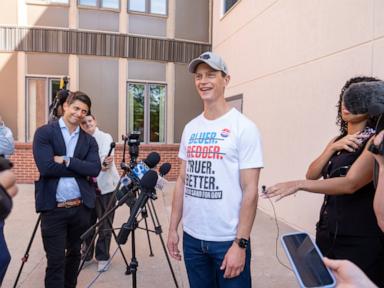
You don't win statewide office as a Democrat in a deep-red state by playing the standard political game. The math just doesn't work. Democrats in Iowa are facing a massive 200,000-person deficit in statewide voter registration, finding themselves outnumbered in every single congressional district. Yet, State Auditor Rob Sand launched his official general election campaign for governor on Sunday with a massive rally in Des Moines, banking on an unconventional strategy that rejects the very concept of the two-party system.
By bringing in Kentucky Governor Andy Beshear to headline the event, Sand did something smart. He didn't just bring in a high-profile surrogate; he brought in living proof that the strategy works. Beshear won a second term in Kentucky, a state Donald Trump carried by 30 percentage points in 2016. In contrast, Trump's largest margin of victory in Iowa was 13 points. If a Democrat can hold the governor's mansion in Kentucky, Sand believes the hill he has to climb in Iowa isn't just manageable—it's shorter.
The Playbook for Winning Red States
Beshear took the stage at The River Place in Des Moines to remind the crowd that national expectations mean nothing when you focus on real local issues. As the current chair of the Democratic Governors Association, Beshear is pulling double duty. He is boosting candidates like Sand while quietly building his own national profile for a potential 2028 presidential bid. His message to Iowa was simple: focus on families, not party lines.
"I am living, breathing proof Democrats can win anywhere, and we should be fighting everywhere," Beshear told the crowd. He spoke about building a party big enough to allow for internal disagreements, so long as the ultimate focus remains on helping neighbors rather than treating them like political enemies.
This isn't just feel-good campaign rhetoric. It's a calculated blueprint. Beshear's success in Kentucky came from leaning into basic infrastructure, public education, and economic development while keeping culture-war politics at arm's length. Sand is trying to capture that exact same energy. The open race for Iowa governor—spurred by outgoing Republican Governor Kim Reynolds—coupled with an open U.S. Senate seat, means Iowa hasn't seen a political landscape this wide open since 1968.
The Problem With the Green Campaign Strategy
Sand's approach to the electorate is explicitly anti-partisan. During his campaign events, he frequently asks the crowd to join him in singing the first verse of "America the Beautiful" and introduces himself through his upbringing hunting, fishing, and attending church. Neither Sand nor his newly minted Republican opponent, Zach Lahn, use traditional red or blue in their campaign materials. Both opted for green, signaling a shared desire to distance themselves from their respective national party establishments.
But pretending the party doesn't exist gets complicated when the financial reality of a modern campaign sets in. Republicans were quick to point out a glaring contradiction in Sand's nonpartisan branding. His campaign has already funneled roughly $750,000 to the Iowa Democratic Party this cycle.
Iowa GOP spokeswoman Jade Cichy wasted no time calling out the move, stating that Sand loves talking about rising above the two-party system right up until it's time to cash checks and share the stage with party insiders. Sand didn't flinch at the criticism, brushing it off with a quick reality check: "News flash: Democrats support a Democrat." He also countered by noting his donor list features three times as many registered Republicans as Lahn's campaign.
Facing a New Breed of Republican Challenger
The general election match-up became clear after Tuesday's primary settled a chaotic five-way Republican contest. Zach Lahn emerged at the top of the ticket. Lahn is not a standard country-club Republican or a conventional establishment politician. He is a regenerative farmer and business owner who built his primary momentum by attacking farm consolidation and corporate tax breaks.
Lahn has successfully tapped into the "Make America Healthy Again" platform popularized by Robert F. Kennedy Jr., blending traditional conservative grassroots organizing with populist, anti-corporate rhetoric. He has already dismissed Sand's moderate credentials. In his victory speech, Lahn labeled Sand a liberal career politician pretending to be someone he isn't.
This dynamic means Sand cannot just run against a corporate conservative caricature. Lahn is actively competing for the same independent, anti-establishment voters that Sand needs to win. Sand's path to victory relies entirely on convincing those voters that real balance requires a divided government. He has repeatedly stated that a decade of one-party control in Des Moines has led to arrogance, pointing directly to recent laws passed by the Republican trifecta that stripped the State Auditor's office of its historical powers to inspect state agency waste and abuse.
Surviving a Deficit at the Ballot Box
The organizing path forward for the Sand campaign requires an immediate, aggressive focus on ticket-splitting. Because the Democratic Governors Association is heavily investing in the state—already sending $140,000 to the state party under Beshear's leadership—the infrastructure is there to run a real ground game. But money cannot buy registration numbers. Sand needs to win over hundreds of thousands of voters who will simultaneously cast ballots for Republican congressional candidates or federal offices.
If you are trying to read the room in Iowa, look closely at the independent voters who make up the largest plurality of the electorate. They aren't looking for national progressive talking points. They are looking for basic accountability and a check on a state government that has faced a tighter budget deficit and a growing agricultural crisis.
The next practical step for anyone watching this race is to track the rural turnout metrics over the next two months. Sand's ability to show up in small towns, talk about his office's history of uncovering misspent tax dollars, and maintain his independent brand will determine if he can actually pull off the flip.
The race for Iowa governor highlights the strategic blueprint that red-state Democrats are using nationwide. To see exactly how Andy Beshear frames this winning strategy for conservative audiences, watch this Beshear campaign rally breakdown. This video shows the specific rhetorical pivots that national political strategists are studying as the midterms approach.