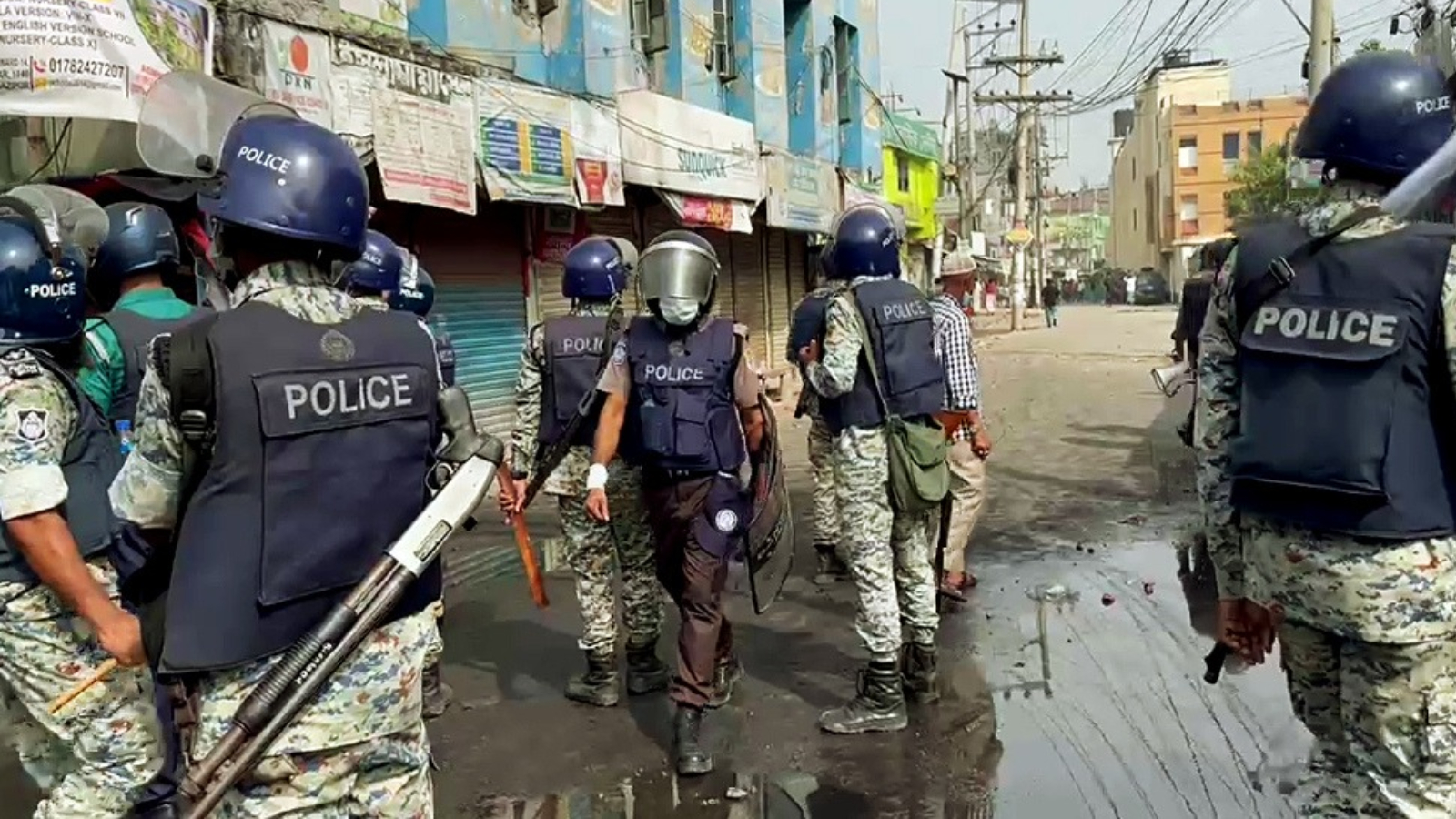
Localized arson campaigns targeting Awami League cadres in Bangladesh are not random outbreaks of mob disorder; they represent a predictable market failure in state monopoly over violence following a regime collapse. When formal judicial mechanisms lag behind street-level grievances, political actors revert to decentralized, symmetric retaliation to establish territorial deterrence.
Standard news reports treat the burning of 20 to 30 Awami League-affiliated residences in Narail—occurring immediately after the fatal assault of two Bangladesh Nationalist Party (BNP) leaders—as isolated criminal episodes. That framing misses the structural mechanics driving the violence. Across Bangladesh in November 2026, two distinct operational theaters have collided: an exiled former ruling party executing low-cost urban sabotage to disrupt governance, and victorious local factions deploying collective punishment to liquidate the remaining grassroots infrastructure of their rivals.
The Anatomy of Asymmetric Retaliation
To understand why residential arson has become the default response to political assassinations in rural districts like Narail, analysts must separate the triggering event from the underlying structural incentives.
In an environment where the Awami League is formally banned from political activity and its leader, Sheikh Hasina, faces an in-absentia death sentence from exile in India, the party cannot compete through conventional electoral or organizational channels. Its remaining operational capacity relies on asymmetric disruption—crude bomb detonations, transport blockades, and targeted attacks on rival party figures. Conversely, local BNP networks hold territorial dominance but face acute pressure to demonstrate protective capacity to their rank-and-file without triggering immediate crackdowns from the central administration.
This dynamic produces a four-stage escalation cycle:
- The Decapitation Strike: Remnant cadres or local rivals execute a high-visibility attack against mid-level operatives of the dominant party, such as the fatal wounding of the two BNP leaders transported to Khulna for treatment.
- The Attribution Gap: Local law enforcement arrests immediate suspects—such as the two individuals detained in Narail—but struggles to file comprehensive charges rapidly or dismantle the broader network. Victims' kin perceive a justice deficit.
- Collective Asset Liquidation: Supporters and relatives bypass the courts, mobilizing within hours to burn the residential and commercial property of suspected perpetrators and their extended political networks.
- Plausible Deniability: Senior local leadership of the dominant party publicly disavows the arson, attributing the fires to spontaneous grief among victims' families while quietly absorbing the strategic benefit of expelling rival organizers from the village.
The Three Pillars of Post-Regime Political Violence
Evaluating the broader November 2026 unrest requires categorizing the incidents by strategic objective rather than geography. Data compiled from police reports and monitoring groups across 14 districts reveals three distinct operational tracks.
1. Extraterritorial Sabotage and Urban Disruption
Exiled leadership in Kolkata and elsewhere faces a classic principal-agent problem: how to project power inside Bangladesh without an intact domestic chain of command. The solution has been financial outsourcing. Allegations from BNP leadership point to cross-border transfers via Mobile Financial Services (MFS) used to contract local operatives for low-cost, high-visibility disruptions. Between November 7 and November 27, 2026, police documented 101 torched vehicles and 100 crude bomb detonations nationwide, concentrated heavily in Dhaka transit corridors like Mirpur, Dhanmondi, and Moghbazar. The objective is economic friction—forcing the state to deploy Border Guard Bangladesh (BGB) platoons and Ansar units to guard railway stations and highways, thereby draining administrative bandwidth.
2. Institutional Signaling
Attacks are not restricted to party workers; they systematically target symbols of the post-2024 political order. Over a two-week window in November, arsonists and vandals struck 104 branches and offices of Grameen Bank—founded by former interim leader Muhammad Yunus—forcing 29 locations to suspend operations, alongside an arson attack on Yunus's ancestral home in Chittagong. Targeting microfinance infrastructure serves a dual purpose: it damages the financial ecosystem associated with the current administration while signaling to rural populations that state security forces cannot guarantee the safety of prominent institutions.
3. Territorial Cleansing via Arson
While urban attacks rely on hit-and-run crude explosives, rural violence focuses on permanent displacement. Burning a rival activist's home achieves what an arrest cannot: it destroys capital, displaces the family unit, and raises the personal cost of political affiliation to an unsustainable level. Monitoring groups indicate that over 247 Awami League-linked homes and businesses have faced attacks during this escalation cycle. In districts like Gopalganj and Madaripur, where Awami League networks retain residual density, these clashes escalate into pitched battles involving dozens of crude bombs and bladed weapons, requiring police to fire blank rounds to separate factions.
Information Warfare and the Communal Distortion Layer
A critical operational variable in the Narail arson attacks is the secondary battle over narrative framing. In South Asian political conflicts, domestic factional violence frequently undergoes rapid reframing into communal or minority-targeted persecution to attract international diplomatic intervention.
Following the Narail fires, digital networks circulated footage alleging that Hindu households and businesses were the primary targets of the arson. Local police administration, led by Superintendent Mohammad Al Mamun Sikder, formally refuted these claims, identifying the viral media as recycled footage from unrelated incidents and synthetic AI-generated videos.
This distortion mechanism operates on clear incentives:
- External Legitimacy Seeking: An outlawed political party lacking domestic institutional support benefits directly if international observers view the current Bangladeshi administration as unable or unwilling to protect religious minorities.
- Bilateral Leverage: With Dhaka pressing New Delhi for Sheikh Hasina's extradition under their bilateral treaty—a request India has resisted—narratives of communal instability complicate diplomatic cooperation and reinforce Indian domestic political resistance to handover.
- Operational Fog: Flooding information channels with fabricated imagery forces local law enforcement to divert investigative resources toward debunking digital rumors while delaying criminal case filings on the actual homicides and arson.
The Enforcement Bottleneck and Deterrence Failure
Why do paramilitary deployments fail to halt localized arson even when hundreds of suspects are detained? In the 24-hour window preceding the late-November lockdown calls, Dhaka Metropolitan Police arrested 550 individuals and filed 35 cases, while district drives netted over 100 more. Yet bus burnings in Mirpur and house torchings in peripheral districts continued.
The failure stems from a structural mismatch between centralized security posture and decentralized threat execution:
- Static Guarding vs. Dynamic Targets: Deploying 113 BGB platoons to fixed checkpoints, railway stations, and major intersections secures critical infrastructure but leaves thousands of private residences and neighborhood roads unguarded. Arson requires minimal logistical preparation—gasoline and a match—allowing attackers to select soft targets outside the security perimeter.
- The Prosecution Lag: In Narail, despite arresting two suspects in the murder of the BNP leaders, police confirmed that no formal case had been filed by noon the following day. When formal legal immobilization lags behind street mobilization, local actors treat state law enforcement as an after-action cleanup crew rather than a deterrent force.
- Asymmetric Risk Calculus: For an unemployed youth contracted via MFS to throw a crude bomb from a moving motorcycle in Dhanmondi, the immediate cash payout outweighs the low probability of conviction in an overburdened court system. For a grieving relative in Narail, the social legitimacy conferred by avenging a slain family member outweighs the remote risk of prosecution under a sympathetic political climate.
Limitations of Current Stabilization Models
Security planners and political analysts often assume that a combination of mass preventative arrests and high-level political rhetoric will restore order. Both mechanisms carry severe operational limitations in the current environment:
- Indiscriminate Dragnet Blowback: Mass arrests—such as detaining hundreds of individuals in routine sweeps—sweep up non-combatants alongside actual operatives. This generates fresh grievances among neutral families, expanding the recruitment pool for underground networks without degrading the core leadership structure.
- Command-and-Control Illusions: Senior BNP figures emphasize restraint and contrast current policing rules with the lethal crackdowns of the previous regime. However, national party directives cannot override localized blood feuds in rural unions where land disputes, brick kiln rivalries, and historical political scores merge into a single violent conflict.
- Extradition Deadlock: Treating Sheikh Hasina's extradition as a prerequisite for domestic stability misdiagnoses the network topology. Decentralized cells operating on small-denomination mobile transfers do not require direct operational micromanagement from an exiled prime minister to execute local arson.
Strategic Interventions to Break the Escalation Loop
Containing the arson cycle requires shifting from reactive paramilitary deployment to targeted financial, judicial, and territorial controls:
- Financial Choke-Point Interdiction: Rather than relying solely on street-level sweeps, intelligence units must audit anomalous Mobile Financial Services (MFS) velocity—specifically structured micro-transfers originating from border districts or linked to known proxy accounts—to sever the funding pipeline between exiled coordinators and local saboteurs.
- Mandatory Rapid-Filing Protocols: Law enforcement must eliminate the administrative gap between initial arrest and formal charge sheets in political homicides. Immediate, transparent judicial remand within six hours of a targeted killing removes the primary justification used by local mobs to initiate retaliatory house burnings.
- Collective Asset Liability for Local Leadership: To eliminate plausible deniability, administrative authorities must hold local party committee heads civilly and criminally liable for property destruction occurring within their union jurisdictions when committed by identifiable party cadres, conditioning local political operating space on verifiable restraint.
- Real-Time Geospatial Verification: District police must pair rapid physical response with immediate, timestamped visual documentation of incident sites to preemptively neutralize synthetic media and recycled footage before communal disinformation triggers secondary retaliatory waves.
Until the state imposes immediate, non-negotiable financial and legal costs on both cross-border sabotage financiers and local retaliatory mobs, residential arson will remain the primary instrument of political negotiation in rural Bangladesh.
For additional context on how recent violence and protests in Bangladesh have unfolded around demands for Sheikh Hasina's return, see Bangladesh Erupts In Violence! Awami League Leaders' Homes Torched As Hasina's Return Demand Grows.