Thousands of believers packed the National Mall under a sweltering sun. On stage, towering columns flanked video screens designed to look like massive stained-glass windows, blending symbols of government power with traditional church architecture. This wasn't a standard Sunday morning church service. It was "Rededicate 250: A National Jubilee of Prayer, Praise & Thanksgiving," a massive, nine-hour event designed to explicitly tie the identity of the United States to conservative Christian theology.
The event marked the first major public rollout of Freedom 250, a public-private partnership backed heavily by the White House to celebrate America’s upcoming semiquincentennial. If you think this was just a harmless gathering for patriotic churchgoers, you're missing the bigger picture. It represents a coordinated, deeply institutional effort to reframe the foundational history of the country just ahead of its 250th anniversary.
The Fusion of Church and State on the National Mall
The physical space of the rally told the story before the speakers even opened their mouths. The backdrop of the Washington Monument was framed by a stage that replicated a federal building, yet it featured a prominent white cross and depictions of the nation’s founders cast in the style of saints. This visual architecture perfectly mirrored the message delivered by a parade of administration officials and evangelical leaders.
House Speaker Mike Johnson took the stage to loud cheers, eventually leading the crowd in a lengthy prayer. He didn't just ask for general blessings. He explicitly rejected what he called "sinister ideologies" that focus on America's historical sins.
"These voices insist to the young and impressionable that our story, the American story, is one of oppression and hypocrisy and failure and that this story can only be understood through the lens of our sins," Johnson told the crowd. "Father, we reject that. We rebuke it in your name."
By framing historical critique as a spiritual battle, the political goals of the conservative movement were elevated to divine mandates. This wasn't an isolated comment. Pastor Samuel Rodriguez, president of the National Hispanic Christian Leadership Conference, opened the day by telling the crowd that the real struggle in the country isn't political. He called it a battle between "the serpent and the lamb." When political disagreements are treated as cosmic warfare, compromise becomes impossible.
Trump and the Power of 2 Chronicles
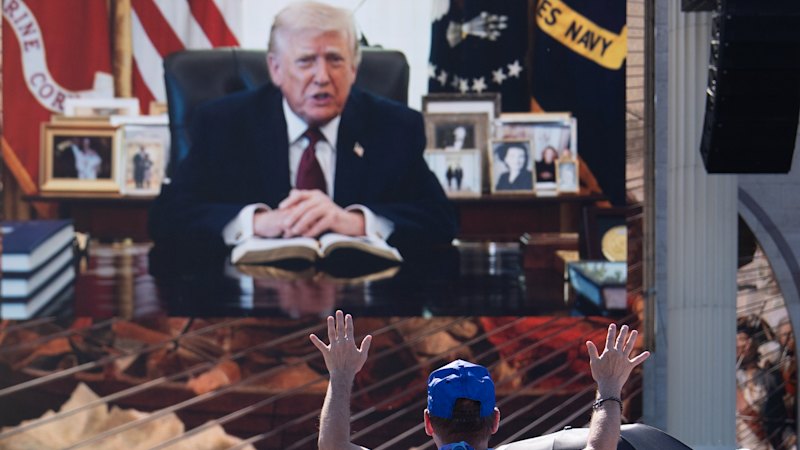
Donald Trump didn't appear in person, but his presence dominated the afternoon via a pre-recorded video message filmed in the Oval Office. He read directly from the Old Testament, specifically 2 Chronicles 7:14. It’s a verse that has become the definitive anthem for Christian nationalist rhetoric.
$$ \text{"If my people, which are called by my name, shall humble themselves, and pray, and seek my face, and turn from their wicked ways; then will I hear from heaven, and will forgive their sin, and will heal their land."} $$
For the people standing on the Mall, this verse isn't just ancient text. It’s a literal roadmap for national survival. The implication is clear: America is sick, it has strayed from its original covenant with God, and political alignment with conservative Christian goals is the only way to trigger divine healing.
Other high-profile administration figures echoed this survivalist tone. Vice President JD Vance spoke via video about a supposed trend of young men "returning to the pews" to find meaning, claiming that faith is the bedrock of American identity. Defense Secretary Pete Hegseth took it a step further, recounting a narrative of George Washington praying on bended knee during the Revolutionary War and calling on Americans to pray to "our Lord and Savior Jesus Christ" to save the nation from modern decline.
The Institutional Machinery Behind the Movement
Critics who dismiss these rallies as mere spectacles ignore the millions of dollars and vast institutional networks funding them. Freedom 250 isn't just an event planning committee. It’s an organization heavily backed by public funds earmarked for the nation's 250th anniversary, and it’s partnering directly with the federal government.
The rally featured the debut of "Freedom Trucks"—massive 18-wheelers designed to travel the country distributing educational materials to K-12 students. These materials aren't coming from traditional secular historians. They're produced in partnership with conservative organizations like PragerU and Hillsdale College, aiming to teach a providential view of American history directly to school children.
The theological lineup was a who's who of Trump’s evangelical inner circle. Paula White-Cain, head of the White House Faith Office, helped orchestrate the event alongside evangelist Franklin Graham and Pastor Robert Jeffress. To give the event a veneer of broader religious representation, organizers included Orthodox Jewish Rabbi Meir Soloveichik on the program. Yet he was the lone non-Christian voice in a nine-hour program entirely dominated by evangelical worship music and Christian rhetoric.
Growing Alarm and the Secular Backlash
Outside the security gates, the pushback was visible. Secular and progressive religious groups organized significant counterprogramming to challenge the rally's message. Organizations like the Freedom From Religion Foundation and Faithful America set up a large balloon shaped like a golden calf near the Mall, a direct biblical nod to idolatry meant to criticize the political worship of Trump.
The Interfaith Alliance took a different approach, projecting phrases like "Democracy not theocracy" onto the exterior walls of the National Gallery of Art. Progressive religious leaders expressed deep worry that the rally represented a narrow, exclusionary vision of American identity. The Rev. Adam Russell Taylor, leader of the progressive Christian group Sojourners, pointed out that defining America purely through a specific ideological strain of Christianity betrays the country's actual commitment to religious freedom.
The data highlights a massive disconnect between the rhetoric on stage and the reality of the American public. While speakers talked of a massive spiritual awakening, data from the Pew Research Center shows that more than a quarter of Americans now identify as atheist, agnostic, or religiously unaffiliated. The attempt to institutionalize a singular religious narrative comes at a time when the country is more religiously diverse—and secular—than ever before.
What This Means for the Near Future
The Rededicate 250 rally wasn't an ending; it was a launchpad. It’s the first of 16 major events planned by Freedom 250 leading up to the official anniversary celebrations. If you want to understand where American politics is heading over the next year, stop looking at standard campaign rallies and start paying attention to these cultural and religious staging grounds.
The event proved that the administration has successfully fused institutional state power with conservative evangelical mobilization. For the true believers on the Mall, the rally delivered exactly what they wanted: validation that their faith and their patriotism are identical. For the rest of the country, it served as a clear warning of how public funds and official state channels are being used to rewrite the national story. Watch the rollout of the Freedom Trucks in your local school districts next, because the battle over America’s identity is moving off the National Mall and straight into local classrooms.