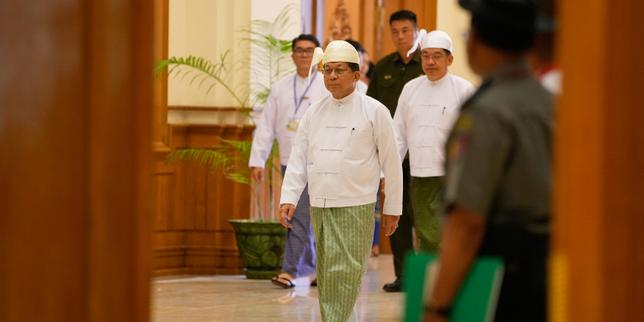
The air inside the Bangkok hotel ballroom smelled of expensive orchids and old money. Outside, the tropical humidity clung to the asphalt like a wet wool blanket, but inside, the climate control hummed with the sterile, quiet efficiency of a bank vault. Men in sharply tailored suits adjusted their silk ties. Cameras clicked in rhythmic, manic pulses.
And then he walked in. For a different perspective, consider: this related article.
Min Aung Hlaing. The man whose name had become synonymous with smoke, ash, and the systematic fracturing of a nation.
If you stood across the street from a village in Myanmar on any given Tuesday, you would not smell orchids. You would smell kerosene and scorched earth. You would hear the sudden, terrifying whine of a jet engine slicing through a morning sky that had spent decades learning how to be afraid. You would see villagers grabbing whatever they could carry—a pot, a sleeping mat, a child's hand—and running toward the tree line before the shrapnel found them. Similar analysis on this matter has been shared by NBC News.
Yet here, thousands of miles and a world away from those burning thatch roofs, flashbulbs illuminated the general’s face. He smiled. It was a practiced, bloodless expression.
Diplomacy is a messy, cynical business. We like to pretend that nations interact like polite neighbors over a white picket fence, sharing sugar and enforcing neighborhood watch rules. But the map is stitched together with blood and trade routes. When a general seizes power at gunpoint, shatters a fragile democratic experiment, and plunges his own people into a multi-front civil war, conventional wisdom says he becomes a pariah. He stays home. He looks out over a ruined kingdom from behind sandbags.
Bangkok just proved conventional wisdom is a fairy tale we tell children to help them sleep at night.
To understand why a man with a target on his back gets treated like an honored guest in a neighboring capital, you have to look past the velvet ropes. You have to look at the gas pipelines humming quietly beneath the ocean floor. You have to look at the millions of migrant workers whose remittances keep entire provinces afloat. You have to confront the cold, brutal geometry of geopolitics.
Borders do not care about your moral outrage.
Consider what happens next when a regime starts bleeding out. It looks for a lifeline. For three long years, the Myanmar military junta has watched its grip slip. It controls the cities, yes, but even the cities wake up to the sound of shifting alliances and economic collapse. The currency is a joke. Inflation eats salaries before they hit the bank. The ethnic armed organizations and the newly formed People's Defense Forces have pushed the military out of vast swaths of the borderlands. The general is losing.
And a wounded animal is dangerous, but a desperate dictator is radioactive.
No one wants to stand too close to a collapsing state, because the shrapnel hits everyone. Refugees do not respect immigration quotas. They spill across rivers and mountain passes, bringing stories of midnight raids, burned monasteries, and empty plates. Drugs manufactured in the lawless hills flood regional markets. Instability is contagious.
So Bangkok makes a calculated, cynical bet.
The Thai capital has always played a delicate game of bamboo diplomacy, bending whichever way the wind blows to keep the roof from caving in. The establishment in Bangkok looks across the western border and sees a neighbor they cannot wish away. They share a porous frontier stretching over two thousand kilometers. They share trade, insurgencies, and energy dependencies. To ignore the man who holds the keys to the barracks—however bloody those keys might be—is to pretend reality does not exist.
This is where the concept of diplomatic recognition gets murky.
It is easy to tweet about human rights from a leather chair in Geneva. It is entirely another thing to manage a refugee crisis on your own doorstep while your factories rely on cheap labor from the very country tearing itself apart. The regional bloc, ASEAN, has floundered for years, trapped by its sacred consensus rule where every member has a veto, effectively guaranteeing that nothing meaningful ever gets done. Five-point consensuses turn into five-point illusions.
While diplomats sip espresso and issue sternly worded statements that no one in power reads, ordinary people pay the freight.
I remember talking to a former schoolteacher from Mandalay who managed to slip across the border last year. She did not look like a revolutionary. She looked like your aunt who bakes cookies for the neighborhood block party. Her hands shook as she stirred her tea. She told me about the morning the soldiers came down her street. They did not kick the door in; they just stood outside, rifles slung lazily over their shoulders, watching the children walk to school. That was the day she realized the architecture of her entire life had turned to dust.
"They think because we are quiet, we have accepted it," she told me, her voice barely a whisper above the restaurant clatter. "We have not accepted anything. We are just waiting for the dark to pass."
The dark is long.
When Min Aung Hlaing sat down at the negotiating table in Bangkok, he was not just seeking a photo opportunity. He was seeking oxygen. Legitimacy is a currency. Once you spend enough time in the same room with regional leaders, once your hand is shaken and your presence is quietly acknowledged, the edges of your isolation soften. The pariah starts to look like a partner again.
That is the hidden cost of realpolitik. Every time a neighbor rolls out the red carpet to stabilize its own borders or secure its economic interests, another layer of insulation is wrapped around a regime that is actively shelling its own villages. It sends a chilling signal to the mothers in the hills, to the young men sleeping in muddy trenches with handmade rifles, to the doctors running underground clinics in the jungle.
It tells them they are alone.
The international order is not a moral compass. It is a mosaic of self-interest. We watch leaders posture about democracy while quietly signing contracts for natural gas. We watch capitals condemn violence in press releases while clearing red carpets for the architects of that very violence.
The general flew back to Naypyidaw a few hours later. His plane sliced through the same clouds that hang over the displacement camps, untouched by the misery below. The red carpet was rolled up, vacuumed, and stored away for the next visitor with blood on his boots. In the grand ballroom, the waiters cleared the orchid centerpieces, wiping the tables clean for the next convention, the next deal, the next illusion of order in a world that refuses to stay fixed.
Out in the borderlands, the rain started again, turning the red dirt into soup, washing away the tracks of yesterday's boots, and leaving the night to the people who refuse to stop running.