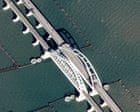
When Sergey Aksyonov hopped on Telegram just after midnight on November 19, 2026, to admit that the Crimean Bridge had been hit yet again, his tone felt noticeably familiar. Damage assessment underway. Heroic emergency crews on the scene. Everything under control.
Don't buy the calm front. That midnight strike wasn't an isolated flare-up or a minor nuisance. It was the third direct hit in four days, capping off a relentless, multi-week campaign that finally dropped the road span into the Kerch Strait and left Russia's southern supply lines gasping for air. Meanwhile, you can explore related stories here: The European Photo-Op Industrial Complex: Why Berlin Summits Won't Save Ukraine.
If you only read standard wire reports, you'd think Ukraine simply fired a few lucky shots at a heavily guarded target. The reality on the ground—and in the water—is much messier for Moscow.
Three Strikes in Four Days Changed Everything
To understand why Aksyonov's November 19 announcement mattered so much, you have to look at the sequence of events leading up to it. Standard news coverage often blurs these strikes together, treating them like one continuous news cycle. They weren't. Each wave served a very specific engineering and military purpose. To explore the bigger picture, check out the detailed report by The New York Times.
- The November 16 Probe: Around 2:00 a.m. Moscow Time, Ukrainian drones slammed into the crossing. Russian officials shut down both spans before opening a single alternating lane of vehicle traffic 17 hours later. Moscow claimed the damage was minor. Yet open-source imagery showed the metal arch over the road bridge visibly bent—listing roughly 15 degrees out of shape. It was a stress test.
- The November 17 Collapse: Less than 24 hours later, around midnight, Ukraine unleashed the main event. President Volodymyr Zelenskyy later confirmed this was the seventh phase of an operation that had been quietly building for weeks. By mixing domestically built Neptune and FP-5 Flamingo missiles with European-made Ruta cruise missiles and Palianytsia missile-drones, Kyiv overwhelmed local air defenses. Both the road-bridge arch and the concrete deck beneath it collapsed straight into the sea.
- The November 19 Rail Hit: With cars and trucks completely cut off, Moscow leaned entirely on the parallel railway bridge. Then came the third blow. Ukrainian Neptune missiles struck the rail section just after midnight, halting train traffic and forcing Aksyonov to issue his now-famous confirmation.
Russian transport officials scrambled to get trains moving again by 4:00 p.m. on November 19, operating at reduced capacity on a single track while crews worked on the damaged line. Even Russia's own Ministry of Transport quietly gave the game away a few days later. On November 24, they updated their official Telegram graphic of the crossing. Gone was the twin-arch silhouette. The new graphic showed only a single rail bridge standing alone.
How Ukraine Bypassed Starlink and Russian Air Defenses
Most military analysts assumed a strike of this scale wouldn't be possible in late 2026. Why? Because Russia had spent years turning the Kerch Strait into one of the most heavily defended patches of water on earth, and SpaceX had tightened satellite restrictions that previously helped guide long-range Ukrainian drones.
Ukraine didn't wait around for permission from Silicon Valley. According to reporting from The Times, Ukrainian engineers built an independent, real-time video and radio relay network specifically for this operation, pulling off the entire multi-day bombardment without touching Starlink.
They also solved the air defense problem through sheer tactical variety. Instead of sending a uniform wave of slow drones that Russian Pantsir and S-400 batteries could pick off one by one, the Security Service of Ukraine (SBU), Navy, and Unmanned Systems Forces coordinated a layered swarm. European defense firm Destinus later confirmed that seven of its Ruta cruise missiles struck the bridge, while its Da Vinci drones flew ahead to suppress and distract Russian radar installations.
When you throw decoys, jet-powered missile-drones, and upgraded 1,000-kilometer-range "Long Neptune" missiles at a fixed target simultaneously, something is going to get through. And it did.
The Ripple Effect on Crimea's Crumbling Logistics
People outside the region often view the Crimean Bridge purely as a political symbol—Vladimir Putin's prized $4 billion pet project tying the annexed peninsula to mainland Russia. Symbolism doesn't move artillery shells. Concrete and steel do.
Once the road span fell into the Kerch Strait on November 17, every single civilian car, fuel tanker, and military supply truck had to reroute onto the so-called "land corridor" running along the Sea of Azov through occupied Zaporizhzhia and Kherson. That bottleneck has turned into a nightmare for Russian commanders.
Consider what happened on the R-280 highway—a stretch drivers have started calling the "Road of Death". Yevgeny Balitsky, the Russian-installed governor of Zaporizhzhia, openly complained on state television that traffic on the highway hit its absolute maximum rated capacity of 14,000 vehicles per day. Because Ukrainian forces have also been systematically bombing smaller bridges along that overland route, convoys are forced into slow, bumpy detours.
Slow trucks are easy targets. Reports from the region describe Russian drivers flooring their accelerators up to 140 kilometers per hour on exposed stretches just to outrun Ukrainian FPV drones.
To make matters worse, Crimea's internal infrastructure is buckling at the exact same time. By November 25 and 26, massive power outages swept across the peninsula after strikes on external energy facilities, knocking out trams, cutting heating in parts of Kerch, and forcing occupation authorities to impose rolling electricity restrictions expected to last up to 10 days. When you lose your main highway, your rail line runs at half-speed, and your power grid goes dark, holding onto a peninsula becomes exponentially harder.
Timing the Strikes Before the Shenzhen Summit
Nothing in modern warfare happens in a vacuum, and the calendar tells a pretty clear story here.
The November 19 strike landed just hours before an unprecedented three-way summit in Shenzhen, China, bringing together U.S. President Donald Trump, Russian President Vladimir Putin, and Chinese President Xi Jinping. Heading into high-stakes diplomatic talks where territorial concessions and ceasefires were front and center, Kyiv needed undeniable proof that Russian control over Crimea isn't permanent or invulnerable.
Dropping a span of the Crimean Bridge right before Putin sat down with Trump and Xi sent a blunt message without a single diplomat saying a word. It showed Washington and Beijing that Ukraine still possesses the industrial capacity—and the independent tech—to sever Russia's most prized military artery on its own terms.
What You Should Watch Next
If you're tracking how this war actually moves rather than just reading daily casualty tickers, ignore the official press releases from Moscow claiming traffic is "back to normal". Watch three concrete indicators over the coming weeks instead.
First, keep an eye on commercial satellite imagery of the Kerch Strait. Repairing a collapsed steel arch and submerged roadbed in winter Black Sea weather isn't a weekend patch job—it takes specialized heavy-lift cranes that become sitting ducks the moment they anchor in the strait. Second, monitor fuel and food prices inside Sevastopol and Simferopol, which immediately reflect whether that single remaining rail track can handle both military hardware and civilian goods. Finally, watch for further strikes on the railway bridges in occupied Kherson and Zaporizhzhia. If Ukraine severs the overland rail links while the Kerch rail span limps along on one track, Russia's entire southern front runs out of gas.