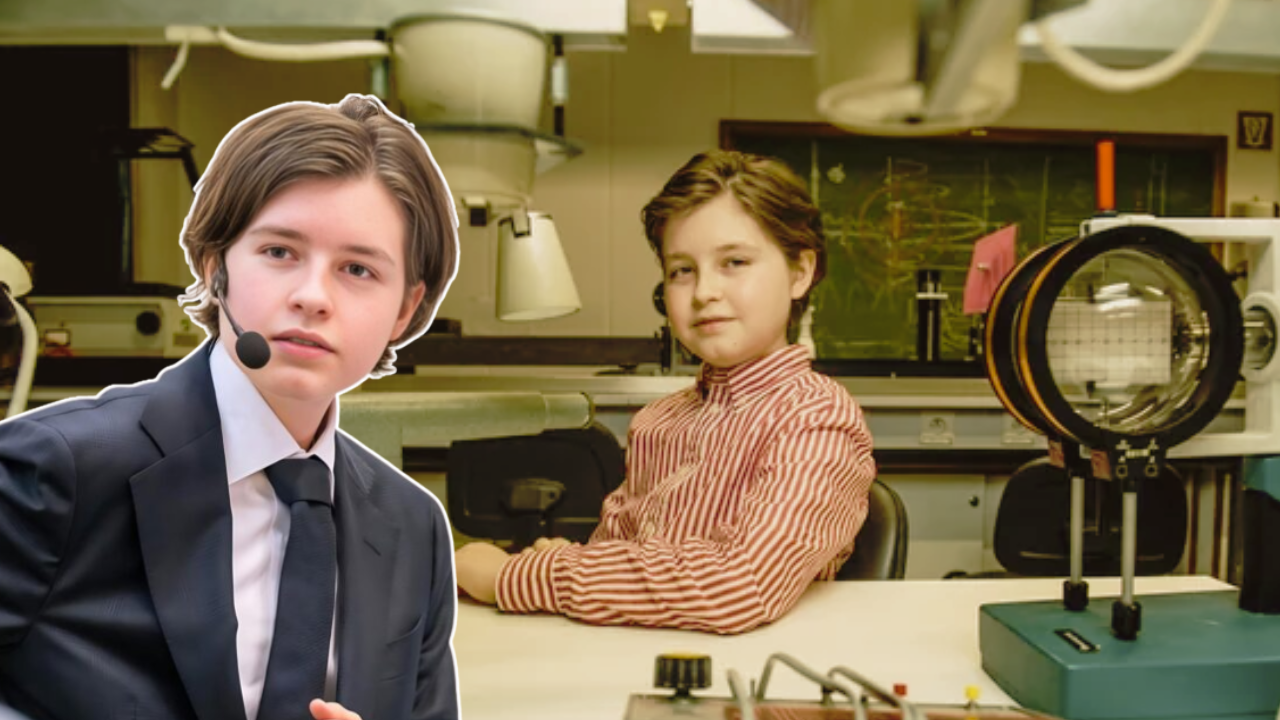
At sixteen years old, Laurent Simons possesses an academic CV that induces vertigo in seasoned researchers. The Belgian prodigy defended a doctoral thesis in quantum physics at the University of Antwerp at age fifteen, focusing on Bose polarons in superfluids and supersolids. Today, his focus has shifted. He is diving into medical science, artificial intelligence, and the biophysical mechanics of human aging. Headlines routinely label him a wunderkind or a modern Einstein, but the reality of his transition from abstract quantum systems to the messy biology of aging reveals a much more calculated scientific trajectory.
Public fascination with child prodigies usually focuses on speed. Speed is a poor metric for scientific breakthrough. Biology does not care about GPA milestones or skipped grade levels. When a researcher targets cellular senescence or metabolic decay, they run into chemical walls that cannot be bypassed with sheer cognitive velocity. Understanding how Simons plans to approach this field requires looking past the viral statistics of his youth and examining the structural mechanics of how exceptional intellects interact with intractable scientific problems.
The Mechanics Of Accelerated Acquisition
To comprehend where Simons is heading, one must look at how he arrived here. Born in December 2009, he moved through primary education before entering secondary school at an unusual pace. By age eight, he had completed his secondary credentials. He then entered Eindhoven University of Technology to study electrical engineering, aiming for an accelerated three-year curriculum. That arrangement collapsed due to institutional disagreements over timelines, prompting a swift relocation to the University of Antwerp.
At Antwerp, he pivoted to physics, securing a bachelor's degree at age eleven and a master's in quantum physics at twelve. Research stints followed, including time spent at the Max Planck Institute of Quantum Optics in Germany. His doctoral defense in November 2025 marked an endpoint for his formal entry into quantum mechanics, but it was never intended as a terminal destination.
Many observers assume this trajectory is purely accidental—a product of exceptionally high intelligence quotients measured around 145. Intelligence is cheap. Millions of people possess high cognitive baseline capacity. What separates a prodigy from a footnote is institutional backing and strategic task selection. Simons did not bounce randomly across disciplines. Each academic phase served as a deliberate tool acquisition exercise. Physics provided the mathematical foundations for modeling complex systems. Quantum mechanics trained him to analyze interactions at microscopic scales where classical intuition fails.
The Transition From Subatomic Particles To Biological Decay
Moving from Bose polarons to human longevity looks like a wild pivot. It is not. Modern biophysics increasingly relies on the exact mathematical machinery used to study quantum states. Biological aging is fundamentally a problem of multi-body complex systems undergoing entropy.
Cells accumulate DNA damage, proteins misfold, telomeres shorten, and chronic low-grade inflammation damages tissue architecture. Traditional biologists often approach these problems through empirical trial and error. They test a molecule, observe a phenotypic change, and document the results. Physicists approach the same system as a network of interacting variables governed by thermodynamic constraints.
Simons has repeatedly stated that his ultimate motivation connects to human health and the prevention of premature loss. Early reports highlighted his childhood desire to build artificial organs and repair damaged biological machinery. That ambition requires more than medical degrees. It requires computational modeling capable of simulating biological networks in real time. Artificial intelligence enters here as an analytical engine. By combining quantum-level analytical thinking with machine learning models trained on vast genomic and proteomic datasets, researchers attempt to predict how cellular networks degrade over decades.
Institutional Strategy And Global Mobility
Talent mobility dictates modern science. Exceptional researchers migrate toward jurisdictions and institutions willing to provide unconstrained resources. Reports tracking Simons indicate that his career path involves setting up future research initiatives, including involvement with Bar-Ilan University in Israel to establish dedicated laboratory space. Israel maintains heavy concentration in biotechnology, deep-tech research, and artificial intelligence integration.
This move reflects an aggressive strategy of institutional alignment. Major scientific breakthroughs rarely occur in isolation. They require high-throughput laboratories, access to specialized imaging equipment, and dense collaborative networks of immunologists, geneticists, and data engineers. For a young researcher shifting domains, finding an academic home capable of absorbing an unorthodox multidisciplinary background is essential.
The family's management of his career deserves scrutiny. Early commercial approaches from major technology conglomerates in the United States and Asia were declined. Immediate monetization was rejected in favor of long-term intellectual development. This mirrors the trajectory of elite institutional venture funds rather than typical child star management. They are treating intellectual capability as an asset class that appreciates through deliberate compounding rather than immediate extraction.
The Hard Limits Of Longevity Science
Enthusiasm surrounding anti-aging research frequently runs ahead of biological reality. Aging is not a single bug in human software that a patch can fix. It is an emergent property of multi-cellular life. Every biological mechanism that prevents cancer—such as cellular senescence, where damaged cells stop dividing to prevent tumors—also contributes to tissue aging by clogging organs with senescent cells that secrete inflammatory signals.
Fixing one component often breaks another. Enhancing telomerase activity can extend cellular division limits, but it frequently removes a crucial tumor-suppressive safety brake, raising cancer risks. Nature operates on evolutionary trade-offs, optimizing organisms for reproductive success rather than indefinite maintenance.
When a sixteen-year-old enters this domain, they encounter skepticism from veteran biontologists who have spent forty years watching promising longevity interventions fail in clinical trials. Rapamycin, metformin, senolytics, and NAD+ precursors all showed incredible promise in murine models. Translating those interventions into safe, effective human therapies has proved brutally difficult. Human lifespan is long, clinical trials are expensive, and biomarkers for biological age remain imperfect proxies for actual morbidity and mortality outcomes.
Interdisciplinary Friction In Modern Laboratories
Simons faces a distinct cultural hurdle. Traditional academic departments are heavily siloed. Departments of molecular biology rarely speak the same language as departments of theoretical physics. A researcher who tries to bridge these worlds often faces institutional resistance from gatekeepers who protect disciplinary boundaries.
To succeed in slowing human aging, Simons must bridge quantitative modeling with wet-lab execution. Theoretical models built on supercomputers are notoriously fragile when exposed to messy in vivo environments where biological variability reigns. Cellular cultures behave differently than organoids, and organoids behave differently than intact mammalian systems.
His training in quantum physics gives him strong quantitative discipline, but biology requires empirical patience. Experiments take weeks or months to incubate. Biological samples contaminate. Animal models behave unpredictably. The fast-paced cadence of clearing university degrees in months will slam against the glacial pace of biological validation.
The Broader Implications For Scientific Talent Pipelines
The fascination with Simons goes beyond individual brilliance. It highlights a structural failure in how modern educational institutions handle exceptional learners. Most global universities are rigidly age-tiered and bureaucratic. They punish acceleration and demand compliance with arbitrary time-in-seat requirements.
Belgium, the Netherlands, and Germany proved flexible enough to accommodate an exceptional student, but thousands of other high-potential minds are stalled by bureaucratic inertia every year. If institutions want to accelerate breakthroughs in complex fields like longevity and artificial intelligence, they need scalable pathways for early-talent integration. Waiting until someone is twenty-two to start thinking about complex multi-disciplinary problems wastes precious decades of peak creative output.
At the same time, shielding a young person from the social isolation of accelerated higher education requires active management. Simons maintains normal adolescent hobbies, balancing heavy research schedules with gaming, go-karting, and spending time with family. Maintaining this balance determines whether an exceptional mind burns out or sustains a fifty-year research career.
The ambition to slow human aging remains one of the ultimate grand challenges of science. Whether a prodigy who mastered quantum mechanics at fifteen can fundamentally shift the trajectory of biogerontology depends less on his IQ and more on his stamina. The biology of decay does not negotiate with brilliance. It yields only to relentless, empirical persistence across decades of laboratory work. The teenage milestone is already achieved; the real work begins now.