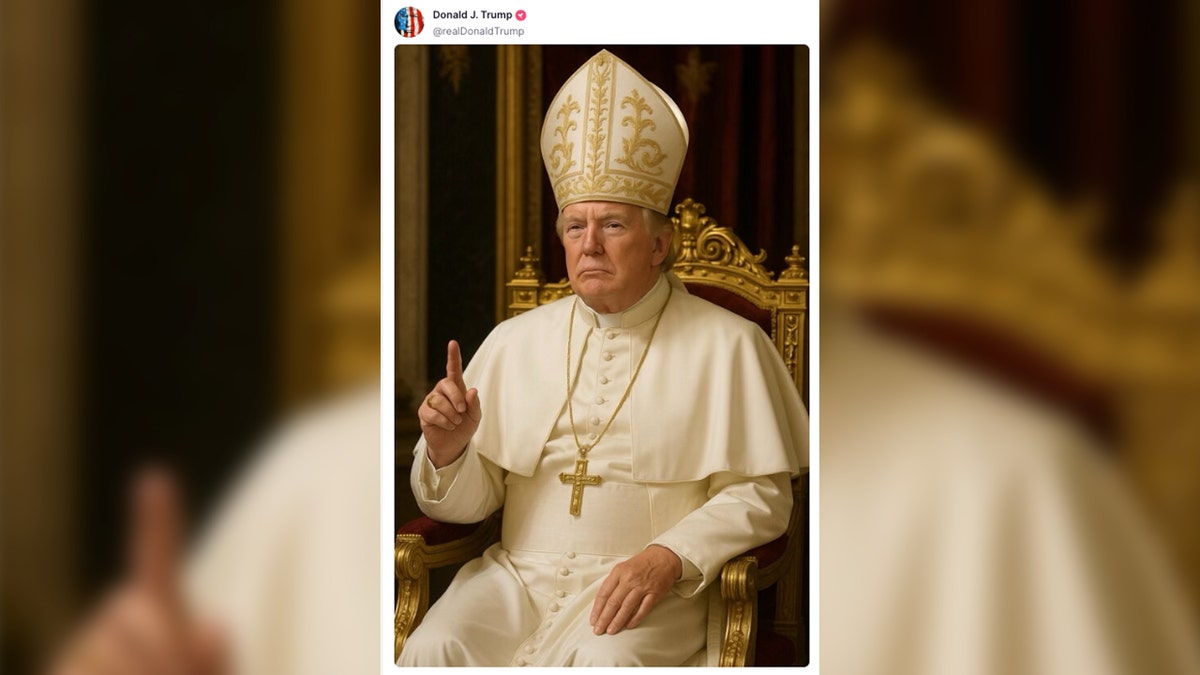
Donald Trump spent the last decade convincing the American electorate that he is the only one who can save them, but he may have finally hit the ceiling of his own mythology. On Sunday night, the president shared an AI-generated image on Truth Social that depicted him in the role of the Messiah—specifically, a Christ-like figure in white robes, performing a "miracle" by laying hands on a sick man. By Monday morning, the post was gone. The swift deletion was not a rare moment of presidential humility, but a panicked response to a fracture in his most loyal base: the religious right.
The image was a visual fever dream. Bathed in celestial light and flanked by the Statue of Liberty, fighter jets, and bald eagles, Trump appeared to be healing a patient in a hospital bed. However, the controversy deeper than mere vanity. This was a calculated move in a escalating war with the Vatican that went sideways, revealing a profound misjudgment of how much blasphemy his supporters are willing to stomach for the sake of "owning the libs."
The Ghost in the Machine
To understand how this happened, we have to look at the source of the pixels. This was not a professional campaign asset. It was a "deep-fried" piece of internet ephemera that began circulating months ago among fringe MAGA influencers. Specifically, conservative commentator Nick Adams shared an earlier version of the image in February. But the version Trump posted on Sunday had been modified in a way that remains unexplained.
In the original Adams version, a silhouette of a U.S. soldier stood in the background. In the version the president shared, that soldier had been replaced by a horned, winged figure—a detail many viewers immediately identified as demonic.
Whether the president failed to notice the demon lurking in the background or his digital team intentionally used a "darker" version of the meme is secondary to the result. For a voter base that takes spiritual warfare literally, seeing a horned creature hovering behind a self-deifying president was not a joke. It was a red flag. When confronted by reporters on Monday, Trump offered a characteristic pivot. "I thought it was me as a doctor," he claimed, suggesting the image was a nod to the Red Cross.
The "doctor" defense is a tough sell when you are wearing a scarlet sash and glowing with the light of the Transfiguration.
A War of Two Sovereigns
The timing of the post was a tactical strike against Pope Leo XIV. As the first American-born Pope, Leo has become a persistent thorn in the administration’s side, specifically regarding the ongoing conflict in Iran. While the White House has framed the war as a necessary defense of Western civilization, Leo has used his platform to denounce it as "inhumane" and "neocolonial."
Hours before the Jesus image went live, Trump launched a 334-word tirade against the pontiff, calling him "weak on crime" and "terrible for foreign policy." The AI image was meant to be the exclamation point—a visual assertion that Trump, not Leo, is the true steward of Christian values.
But the strategy backfired. Instead of rallying the troops, the post forced even his most vocal surrogates to draw a line. Riley Gaines, a frequent rally guest, publicly questioned the president’s state of mind, writing that "God shall not be mocked." Former Representative Marjorie Taylor Greene, who has rarely found a Trump provocation she couldn't defend, denounced the image as "blasphemy" containing an "Antichrist spirit."
The Tech of Modern Idolatry
This incident highlights a growing problem in the White House’s digital strategy: the reliance on AI-generated "vibes" over reality. AI tools have made it incredibly easy to produce high-fidelity propaganda that bypasses the traditional filters of a communications office. When a president can generate a photo of himself as a deity in thirty seconds using a prompt, the barrier to entry for sacrilege disappears.
The prompt-to-post pipeline is dangerous because AI lacks a sense of irony or theological boundary. It simply mixes the most high-engagement symbols available—in this case, the flag, the cross, and the leader. For a secular audience, it’s just another weird meme. For the Evangelical and Catholic voters who handed Trump his 56% majority in 2024, it is a violation of the First Commandment.
Religious leaders who have spent years defending Trump’s "imperfect vessel" status found themselves unable to square this circle. Bishop Robert Barron, who serves on a Trump-appointed religious liberty commission, called for an apology. The friction is real. You can be a "strongman" leader, and you can be a "defender of the faith," but the moment you try to be the object of the faith, the coalition begins to crumble.
The Policy Behind the Poses
Critics were quick to point out the irony of the "healing" imagery. Only months ago, the administration signed legislation that significantly gutted federal Medicaid spending. The optics of the president role-playing as a miraculous healer while millions face the loss of healthcare coverage provided a grim contrast that the opposition was happy to exploit.
The "Antichrist" label, once reserved for the president's enemies by his supporters, is now being whispered within the house. On Truth Social, a platform where dissent is usually scrubbed within minutes, the comments section under the Jesus image was a rare battlefield of "Amens" and "Delete this nows" before the post was finally nuked.
The deletion doesn't erase the digital footprint. It only confirms that for the first time in years, Donald Trump found a line he couldn't cross. He has survived scandals that would have buried any other politician, but he may have finally learned that in American politics, you can fight the Pope, but you can't replace the Savior.
The move to scrub the post shows that the campaign's internal polling likely registered a vertical drop in support among the very people who feel the most protective of the iconography he tried to hijack. If the president wants to maintain his grip on the religious right, he will have to go back to being a man of the people rather than a god among them.
The visual of a horned beast behind a man claiming divine power is an image that won't easily be forgotten by those who believe the devil is in the details.