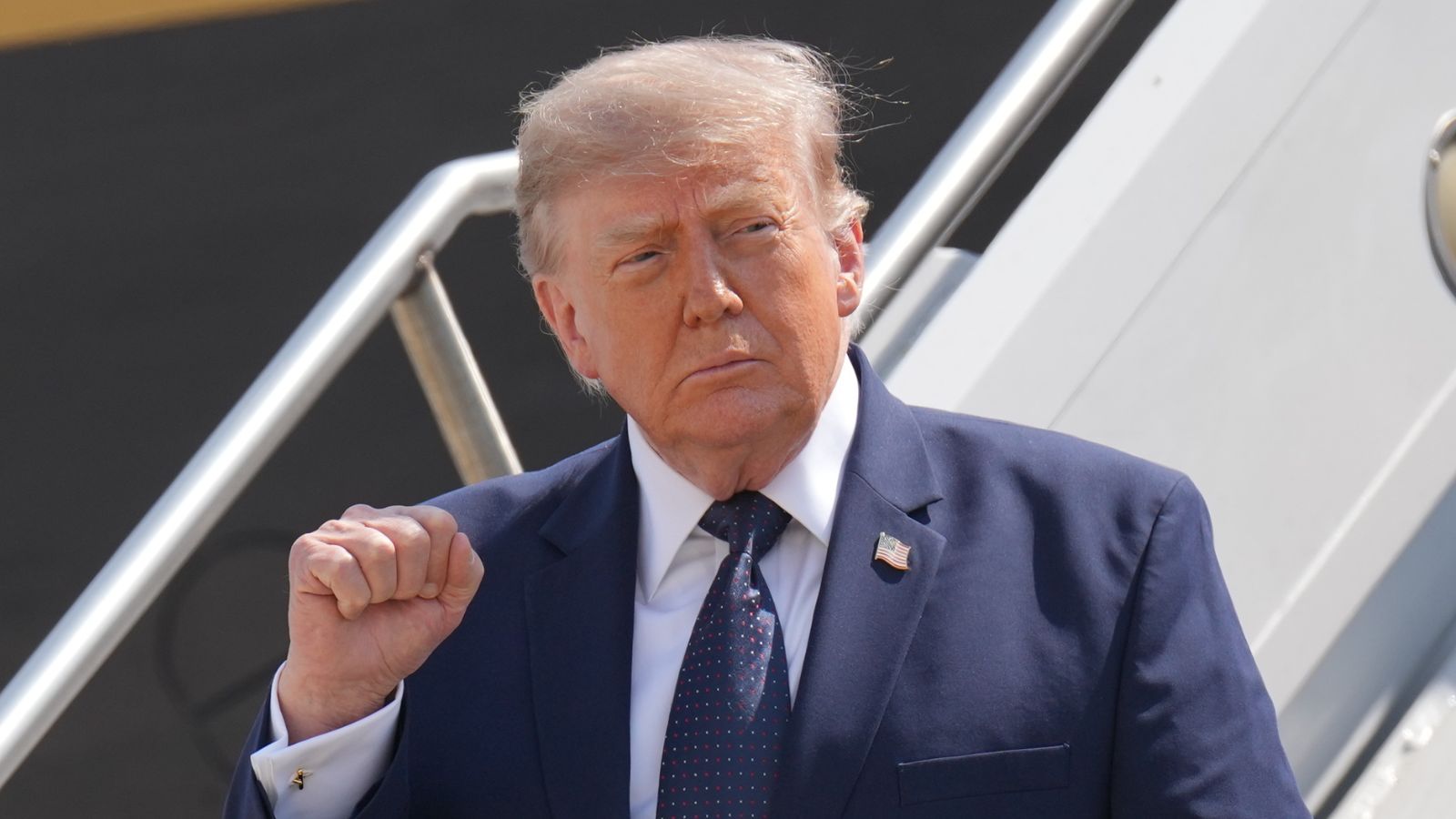
Donald Trump wants to tax the wind. On Friday, the American president turned his trade-war machinery toward a new target, threatening to slap heavy tariffs on Canadian imports because wildfire smoke from Ontario is crossing the border. Trump accused Ottawa of willful negligence in its forest management practices, characterizing the drifting plumes of ash as an invasion of filthy air.
The political theater is obvious, but the underlying mechanics reveal a much deeper breakdown in North American diplomacy. Millions of Americans across eighteen states are currently breathing hazardous air, Detroit and Chicago are registering the worst air quality indexes in the world, and Sunday's World Cup final in the New York-New Jersey area is suddenly facing a smoky disruption. Yet behind the fiery social media posts lies a stark reality: the White House has virtually no legal mechanism to enforce a weather-based tax, especially after a crushing Supreme Court ruling earlier this year stripped the executive branch of its favorite economic emergency powers. What looks like an environmental dispute is actually a calculated maneuver to squeeze Canada's new Prime Minister, Mark Carney, just weeks after Washington refused to renew the continent’s long-term trade pact. Don't forget to check out our previous coverage on this related article.
The Mirage of Atmospheric Customs Duties
Trump’s assertion that the cost of pollution must be added to the tariffs Canada currently pays sounds simple on a smartphone screen. In practice, it breaks every rule of international trade law.
To levy a tariff, a government typically needs to prove unfair subsidies, currency manipulation, or direct national security threats tied to a tangible, manufactured commodity. Smoke does not clear customs. It does not carry a bill of lading. White House officials have scrambled to find alternative procedural laws that require extensive investigations and public comment periods, a slow-moving bureaucratic reality that completely undercuts the president's desire for immediate executive retaliation. To read more about the context of this, The Washington Post offers an informative breakdown.
Furthermore, the legal avenues for this type of action have fundamentally shifted. In early 2026, the United States Supreme Court significantly constrained executive tariff powers, ruling that the president could no longer use sweeping national security emergencies to bypass Congress and slap arbitrary duties on foreign partners. This decision dismantled the exact playbook used during Trump's previous trade offensives. Without that emergency tool, the administration is left holding an empty threat, relying on a patchwork of minor trade statutes that can take months, if not years, to yield actual import taxes.
Behind the Sudden Attack on Ottawa
This sudden rhetorical escalation did not happen in a vacuum. It is the culmination of months of simmering hostility between Washington and the newly formed Canadian government under Mark Carney.
North American Trade Tensions (Mid-2026)
┌─────────────────────────────────┐
│ White House Refuses Long-Term  │
│ Renewal of Trade Agreement      │
└────────────────┬────────────────┘
                 │
                 ▼
┌─────────────────────────────────┐
│ Canada and China Enact          │
│ Retaliatory Import Tariffs      │
└────────────────┬────────────────┘
                 │
                 ▼
┌─────────────────────────────────┐
│ Canadian Wildfire Smoke         │
│ Crosses U.S. Border             │
└────────────────┬────────────────┘
                 │
                 ▼
┌─────────────────────────────────┐
│ Trump Threatens Tariff Hikes    │
│ Citing Forest Mismanagement     │
└─────────────────────────────────┘
Carney, a former central banker, has spent months criticizing Washington’s aggressive economic nationalism. He has pushed back hard against rhetoric suggesting Canada should be treated as a subordinate economic entity. Earlier this month, U.S. Trade Representative Jamieson Greer confirmed the White House would opt out of a long-term extension of the North American trade framework, choosing instead a system of rolling negotiations designed to keep Ottawa permanently off-balance.
The wildfire smoke offers a convenient, emotionally charged cudgel to accelerate that leverage. By tying an environmental crisis directly to the pocketbooks of American consumers and Canadian exporters, the administration is attempting to force Carney into a defensive posture before formal trade talks even begin.
The Realities of Modern Boreal Forestry
The accusation from American politicians that Canada simply refuses to clean up its debris ignores the raw mathematics of the northern wilderness.
Canada contains roughly nine percent of the world’s total forest cover. The vast majority of the current blazes are tearing through remote, roadless stretches of northwestern Ontario and the boreal zones, areas where human intervention is not only logistically impossible but ecologically counterproductive.
- Scale: The current active fires span millions of acres across terrain with zero ground infrastructure. Moving heavy debris-removal machinery into these regions would require building thousands of miles of wilderness roads.
- Ecology: Boreal forests require fire cycles to regenerate. Decades of total fire suppression policy, a strategy the U.S. has historically favored, often leads to an unnatural accumulation of fuel that makes subsequent burns far more severe.
- Resources: Even with international aid, no nation possesses enough firefighters to extinguish hundreds of remote lightning-struck blazes simultaneously.
While conservative think tanks correctly point out that Canada carries out prescribed burns at a fraction of the rate required to protect border-adjacent communities, grooming millions of square kilometers of subarctic wilderness is a physical fantasy.
Capitol Hill Capitalizes on the Smog
Trump is far from alone in using the smoke to score political points. Capitol Hill has quickly turned the hazy skies into a legislative weapon.
Senator Bernie Moreno is introducing a bill that would force the executive branch to formally evaluate whether Canadian wildfire containment efforts are insufficient, mandating economic sanctions against specific Canadian forestry and environmental officials if they fail the test. In Michigan, where Detroit residents are currently breathing air thick with the smell of burning pine, local politicians have warned that American patience has expired. Some congressional representatives have gone as far as suggesting the U.S. should halt the upcoming opening of the multi-billion-dollar Gordie Howe International Bridge until Canada controls its airspace emissions.
This represents a dangerous evolution in cross-border relations. If ecological disasters can be classified as hostile economic acts, the entire framework of international diplomacy begins to unravel. The United States has frequently sent its own smoke north during catastrophic fire seasons in California and Washington state, yet those events were treated as shared continental tragedies rather than acts of industrial sabotage.
The Hypocrisy of Free Market Smoke
The threat of tariffs exposes a profound misunderstanding of who actually pays import taxes. If the White House succeeds in applying a carbon-smoke premium to Canadian lumber, oil, or minerals, the financial penalty will land squarely on American builders, manufacturers, and energy consumers.
The administration’s new domestic fire strategy, which relies on a doctrine of full suppression to instantly stamp out every ignition on American soil, is already showing severe strain. Following the tragic deaths of three federal firefighters in Colorado last month, forestry experts have increasingly warned that rushing crews into volatile, unmanaged wilderness to satisfy political mandates is a recipe for disaster.
Blaming Ottawa provides a perfect distraction from domestic infrastructure failures. It allows politicians to avoid answering why American power grids remain vulnerable, why domestic forest management budgets are tied up in litigation, and why air filtration upgrades for public schools remain underfunded. Finding a foreign scapegoat is always cheaper than rebuilding a continent's climate resilience.
Mark Carney has attempted to cool the rhetoric by noting that atmospheric warming changes the baseline rules for both nations, requiring integrated coordination rather than trade litigation. But in an election year dominated by economic grievances, nuance is the first thing to choke. The smoke drifting across the Great Lakes will eventually clear when the autumn rains arrive, but the political poison injected into the relationship between America and its largest trading partner will linger far longer than the haze.