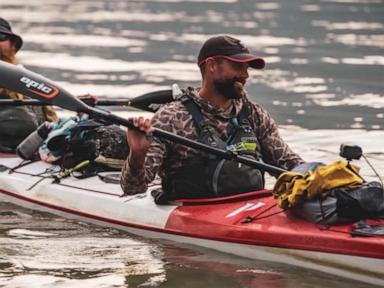
The traditional narrative of the wounded warrior follows a predictable script. A catastrophic injury occurs, a profile in courage emerges, and a network television segment wraps the entire ordeal in a neat, three-minute package designed to evoke inspiration rather than inspection. The recent media focus on former Navy SEAL David Charbonnet, celebrated under network banners like "America Strong," perfectly illustrates this dynamic. Charbonnet, a member of SEAL Team 1 who was paralyzed from the waist down during a 2011 parachuting mishap, is currently training to qualify for the 2028 Paralympic Games in paracanoe.
But the glossy broadcast profile glosses over the brutal structural mechanics of catastrophic military injury recovery. Behind the triumphalist music lies a stark reality: the transition from elite special operations asset to paralyzed civilian is a violent institutional decoupling. The true story is not merely that an individual possessed the grit to survive an 80-foot freefall after his canopy stalled; it is that the existing institutional infrastructure for severe spinal cord injuries requires wounded veterans to build their own parallel systems of rehabilitation, funding, and community survival just to stay in the fight. Discover more on a related topic: this related article.
The Mirage of Total Care
When a Navy SEAL is injured on duty or during pre-deployment training, the immediate medical response is world-class. The military machine excels at acute trauma care, stabilization, and immediate surgical intervention. Charbonnet’s L1 burst fracture and cracked liver were expertly mended by military surgeons. Yet, a fundamental rift exists between acute stabilization and long-term neurological rehabilitation.
Once an operator is stabilized and medically retired, they are transferred from the highly funded, agile ecosystem of Naval Special Warfare into the sprawling bureaucracy of the Department of Veterans Affairs. The VA hospital system is designed for a broad demographic, primarily managing chronic age-related illnesses and general service disabilities. It is structurally unequipped to provide the high-intensity, specialized, long-term neurological therapy required to keep a former elite athlete at peak physical performance. Additional journalism by NBC News delves into related perspectives on the subject.
Standard bureaucratic outpatient rehabilitation allocations are typically limited to a set number of sessions per year. For a spinal cord injury, a few hours of physical therapy a week is the equivalent of trying to clear a landslide with a plastic shovel. The nervous system requires continuous, aggressive stimulation to prevent muscle atrophy, manage autonomic dysreflexia, and maintain cardiovascular health.
The Outpatient Deficit and the Rise of Guerrilla Rehab
To survive the cliff-edge of medical discharge, severely injured veterans routinely have to look outside the federal government. After Charbonnet was released from inpatient care at the VA hospital in La Jolla, his SEAL Team physical therapist had to look beyond the military health system to find adequate long-term care. That search led to VIP NeuroRehabilitation Center, a non-profit clinic in San Diego.
The reliance on non-profit centers highlights a systemic failure. If an injured veteran does not live in a major military hub like San Diego, their access to specialized neurological equipment drops precipitously. Specialized rehabilitation tools are rarely accessible through standard insurance or foundational VA coverage.
- Locomotor Training Systems: Robotic treadmills that manually move a paralyzed individual's legs to stimulate neural pathways.
- Functional Electrical Stimulation (FES) Bikes: Systems that utilize computer-generated electrical pulses to contract paralyzed muscles, forcing them to pedal an ergonomic bicycle.
- Hyperbaric Oxygen Chambers: Used off-label to mitigate secondary tissue damage, requiring out-of-pocket expenses running into thousands of dollars.
The financial burden of this gap is astronomical. A single specialized wheelchair can cost upwards of $10,000, while home modifications to accommodate paralysis easily cross the six-figure mark. Charbonnet’s family required intervention from the Tunnel to Towers Foundation to alleviate the financial strain of equipping their home. Without third-party philanthropy, the baseline economic cost of surviving a catastrophic military injury can easily bankrupt a family.
The Weaponization of the Athlete Mindset
The pivot from Navy SEAL to elite paracanoe athlete is frequently framed as a seamless translation of mental toughness. Charbonnet qualified for the Paracanoe World Championships in Hungary just 13 months after picking up a paddle. He is currently aiming for the 2028 Los Angeles Paralympics.
However, the psychological framework required to survive this transition is far more complex than simple perseverance. It requires a complete destruction and reconstruction of identity. For an elite operator, physical capability is not just a job requirement; it is their entire currency. When that currency is wiped out by an 80-foot fall, the psychological drop can be deadlier than the physical one.
[Elite Special Operator Identity]
       │
       ▼ (80-Foot Fall / Spinal Injury)
[Identity Vacuum / Loss of Physical Currency]
       │
       ▼ (The Pivot to Adaptive Athletics)
[Reconstructed Identity: Para-Athlete & Advocate]
Charbonnet has openly admitted that he initially resisted entering adaptive sports. The transition from being a member of an elite, shadowy military unit to competing as a paralyzed athlete carries a profound psychological friction. The term "handicapped" feels like an antithesis to the warrior ethos.
The breakthrough for Charbonnet happened when he realized that kayaking allowed him to train alongside able-bodied athletes, including the US Men’s National Team and youth paddlers on Mission Bay. The water serves as an equalizer. In a sprint kayak, the kinetic energy is generated from the torso up, effectively masking the paralysis of the lower limbs and allowing the individual to operate at a high-performance threshold without the constant visual reminder of a disability.
The Structural Realities of the Paralympic Pipeline
While media profiles paint the journey to the 2028 Paralympics as a story of pure willpower, the elite adaptive sports pipeline is governed by intense geopolitical and financial logistics. Competing at an international level in paracanoe requires specialized coaching, cutting-edge carbon-fiber watercraft, and extensive international travel.
The United States Olympic & Paralympic Committee provides stipends and support, but the bulk of development funding falls onto the athlete and private donors. Charbonnet’s training was largely made possible because organizations like America’s Warrior Partnership and the Warrior Foundation Freedom Station stepped in to secure private funding for a professional coaching staff.
Furthermore, international classification systems in para-sports are cutthroat. Athletes are grouped based on their level of physical function to ensure fair competition. Navigating these classifications requires a continuous dance with sports medicine doctors and regulators, where a slight shift in medical ruling can alter an athlete’s competitive viability overnight. The romanticized view of a veteran just working hard on the water ignores the corporate, logistical, and bureaucratic machinery that dictates who gets to wear the team jersey.
Institutional Failure Replaced by Personal Mission
The ultimate irony of these "America Strong" narratives is that the individuals profiled often end up doing the work that the institutions originally promised to handle. Charbonnet did not just use VIP NeuroRehabilitation Center to recover; he eventually became the president and Chairman of the Board of the organization. He partnered with his father, another former SEAL, to launch "Beyond the Teams," a non-profit designed to raise hundreds of thousands of dollars to fund other rehabilitation clinics.
This pattern is rampant across the special operations community. The government funds the war fighter, but the veteran community funds the recovery. The survival of these wounded operators relies entirely on an insular network of former teammates, philanthropic foundations, and private citizens.
The narrative cannot end with a neat bow about a resilient veteran training for a gold medal. The real story is that the line between a successful recovery and absolute institutional abandonment is thin, expensive, and heavily reliant on private charity. The resilience on display is undeniable, but it is a coping mechanism for an underlying system that breaks its instruments and expects the pieces to glue themselves back together.