Silence.
That is what hits you first when you sit beside a struggling reader at seven o'clock on a Tuesday evening, the kitchen dishes still soaking in lukewarm suds while a dog-eared paperback lies open on the table like an unexploded device. You watch a seven-year-old squint at the page, their shoulders creeping up toward their ears, their thumb tracing the spine so hard the white knuckle looks bruised, and you realize that for a massive portion of the population, a book is not a doorway. It is a wall. Recently making news recently: What Really Happened With Prince William Kate Middleton and Thomas Markle.
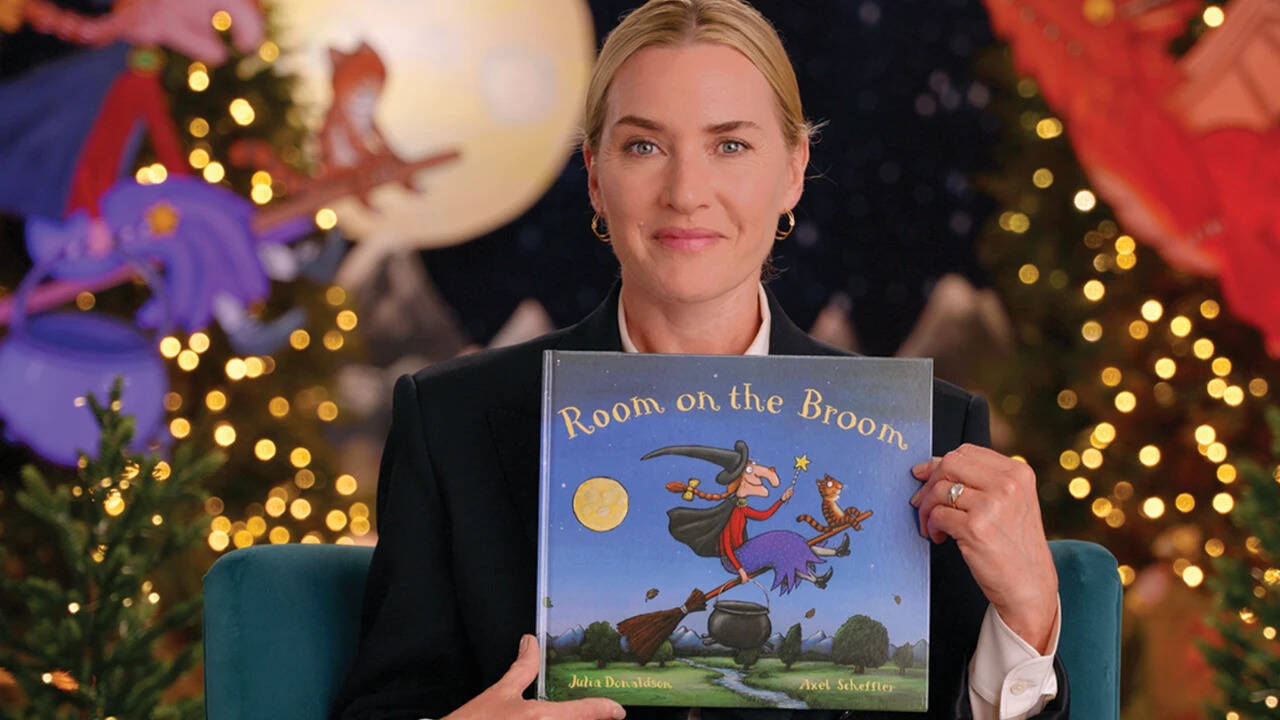
I know this wall intimately because I spent years trying to help my own nephew climb it, sweating through phonics worksheets and watching his bright, chaotic curiosity shrivel the second the printed word entered the room. We treat reading as a mechanical hurdle, a set of phonetic gears that simply need oiling, yet we forget what happens to a child's spirit when every single word feels like a test they are already failing. When Kate Winslet stepped into a recording studio to read Room on the Broom for Storyline Online, the entertainment press treated it like another pleasant piece of celebrity charity, a three-paragraph blurb sandwiched between red-carpet fashion breakdowns and box-office projections. They missed the point entirely.
The Architecture of a Shared Breath
To understand why an Academy Award-winning actor sitting in front of a microphone with a picture book matters so much, we have to look at what happens in the brain when a story stops being a chore and becomes a performance. Consider a hypothetical classroom in a high-poverty district, the kind where the library shelves are thin and half the kids haven't had a bedtime story read to them since they were toddlers. Let's call the boy in the back row Leo, though you could find him in any zip code from rural Ohio to inner-city London. Leo hates reading because reading is the thing that makes him look slow in front of his friends. Additional information into this topic are detailed by Reuters.
Now, picture the screen coming alive in that classroom. There are no explosions, no hyper-caffeinated cartoon squirrels screaming for attention, and no algorithmic dopamine traps designed to fry a developing prefrontal cortex. Instead, there is Kate Winslet—a woman whose voice has carried the weight of sunken ocean liners, nineteenth-century heartbreak, and gritty small-town detectives—leaning forward with the fierce, conspiratorial warmth of an aunt who knows a secret. When she reads Julia Donaldson's rhythmic, galloping verse about a clumsy witch who keeps dropping her hat, her bow, and her wand, something fundamental shifts in the room.
Leo isn't decoding syllables anymore. He is riding the wind.
Storyline Online, an initiative created by the SAG-AFTRA Foundation, operates on a deceptively simple premise that has quietly generated hundreds of millions of views across the globe. By pairing celebrated actors with richly illustrated children's books—and adding subtle, moving animations that breathe life into Axel Scheffler's original artwork without turning the book into a noisy television show—the program bridges the chasm between oral storytelling and visual literacy. Research consistently shows that being read to aloud is the single most effective way to build vocabulary, foster comprehension, and instill a lifelong love of reading, yet millions of children lack consistent access to fluent, expressive readers at home.
Why the Voice Matters More Than the Fame
Cynics love to roll their eyes when Hollywood steps into the literacy space, assuming it is all brand management and soft-focus vanity. If you have ever listened to a celebrity sleep-story app at midnight, you know how flat a famous voice can sound when the actor is phoning it in between film shoots. Winslet does the exact opposite.
She treats Room on the Broom with the exact same technical rigor she brings to a period drama or a psychological thriller. Listen closely to the pacing of her reading and you can hear the craft of a seasoned stage and screen veteran at work. She gives the witch a breathless, scatterbrained kindness that makes you immediately protective of her. She shifts her register for the overly eager dog, the proud green bird, and the impeccably clean frog, giving each animal a distinct vocal silhouette so a child who cannot yet read the dialogue tags still knows precisely who is speaking and how they feel.
And then comes the dragon.
When the terrifying beast rises up, hungry for "witch and chips," Winslet drops her voice into a gravelly, menacing rumble that makes the air in the room feel heavier. For a child watching, that moment of genuine theatrical tension is crucial. In cognitive psychology, this is known as emotional scaffolding; the narrator's vocal inflections carry the emotional weight of the text, allowing the child's brain to focus entirely on meaning, empathy, and narrative prediction rather than getting bogged down in the mechanics of letter recognition. Think of it like training wheels on a bicycle, except instead of keeping the bike upright, the actor's voice provides the momentum that makes balancing effortless.
The Invisible Stakes of the Bedtime Gap
We rarely talk about the quiet grief of parents who want to read to their children but cannot. Sometimes it is a matter of exhaustion—working two shifts so the rent clears leaves precious little vocal energy for doing funny voices at nine at night. Sometimes it is a language barrier, where immigrant parents desperately want their children to master English fluency while feeling self-conscious about their own pronunciation. And sometimes, far more often than polite society admits, the parent themselves struggles with low literacy, carrying a lifelong shame that makes opening a picture book feel like walking across broken glass.
I remember talking to a father outside a community center a few years ago who confessed, his eyes fixed firmly on his boots, that he used to pretend he had a sore throat every night just to avoid stumbling over the words in his daughter's books. The shame wasn't just his; it was slowly starving his daughter's imagination.
This is the hidden crisis that free, accessible digital storytelling quietly dismantles. Because Storyline Online is entirely free, ad-free, and available on demand to anyone with an internet connection—whether on a smartboard in an underfunded elementary school, a tablet in a pediatric hospital ward, or a cracked smartphone screen on a late-night bus—it democratizes the experience of the master storyteller. A parent who struggles to read can sit beside their child, hit play on Kate Winslet's reading, and share the exact same gasp when the broom snaps in two. The stigma evaporates. The parent isn't failing; they are co-experiencing a piece of theater with their kid.
The Radical Empathy of a Crowded Broom
Beyond the mechanics of literacy, there is a reason Room on the Broom has endured for over twenty years since Julia Donaldson and Axel Scheffler first published it in 2001, selling millions of copies worldwide and inspiring an Oscar-nominated animated short. On the surface, it is a charmingly silly story about a witch who keeps losing her accessories and acquiring animal passengers. Beneath the rhymes, however, lies a profound blueprint for how human beings survive in a hostile world.
Every time the witch stops to retrieve a fallen object, a new creature emerges from the wilderness—a dog from the bushes, a bird from the trees, a frog from the ditch—and asks the same vulnerable question: "Is there room on the broom for a dog like me?"
The witch never checks their credentials. She never asks what they can contribute to the aerodynamics of the flight, even when their combined weight literally snaps her broomstick in half and drops them straight into the path of a fire-breathing dragon. She simply says, "Yes!"
When the dragon corners her, ready to devour her whole, it is not magic spells or sheer strength that saves her life. It is the muddy, dripping, ridiculous monster formed by the dog, the bird, the frog, and the cat rising out of the ditch together—a creature with four heads, wings, and a terrifying voice that sends the dragon fleeing in terror. Inclusion, the story argues without ever preaching a single word, is not a charity project; it is a survival strategy.
Hearing Winslet deliver those lines adds an unspoken layer of resonance. Here is an artist who has spent her entire career championing flawed, deeply human characters and pushing back against an industry obsessed with narrow definitions of perfection. When she voices the witch's unconditional welcome, it doesn't sound like a line read off a teleprompter. It sounds like a conviction.
What Happens After the Screen Goes Dark
Critics of screen time—and I count myself among the skeptics when it comes to mindless scrolling—often lump all digital media into the same toxic bucket. Yet neuroscientists and educators draw a sharp line between passive consumption and active, dialogic engagement. A fast-paced cartoon bombards the brain with rapid scene cuts that demand zero cognitive effort, leaving children restless and overstimulated once the device is turned off.
A recorded read-aloud operates at the speed of human thought.
Look at how a child interacts with a Storyline Online video compared to a standard animated show. Because the camera lingers on the illustrated pages, panning slowly across the ink-and-watercolor textures while the text appears gently at the bottom of the screen, the child's eyes naturally track from left to right. They begin associating the rhythm of Winslet's voice with the shapes of the words on the page. More importantly, the supplemental activity guides provided alongside the video give teachers and parents concrete ways to pull the story off the screen and into the physical world—asking kids to predict what the witch's new, magnificent broom will look like, or discussing what it feels like to be the newcomer asking for a seat at a crowded table.
When my nephew finally broke through that wall of reading anxiety, it wasn't because of a flashcard drill or a timed comprehension test. It happened because we found a story whose rhythm got stuck in his head like a favorite song, and he wanted to hear the words in his own mouth. He wanted to own the magic for himself.
That is the real legacy of projects like this, and the quiet triumph of Kate Winslet stepping into that booth. She didn't just read a children's book to a camera. She handed millions of kids—and the exhausted, hopeful adults sitting beside them—a reason to believe that the symbols on a page are not barriers meant to keep them out, but invitations waiting to be accepted. Somewhere tonight, a child who spent all day feeling small in a classroom is going to curl up under a blanket, press play, hear a warm British voice whisper "Iggety, ziggety, zaggety, zoom!" and realize, perhaps for the very first time, that there is plenty of room on the broom for them, too.