The air conditioning in a Singapore hotel ballroom always smells faintly of recycled mint and cold ambition. If you have ever sat in one of those rooms during a regional media summit, you know the routine. Men in tailored dark suits—and a few women in sharp blazers—exchange heavy cardstock business cards with both hands. Someone clicks through a slide deck projected onto a screen the size of a billboard. Phrases like "cross-border capital flows" and "regional content ecosystems" bounce off the acoustic ceiling tiles, landing softly on the carpeted floor where nobody ever picks them up.
Press releases are born in rooms like this. Most of them die five minutes after hitting a journalist's inbox. For another perspective, consider: this related article.
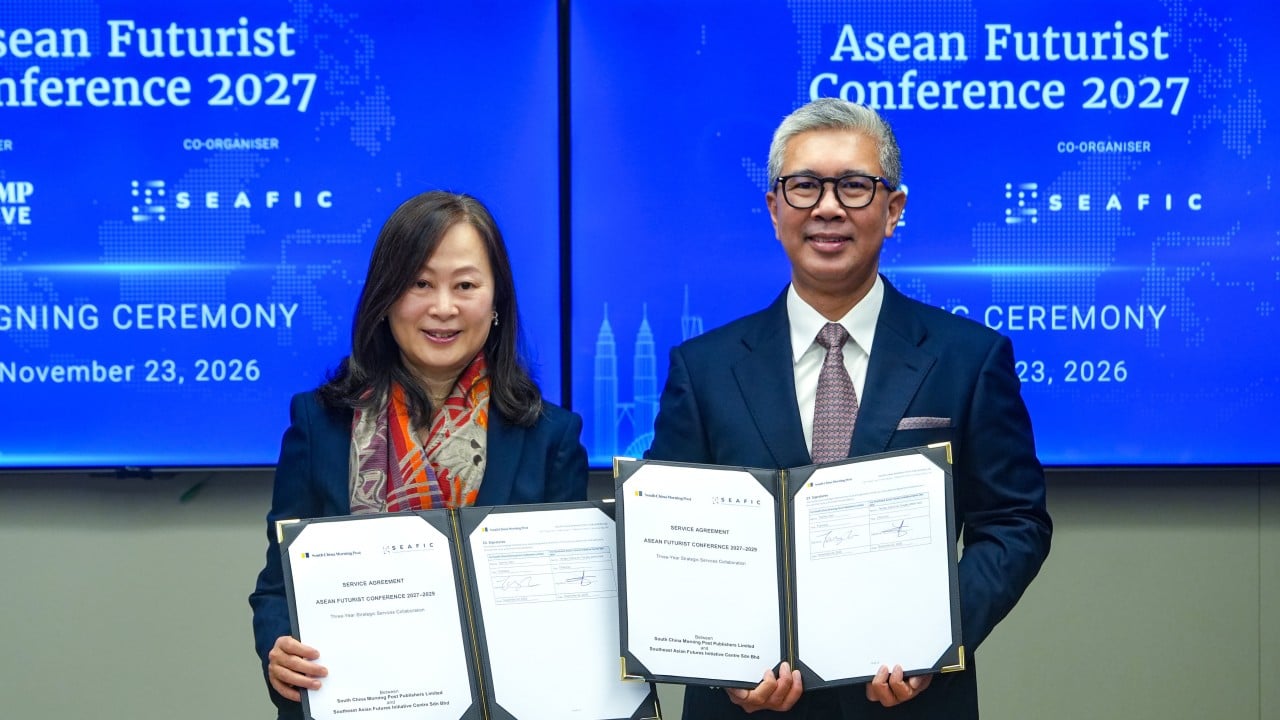
Consider a headline that crossed the wires recently: the South China Morning Post and the Southeast Asia Fiction Film Lab, better known as SEAFIC, signed a three-year agreement to co-host the Asean Futurist Conference. On paper, it reads like standard corporate housekeeping. Two organizations agree to throw an event together for thirty-six months. You scan the names, register the dates, and move on to whatever crisis is unfolding in your feed.
Stop. Look closer at what just happened in that room. Further insight on the subject has been published by E! News.
To understand why a legacy Hong Kong newspaper and an indie filmmaking lab just locked arms for three years, you have to leave the air-conditioned ballroom behind. You have to travel to a cramped, humid editing suite in Manila, or a noisy coffee shop in Jakarta where a twenty-eight-year-old director is staring at a spreadsheet that refuses to balance.
The Invisible Wall Around Southeast Asian Stories
Let us invent a filmmaker to make this concrete. Call her Maya. Maya lives in Ho Chi Minh City, and she has spent four years writing a screenplay about three generations of women running a floating market stall on the Mekong Delta. It is funny, devastating, and smells like river mud and star anise.
Maya does not lack talent. She lacks a bridge.
For decades, if Maya wanted money to shoot her film, she faced a brutal, unspoken reality. Local studios in Vietnam might tell her the story is too quiet, too art-house to fill multiplex seats on a Friday night. Meanwhile, European film funds—the traditional lifelines for Southeast Asian auteurs—might ask her to make the river feel more exotic, or lean harder into political trauma to satisfy festival programmers in Berlin or Cannes. Between domestic commercial demands and Western festival expectations, authentic Southeast Asian cinema gets squeezed into a narrow corridor.
I spent years covering independent production across Asia, and I have watched dozens of real-life Mayas burn out in that exact corridor. You sit across from them at film markets in Busan or Hong Kong, watching the light behind their eyes dim as they pitch the same project for the fourteenth time to an executive who is checking his phone under the table. The tragedy of Southeast Asian cinema has never been a scarcity of stories. Home to nearly 700 million people, dozens of languages, and some of the fastest-growing economies on earth, the region is an engine of raw human drama. The tragedy has always been distribution, capital, and translation—not of words, but of cultural context.
That is where SEAFIC enters the picture. Founded in 2016 by producer Raymond Phathanavirangoon, the Southeast Asia Fiction Film Lab became an unlikely sanctuary for directors like Maya. Unlike traditional markets that treat scripts like commodities to be traded in fifteen-minute speed-dating sessions, SEAFIC operated like a greenhouse. It brought first- and second-time filmmakers from Thailand, Indonesia, the Philippines, Malaysia, Vietnam, Singapore, Myanmar, Cambodia, and Laos together for intensive, months-long script development. It cared about the soul of the story before anyone talked about box office projections.
Yet even the best greenhouse cannot change the weather outside. Once a SEAFIC filmmaker finished a brilliant script, they still had to step out into the storm of global financing, emerging technologies, and shifting audience habits.
Why a Newspaper Needed a Film Lab
Now look at the other half of this three-year marriage: the South China Morning Post.
For over a century, SCMP has been the newspaper of record in Hong Kong, chronicling the rise of Asian capitalism, geopolitical tremors, and the shifting tides between China and the rest of the world. In recent years, however, traditional journalism has faced an existential reckoning. Readers do not just want daily dispatches anymore; they want convening power. Media companies survive by becoming platforms where industries gather to figure out what happens next.
Why would a powerhouse news organization care about an independent Southeast Asian film lab?
Follow the money. And follow the demographics.
Global entertainment is undergoing a tectonic shift. Western audiences, once famously allergic to subtitles, spent the last decade devouring Korean television, Japanese anime, and Indian blockbusters. Streaming platforms poured billions into Asia, hunting for the next global phenomenon. Yet while Seoul and Tokyo became saturated, high-cost production hubs, investors began looking south. ASEAN—the Association of Southeast Asian Nations—suddenly looked like the last great untapped creative frontier.
SCMP possesses what SEAFIC never had: massive institutional reach, direct lines to corporate boardrooms, sovereign wealth decision-makers, and tech executives across Greater China and the broader Asia-Pacific. SEAFIC, in turn, holds what money cannot easily buy: street-level credibility, deep artistic trust, and early access to the brightest creative minds across ten distinct nations.
When you put them together for three years to host the Asean Futurist Conference, you are not just planning an annual seminar. You are building an intentional collision between people who hold the capital and people who hold the culture.
The Architecture of a Three-Year Bet
A one-off conference is a party. A three-year commitment is infrastructure.
Think about how long it actually takes to make a movie or launch a media venture in Southeast Asia. From the moment a writer types "Fade In" to the night an audience sits in a dark theater, three years is the bare minimum. By locking in a multi-year timeline, SCMP and SEAFIC are signaling to bankers, tech founders, and studio heads that this is not a tourist excursion into ASEAN culture.
Imagine what happens inside the Asean Futurist Conference when it works as intended.
In one corner of the room, an artificial intelligence entrepreneur from Shenzhen is demonstrating new localization tools that can dub a Tagalog dialogue track into Mandarin or English while preserving the original actor's vocal timbre and emotional cadence. Ten feet away, a Filipino producer who has struggled for a decade to get her films screened outside Manila is listening intently. Suddenly, the language barrier that kept Southeast Asian cinema fragmented into isolated national islands begins to look porous.
Elsewhere on the schedule, panels dissect the brutal economics of regional co-productions. How do you structure tax incentives when a film is shot in Malaysia, edited in Thailand, and financed out of Singapore and Hong Kong? Historically, those questions required expensive lawyers and months of trial and error. Here, they become shared playbooks.
Skepticism is healthy here. Anyone who has attended enough industry summits knows how easily "futurist" conferences slide into empty techno-utopianism. Tech evangelists love to lecture artists about how algorithms will replace intuition, while artists roll their eyes and retreat to the bar. There is a real risk that bringing corporate media executives and indie filmmakers under one roof creates friction rather than fuel.
I have felt that friction firsthand. There is a distinct discomfort when you watch a sensitive documentary filmmaker try to explain the nuance of rural displacement to a venture capitalist who measures human attention in fifteen-second retention metrics. Sometimes the two languages simply do not translate. You wonder if the corporate machine will end up flattening the very weirdness that makes Southeast Asian art worth watching in the first place.
What Happens When the Lights Dim
Yet the alternative—keeping those worlds hermetically sealed from one another—is worse.
When artists stay locked out of rooms where capital and technology are debated, other people design their future for them. Streaming algorithms dictate which stories get greenlit. Foreign studios buy up local intellectual property on the cheap, strip out the cultural specificity, and sell it back to the region as homogenized filler.
By co-hosting the Asean Futurist Conference, SEAFIC ensures that the filmmakers are not merely invited to perform on a panel for decoration; they are co-architects of the agenda. They get to ask the uncomfortable questions about copyright, cultural ownership, and fair revenue sharing before the rules of the next decade are cast in concrete.
Think back to Maya, our hypothetical Vietnamese director with the script about the Mekong floating market.
Without a bridge, her story stays trapped on a hard drive in Ho Chi Minh City, read by twelve friends and rejected by three cautious local distributors. With the kind of ecosystem this partnership aims to wire together, a different chain reaction becomes possible. Maya refines her script through SEAFIC's rigorous mentorship. At the conference, she meets an executive producer from Hong Kong who recognizes that the emotional core of a mother-daughter business rivalry plays just as powerfully in Kowloon or Kuala Lumpur as it does in Can Tho. A regional tech partner steps in with post-production support. Suddenly, a hyper-local story has a Pan-Asian runway.
None of this happens overnight. Press releases are tidy; cultural shifts are messy, slow, and full of false starts. Three years from now, there will be no single metric on a spreadsheet that captures every quiet conversation sparked in the hallways of the Asean Futurist Conference.
You will only know it worked years later, when you sit in a darkened theater thousands of miles away, watching a film spoken in a language you do not understand, feeling your throat tighten at a story that almost never got told.