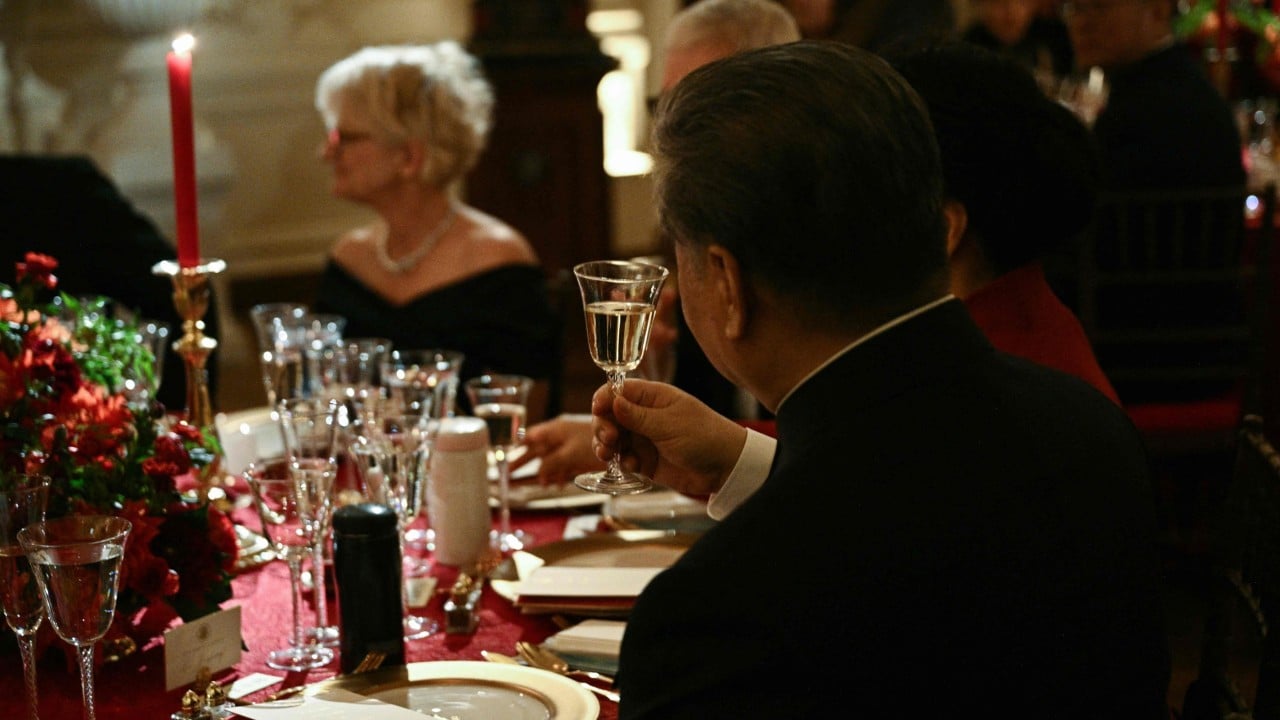
Watch the hands of a head of state when the cameras stop clicking.
At a White House state dinner, every millimeter of the table is choreographed months in advance. The weight of the sterling silver forks, the angle of the crystal goblets, the exact vintage of California Pinot Noir poured by white-gloved servers—all of it is designed to project effortless hospitality and subtle dominance. Yet, during the high-stakes diplomatic dinners between Washington and Beijing, sharp-eyed observers noticed a jarring anomaly sitting right beside the immaculate White House glassware. Meanwhile, you can read related events here: Inside the Italian Classroom Decree That is Upending European Integration Politics.
A thermos.
Not a crystal decanter, and certainly not an official presidential goblet. It was a personal, insulated flask belonging to Chinese President Xi Jinping, paired with another for First Lady Peng Liyuan, quietly tended by their own aides amid the gilded splendor of the East Room. To see the full picture, check out the excellent article by Associated Press.
To the casual observer scrolling past a viral photograph, it looked like an eccentric quirk, maybe even a mild breach of diplomatic etiquette. Why bring a travel mug to a palace? Why reject the finest culinary hospitality the United States government can muster?
Look closer. That modest cylinder of stainless steel and vacuum-sealed insulation is neither an accident nor an insult. It is a physical manifestation of a thousand-year-old survival instinct, a high-level security protocol, and a deeply human ritual that bridges the gap between an ordinary factory worker in Shenzhen and the most powerful leader in Beijing.
The Architecture of Absolute Paranoia
To understand the flask, you first have to understand the terrifying vulnerability of eating someone else's food when your life shapes the trajectory of a billion people.
Consider a hypothetical scenario. Imagine you are an intelligence director tasked with keeping a superpower's leader alive on foreign soil. You can sweep a hotel suite for listening devices in four hours. You can line a motorcade route with counter-snipers, weld manhole covers shut along Pennsylvania Avenue, and surround a banquet hall with concentric rings of armed agents. Every external threat can be mapped, measured, and neutralized with steel and surveillance.
Except for the one threat the target willingly puts inside their own body.
In the shadow world of executive protection, poison is the ultimate equalizer. It requires no breach of a perimeter, no gunfire, and no immediate confrontation. Historically, from the silver tasting spoons of European monarchs to the dedicated food-testing laboratories of the Kremlin, empires have lived in perpetual dread of the banquet table.
When a Chinese leader travels abroad, they do not simply pack a suitcase; they export a closed-loop biological ecosystem. The Central Security Bureau—the elite bodyguard unit responsible for the Zhongnanhai leadership compound—operates on a doctrine of zero trust. Before a single grain of rice touches a plate at a foreign summit, dedicated teams inspect the kitchens, vet the supply chains, and test the ingredients.
Yet, at a White House state dinner, the host controls the kitchen. The Secret Service and White House culinary staff guard that territory fiercely. Bringing a personal food taster to the head table is a diplomatic non-starter; it screams distrust in front of the global press.
So, how do you solve an impossible security dilemma without causing an international incident? You bring your own drink.
By having personal aides pour exclusively from sealed, pre-vetted flasks—and ensuring those aides maintain an unbroken chain of custody over the vessels—the security detail eliminates the single easiest vector for covert contamination. Nobody slips anything into a glass when the glass is filled from a bottle that never leaves a bodyguard's sight.
It is brilliant. It is silent. And it turns a potential assassination vector into an innocent-looking beverage preference.
The Myth of Cold Water
Still, reducing the thermos solely to cloak-and-dagger espionage misses half the story—and arguably the more revealing half. If security were the only motive, the aides could simply bring bottled spring water. Instead, they bring insulated flasks filled with piping hot water or steeped tea.
To an American palate conditioned to clinking ice cubes in every glass from January to December, the sight of a world leader sipping scalding water during a formal dinner feels baffling. I remember the first time I spent an autumn in Beijing, shivering on a train platform while nursing a brutal head cold. When I asked a local colleague where to find cold water, he looked at me as if I had asked for a glass of motor oil. He unscrewed the lid of his battered metal thermos, poured a capful of steaming water, and told me that cold liquids shock the stomach and steal the body's internal fire.
That belief is not a passing wellness trend. It is the bedrock of daily life across China, rooted in centuries of Traditional Chinese Medicine and reinforced by modern history.
In traditional medical philosophy, the human body is a delicate balance of yin and yang—cool and warm energies. The digestive system is viewed as a cooking pot that requires warmth to transform food into energy. Pouring ice water into that pot is thought to extinguish the digestive fire, leading to fatigue, poor circulation, and vulnerability to illness. For generations, Chinese children have been taught that warm water cures everything from a minor headache to menstrual cramps to the onset of a flu.
Then came the twentieth century, which turned a cultural preference into a public health mandate.
During the early decades of the People’s Republic of China, municipal water systems were fragile, and waterborne diseases like cholera and typhoid posed lethal threats. In the 1950s, the government launched massive public hygiene campaigns urging citizens to boil all drinking water before consumption. Boiling killed the pathogens. Keeping that boiled water hot in a vacuum flask—the iconic baowenbei—meant you had safe hydration all day long.
The thermos became an essential household appliance, right alongside the bicycle and the sewing machine. Factories installed giant communal boilers so workers could refill their flasks during shifts. Train cars featured hot water dispensers at the end of every aisle.
When Xi Jinping steps up to a podium at the Great Hall of the People, or sits beside the President of the United States, a server reliably places a lidded porcelain teacup or a sleek flask within reach. For Xi, who spent seven formative years living in cave dwellings and working alongside farmers in the rural village of Liangjiahe during the Cultural Revolution, the habit is muscle memory. A man raised in the rugged, freezing winters of Shaanxi province does not suddenly develop a taste for iced sparkling water just because he moved into Zhongnanhai.
The Choreography of the Cup
Watch the footage of any major diplomatic summit involving Beijing, and you will see a fascinating ballet unfold around those flasks.
In diplomacy, nothing happens by chance. Every gesture is a signal meant to be read by domestic audiences back home and foreign adversaries across the table. When Western leaders attend a state banquet, they raise crystal glasses of wine to toast friendship, prosperity, and cooperation. Alcohol has long been the lubricant of statecraft, designed to lower inhibitions and foster camaraderie.
China has its own potent version of diplomatic alcohol: baijiu, specifically the fiery, sorghum-based Kweichow Moutai that famously fueled the 1972 banquets between Richard Nixon and Zhou Enlai. Back then, Zhou used glass after glass of Moutai to project vigor, hospitality, and fearlessness.
Times have changed. Decades of relentless anti-corruption campaigns inside China have stripped away the culture of lavish, alcohol-soaked official banquets. Excess is out; discipline is in.
Today, when Xi Jinping raises a glass at a White House dinner, he participates in the ceremonial toast—often taking only a polite, microscopic sip—before returning to his personal thermos. To his domestic audience watching the evening news on CCTV, that visual sends an unmistakable message. It says: Our leader is grounded. He is disciplined. He may be dining in the palace of the world's other superpower, surrounded by foreign luxury, yet his habits remain identical to yours.
Think about the emotional resonance of that image. A retired teacher in Chengdu or a civil servant in Wuhan sees the paramount leader drinking from the exact same type of insulated flask sitting on their own kitchen counter. In a political system where the top leadership is largely opaque and physically isolated from the public, shared daily rituals become vital threads of legitimacy. The thermos humanizes the untouchable.
At the same time, look at what that flask communicates to the host across the table.
Diplomacy is an arena of subtle psychological leverage. When you enter another leader's house, you play by their rules. You sit in their chairs, eat their menu, and listen to their orchestra. By placing a personal thermos on the table, the guest quietly reclaims a sliver of territory. It is a polite, undeniable assertion of autonomy: We are here to talk, we respect your hospitality, but we remain entirely self-contained.
The Hidden Mechanics of Statecraft
It is easy to mock the rigid protocols of international summits until you realize what happens when those protocols fail.
History is littered with leaders incapacitated at the worst possible moments by something as mundane as a stomach bug or an allergic reaction. When you are negotiating trade tariffs worth hundreds of billions of dollars, or trying to prevent a miscalculation in the South China Sea, cognitive clarity is everything. Jet lag alone degrades human decision-making; add an unfamiliar, rich Western banquet menu—heavy on dairy, butter, and raw ingredients—and you have a recipe for physical misery.
State dinners are endurance tests disguised as parties. After hours of closed-door bilateral meetings, press conferences, and formal arrivals, a leader has to sit upright under blinding lights, make small talk through interpreters, and stay sharp enough to avoid verbal traps.
Hydration is fuel. Warm tea or hot water soothes vocal cords strained by hours of speaking, settles a jet-lagged stomach, and keeps the mind steady without the crash of sugar or the fog of alcohol.
I used to think protocol officers were overly dramatic people obsessed with seating charts and napkin folds. Then I watched a live broadcast of an international summit where a world leader suffered a violent coughing fit mid-speech, gasping for air while scrambling for a glass of water that wasn't there. The silence in that room was agonizing. Authority evaporates in seconds when the human body betrays you on a global stage.
That is why the aides hover just out of frame. In Beijing’s diplomatic protocol, the tea attendant—often a highly trained, discreet official—moves with the precision of a surgeon. At precise intervals, they step forward, uncap the personal flask, refill the cup, and vanish before a photographer can ruin the composition.
There is no fumbling. There is no improvisation. Even the temperature of the liquid is calibrated so the leader never burns their tongue on live television.
The Weight of a Simple Object
We live in an era obsessed with high-tech spectacle. We analyze satellite imagery of naval fleets, dissect lines of artificial intelligence code, and track semiconductor supply chains to gauge the balance of power between Washington and Beijing. We look for grand, sweeping indicators of intent.
Yet, often, the clearest window into how a nation thinks is sitting right in plain sight on a linen tablecloth.
The next time a photograph surfaces from a high-stakes summit—whether in Washington, San Francisco, Paris, or Beijing—ignore the flags in the background for a second. Look past the tailored suits and the practiced smiles.
Find the stainless-steel cylinder resting beside the crystal wine glass.
Inside that quiet, unassuming flask sits a convergence of worlds: the ancient medical wisdom of balancing inner heat, the collective memory of a nation learning to boil water to survive, the ruthless pragmatism of modern intelligence services guarding against invisible threats, and the quiet insistence of a superpower refusing to let anyone else pour its cup.


