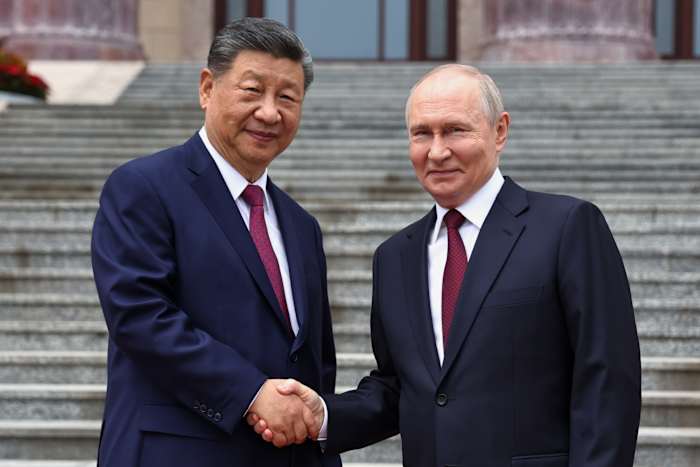
Vladimir Putin didn't just go to Beijing for the tea and the 21-gun salute. He went because, frankly, he doesn't have many other places to go. Meeting with Xi Jinping on Wednesday, the optics were exactly what you'd expect: two "old friends" hailing a "new era" of ties and a "multipolar world." But if you look past the red carpets and the 47-page joint statement, the math tells a much more lopsided story.
Russia is leaning on China as its primary economic lifeline, yet Beijing is playing a very careful, very calculated long game. It’s a partnership of necessity, but China is the one holding the checkbook.
The Energy Trap No One Mentions
The headline from the summit was all about "growing energy trade." Putin was quick to point out that Russia is a "reliable supplier" while China is a "responsible consumer." Translated from diplomat-speak, that means Russia has a lot of oil and gas it can't sell to Europe anymore, and China is happy to take it—at a massive discount.
By the start of 2026, the Power of Siberia 1 pipeline hit its full capacity of 38 billion cubic meters (bcm) a year. That’s great for Gazprom on paper, but it’s a drop in the bucket compared to what Russia used to send to the EU. The real prize Putin wants is the Power of Siberia 2 pipeline. This project would cut through Mongolia and pump another 50 bcm into northern China.
Here’s the catch: Xi hasn't signed the dotted line on the final construction. Why? Because China doesn't actually need it yet. Beijing is diversifying its energy like a paranoid hedge fund manager. They’re buying LNG from the Middle East, expanding domestic coal, and watching the Iran war drive up prices while they sit back and wait for Russia to offer a lower price. Russia needs the cash now; China can wait for a bargain.
The Reality of the Trade Numbers
You’ll hear officials brag about bilateral trade hitting $240 billion. It sounds impressive until you look at the 2025 dip. Last year, trade actually fell by nearly 7% because of cooling oil prices and "payment friction."
"Payment friction" is a polite way of saying Chinese banks are terrified of Western secondary sanctions. Even though 99% of their trade is now settled in yuan and rubles, Chinese companies don't want to get locked out of the US dollar system. It’s an awkward reality:
- China's share of Russia's new car market is over 50%.
- Chinese smartphones dominate Russian pockets.
- Russia is now China’s second-largest soybean supplier.
But the moment a Russian transaction looks like it might trigger a US Treasury warning, Chinese banks suddenly get very slow to process the paperwork. Xi is a friend, but he's not a martyr for the Russian economy.
Security and the Multipolar Mirage
The joint declaration signed Wednesday focused heavily on building a "multipolar world," a direct jab at the US. It’s a convenient narrative for both leaders. For Putin, it’s proof he isn't isolated. For Xi, it’s a way to signal to Washington—just days after Donald Trump’s visit to Beijing—that China has options.
The "no limits" partnership actually has quite a few limits. While China has ignored Western demands to stop shipping dual-use goods (the kind that end up in Russian drones and tanks), they haven't sent actual "lethal aid." Xi wants Russia to stay stable and keep the West distracted, but he doesn't want to get dragged into the mud himself.
What This Means for the Global Market
If you're looking at where this goes next, don't expect a sudden explosion of Russian wealth. Expect a slow, steady absorption of the Russian economy into the Chinese sphere of influence.
- Energy Prices: Russia will continue to be a price-taker. Since they can't easily send gas elsewhere, China will dictate the terms of the Power of Siberia 2 deal.
- The Yuan's Rise: The "de-dollarization" of Eurasia is real. With nearly 40% of Russian international trade now in yuan, the ruble is essentially becoming a satellite currency.
- Logistics: Watch the Arctic. China is increasingly interested in the Northern Sea Route, which Russia controls. It’s a shortcut to Europe that avoids the Suez Canal, and it's a key part of their long-term infrastructure play.
Putin’s visit to Beijing was a success in terms of theater, but it also highlighted his lack of leverage. He’s selling the family silver to the neighbor to keep the lights on. Xi is buying it, but only at the price he chooses.
To stay ahead of these shifts, watch the specific language used in the coming months regarding the "Mongolian route" for gas. If a firm date isn't set by the end of the year, it's a sign that Beijing is still squeezing Moscow for a better rate. Don't be fooled by the smiles; this is a business transaction, and the terms are strictly in favor of the House of Xi.