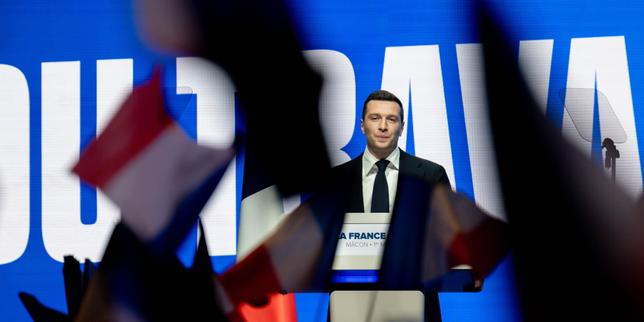
The French far right is trapped in a geopolitical contradiction it can no longer hide. While Marine Le Pen and Jordan Bardella attempt to project the image of a responsible, government-ready party, a pro-Russian front page from the newly launched right-wing weekly JDNews has shattered the illusion of a unified nationalist front. The National Rally (RN) is trying to execute a high-stakes balancing act between its historical, financial, and ideological ties to Moscow and its desperate need for mainstream credibility. This strategy is failing because Moscow keeps forcing its hand.
For years, the RN operated on a simple premise. They could praise Vladimir Putin's defense of traditional values while dismissing concerns about Russian expansionism as transatlantic paranoia. The 2022 invasion of Ukraine made that position untenable. The party spent two years scrubbing its past, repaying its infamous €9.4 million Russian bank loan, and voting for symbolic support for Kyiv in the European Parliament.
Then came JDNews, a media property controlled by billionaire Vincent Bolloré. When the publication ran a cover story echoing Kremlin talking points and framing Russia's position with distinct sympathy, it tore open the stitched-up wounds of the French nationalist movement. It forced Le Pen's strategists to confront a brutal reality. They cannot control the broader ecosystem they rely on for political momentum.
The Geopolitical Double Game Falls Apart
The core of the RN's current crisis lies in its split-screen messaging. In Paris, Jordan Bardella presents himself as a modern statesman. He speaks of supporting Ukrainian sovereignty and maintaining France's defense commitments. In Brussels and Strasbourg, the party's representatives frequently abstain from or vote against concrete defense packages, sanctions, or financial aid to Kyiv.
This double game is not just a tactical choice. It is a structural necessity for a party divided between two distinct voter bases. On one side are the older, security-minded conservatives who view Russia as a historical threat to Europe. On the other side sits a radicalized core that views Putin as a bulwark against globalism and progressive social policies.
When a major right-wing media outlet like JDNews openly breaks ranks to signal alignment with Moscow, the RN loses its strategic ambiguity. It is forced to choose. Aligning with the pro-Russian sentiment alienates the moderate swing voters needed to win a presidential runoff. Condemning it risks alienating the hardline base and fracturing the conservative media empire that has spent years laundering the party’s ideas into the mainstream.
The Illusion of Delinking from Moscow
Party leadership insists the RN has evolved. They point to the liquidation of the First Czech-Russian Bank loan as proof of their independence. This argument ignores the deeper ideological infrastructure that binds European nationalism to Russian influence networks.
Money was only ever a symptom. The real connection is a shared vision of a fragmented Europe. Moscow seeks a continent of atomized nation-states, stripped of the collective security guaranteed by NATO and the economic cohesion of the European Union. The RN’s platform, despite its recent softening, still calls for a radical reduction of French participation in EU mechanisms and a withdrawal from NATO’s integrated military command. The goals remain functionally aligned, even if the rhetoric has been sanitized for television.
The Vincent Bolloré Factor and Media Alignment
The emergence of JDNews as a geopolitical wild card highlights a shift in the French media landscape. The concentration of media properties under conservative industrialist Vincent Bolloré has created a powerful echo chamber for right-wing ideas. This network has largely benefited the RN by normalizing its positions on immigration, national identity, and law and order.
Geopolitics complicates this alliance. The editorial line of these new media properties does not always answer to the electoral timeline of the RN. A media apparatus built on outrage and ideological purity needs to feed its audience high-octane contrarianism. Pro-Russian sentiment serves as the ultimate anti-establishment posture.
[Traditional Right] ----> Focuses on National Sovereignty & Defense
       |
       v
[The RN Tightrope] <----> Balancing Voter Legitimacy vs. Ideological Roots
       ^
       |
[Bolloré Media]    ----> Pushes Anti-Establishment / Pro-Kremlin Narratives
This creates a structural vulnerability for Le Pen. She has spent a decade building a disciplined party apparatus where dissent is ruthlessly suppressed. Yet, she cannot discipline the media barons who fund her ideological ecosystem. When a publication in that ecosystem decides to validate Kremlin narratives, the RN is dragged back into a debate it desperately wants to avoid.
The Congressional Trail of Breadcrumbs
The vulnerability is magnified by ongoing institutional scrutiny. In Paris, parliamentary investigations into foreign interference have repeatedly flagged the RN’s historical links to Russian state actors. These are not merely historical footnotes. They are active political liabilities that opponents weaponize during every legislative cycle.
Every time a friendly media outlet runs a headline sympathetic to Moscow, it validates the warnings found in these official reports. It reminds the French electorate of the many RN officials who traveled to Crimea as "election observers" following the 2014 annexation. It recalls the public statements of admiration that Le Pen has never fully been able to contextualize away.
The Strategic Failure of Normalization
The RN's path to the Élysée Palace relies entirely on the concept of dédiabolisation—de-demonization. The strategy dictates that the party must appear boring, predictable, and safe. It must look like a standard conservative government-in-waiting.
A pro-Russian foreign policy is none of those things. For the French business elite and the upper-middle-class voters who decide presidential elections, an alignment with an aggressive, revisionist power in Eastern Europe represents an existential risk to economic stability and national security. It represents chaos.
The JDNews controversy proves that the RN’s normalization is skin-deep. The party can dictate what its deputies wear to the National Assembly. It can edit its policy manifestos to remove explicit calls to leave the euro currency. But it cannot suppress the underlying ideological currents of its movement. The pro-Russian sentiment within the French far right is not a legacy issue fading into the past. It is an active, living component of the movement's identity.
The Cost to European Alliances
This internal tension has devastating consequences for the RN’s international ambitions. To govern effectively, Le Pen needs allies across Europe. She has spent considerable effort courting figures like Italy’s Giorgia Meloni, who has successfully transitioned from a radical nationalist to a reliable Atlanticist partner on the global stage.
Meloni’s success was built on a fierce, unambiguous rejection of Moscow’s aggression. She recognized that entry into the Western governing elite requires total compliance on matters of collective security. By failing to police its own ecosystem and allowing pro-Kremlin rhetoric to pollute its space, the RN signals to potential allies in Rome, Brussels, and Washington that it remains an unreliable partner. It remains a wild card in a continent that is currently rearming for a prolonged confrontation with Russia.
The Deep Roots of Nationalist Russophilia
To understand why the RN cannot simply cut ties with Moscow, one must look at the intellectual foundation of the French far right. This is not a marriage of convenience. It is a long-standing ideological romance based on a shared rejection of the post-Cold War liberal order.
For decades, nationalist theorists in France have viewed Russia not as a geopolitical adversary, but as the last superpower capable of resisting Western decadence. They see Moscow as a defender of Christian civilization, national sovereignty, and patriarchal social structures against the perceived excesses of American cultural dominance and European technocracy.
This worldview is deeply embedded in the party's cadre of advisers, regional officials, and intellectual backers. You can change the party logo. You can change the name from Front National to Rassemblement National. You cannot erase the intellectual DNA of the people who staff the movement. When an outlet like JDNews publishes a pro-Russian piece, it is not an error. It is the spontaneous re-emergence of the movement's true conviction, breaking through the carefully applied veneer of political respectability.
The Coming Clash with Reality
The RN is running out of time to resolve this contradiction. As the war in Ukraine drags on and European defense budgets rise, the space for strategic ambiguity is shrinking to zero. Every vote in Paris and Brussels will be scrutinized. Every media appearance will become a cross-examination on foreign policy.
The party’s current strategy of silence, defection, and rapid news-cycle management is hitting its limit. They can no longer pretend that their international policy doesn't matter to domestic voters. Security is no longer an abstract concept debated in foreign policy think tanks. It is a kitchen-table issue tied to energy prices, inflation, and national defense.
Le Pen's silence on the JDNews controversy is telling. It is the silence of a politician who knows that any decisive move will trigger a crisis. To condemn the coverage is to declare war on the very media empire helping her reach power. To defend it is to abandon the centrist voters she needs to win that power. The RN is discovered to be immobile, frozen on a geopolitical fault line of its own making, waiting for the ground to shift beneath its feet.


