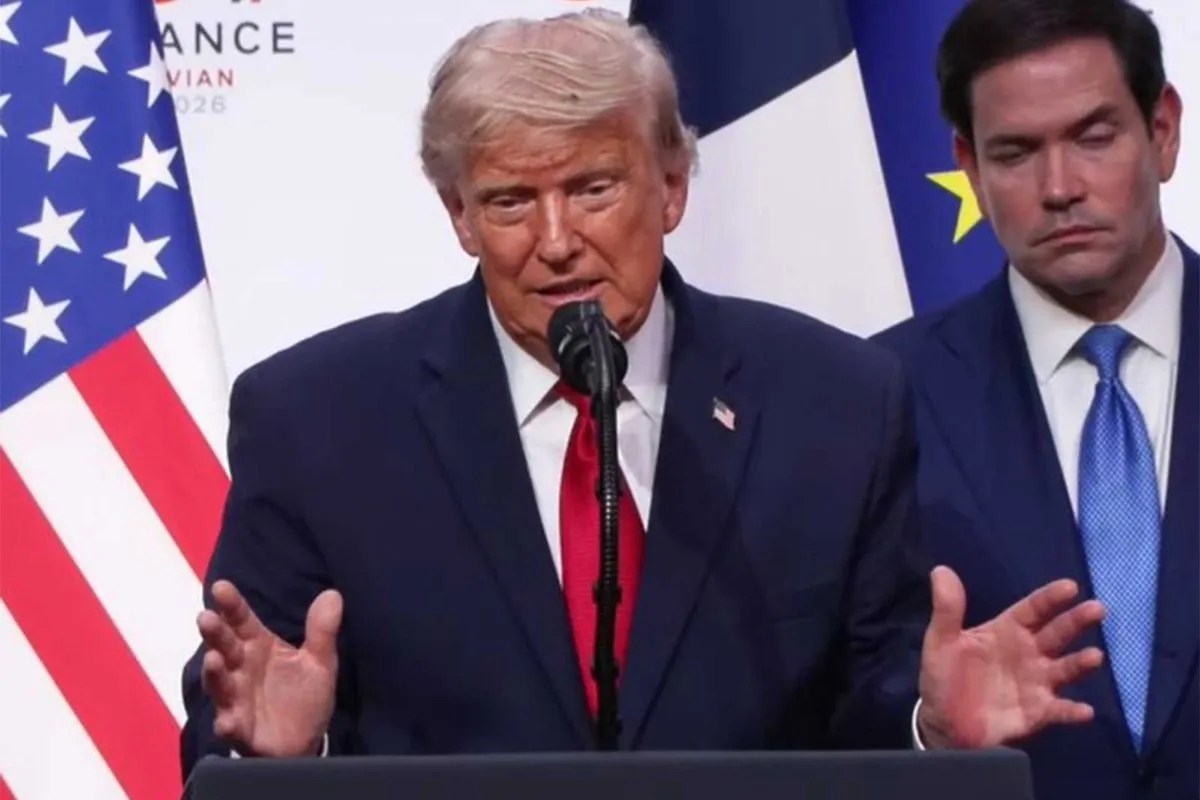
The rain in Versailles did not care about geopolitics. It fell in heavy, unblinking sheets, slicking the cobblestones of the palace where treaties once reshaped the world. Stepping out into the damp June air, leaving behind a dinner with the French president, Donald Trump paused. The cameras caught him—hunched against the chill, eyes narrowed.
A reporter shouted a question through the downpour, a question about billions of dollars, frozen bank accounts, and a country the United States had spent months pushing to the brink.
Trump did not offer a grand ideological defense. He did not speak of spreading democracy or punishing tyrants. Instead, he leaned into the microphone and spoke with the cold, transactional clarity of a man who views the entire global order not as a temple of values, but as a ledger.
"It’s not our money, it’s their money," Trump said, his voice flat against the rumble of idling engines. "And we froze it at a certain point in time. I guess we’re going to have to give it back, you know. If we didn’t give it back, nobody would ever invest in the dollar again."
It was a staggering admission. It was the sound of an empire recalculating the cost of its own leverage.
To understand how we arrived at this rain-slicked courtyard in France, you have to look past the dense, multi-page memorandums of understanding signed by diplomats. You have to look at what happens when the invisible machinery of global finance grinds against the raw, desperate reality of human survival.
Consider a hypothetical merchant in Tehran—let us call him Farhad. Farhad does not build ballistic missiles. He does not sit on the Supreme National Security Council. He sells spare automotive parts from a cramped stall in the Grand Bazaar. For months, as the war dragged on and the Strait of Hormuz remained choked by blockades, Farhad watched his world shrink. The price of milk doubled, then tripled. The medicine his mother needed for her heart vanished from the shelves, trapped behind a wall of international sanctions.
Farhad’s reality is the quiet, grinding friction that numbers on a spreadsheet never capture. When an economy is suffocated, it is not the regime that starves first; it is the bazaar. The Trump administration knew this. The strategy was total pressure. But pressure, like any physical force, creates an equal and opposite reaction.
The breakthrough did not happen because either side suddenly found their moral compass. It happened because the alternative was a collapse too massive for even the world's largest economy to absorb. Since February, when the conflict effectively shut down the primary artery handling 20 percent of the world’s petroleum, global energy markets have been screaming. Gas stations from Ohio to Osaka felt the squeeze.
But the real problem lies elsewhere, buried deep within the architecture of global trust.
When the United States freezes the assets of a foreign central bank—in this case, an estimated $24 billion locked away in international vaults—it is executing the ultimate financial power move. It is telling the world that your wealth is only yours so long as you behave. For decades, the global financial system accepted this because the American dollar was the only game in town. It was safe. It was absolute.
But trust is a fragile thing. Weaponize it too often, and the illusion begins to crack.
Imagine a room full of central bankers in Beijing, New Delhi, or Brasilia watching Washington freeze billions at the stroke of a pen. They don't just see a rogue nation being punished. They see a precedent. They begin to wonder: If our interests align against Washington tomorrow, will our reserves vanish next?
That is the invisible stake Trump acknowledged in Versailles. The American dollar retains its throne only because the rest of the world believes the bank won't arbitrarily lock the doors. If that belief dies, the dollar dies with it. The decision to unfreeze Iran's assets was not a gesture of goodwill; it was an act of self-preservation for the greenback.
Naturally, the deal has ignited a firestorm back home. Critics view the 14-point memorandum as a humiliating retreat, arguing that Washington is capitulating just as the pressure was peaking. Vice President JD Vance scrambled to control the narrative, insisting that no actual American tax dollars are being handed over and that the funds will only flow as a reward for verified compliance. "They're not getting a single dime of American money," Vance clarified, trying to soothe a restless political base ahead of the midterm elections.
The mechanics of the deal are structured like a high-stakes poker game where neither player trusts the cards. Under the interim framework, the release of the $24 billion is not an upfront lump sum. It is tied to a strict 60-day timeline. Half is positioned on the table as a guarantee; the rest is contingent on Iran gradually reopening the Strait of Hormuz and allowing inspectors to verify the diluting of its enriched uranium stockpile.
Then there is the staggering $300 billion reconstruction fund mentioned in the draft. It sounds like a massive payout, a Western-funded Marshall Plan for a bitter adversary. But the truth is more nuanced. The United States isn't writing that check. Instead, the agreement promises to lift the secondary sanctions that have long terrified European, Asian, and Gulf investors. It allows third-party capital—money from Dubai or Shanghai—to flow back into Iranian infrastructure without the fear of American retribution.
It is a gamble born of exhaustion. The war had reached a point of diminishing returns. Washington realized that a nation of 91 million people pushed into absolute starvation does not surrender; it explodes.
The deal is far from a permanent peace. It is a fragile, 60-day breathing room bought with frozen cash and mutual suspicion. Hardliners in Tehran are already screaming that their leadership retreated too early; politicians in Washington are shouting that the president gave away the house.
But back in the Grand Bazaar, the calculus is entirely different. For the people who actually inhabit the numbers on the ledger, the news from Versailles isn't about geopolitical dominance or the strength of the reserve currency. It is the sound of a shutter lifting. It is the distant, uncertain hope that tomorrow, the price of bread might stop rising.
Trump’s words will linger long after the rain dries in France. By admitting that the money belonged to Tehran, he stripped the romanticism from American foreign policy, leaving behind only the raw framework of global commerce. We are left with a stark reminder of how the modern world functions: even the most powerful empire on earth must eventually pay its debts to the system that keeps it rich.


