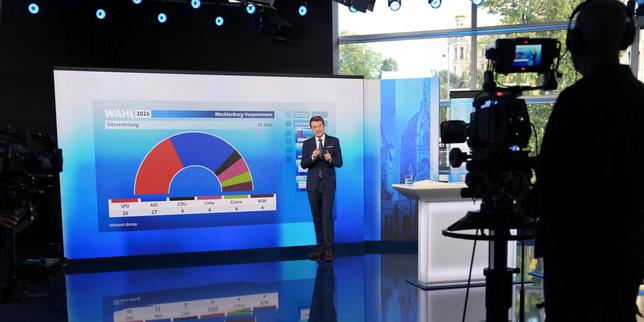
Politics in Germany just broke. If you thought the traditional party system was merely bending under pressure, the state election in Mecklenburg-Western Pomerania proved you completely wrong. The Alternative for Germany surged to victory, pulling in an incredible 38.2 percent of the vote. But that headline-grabbing number only scratches the surface of a much deeper institutional crisis.
The real shocker wasn't just the rise of the right. It was the total collapse of Chancellor Friedrich Merz’s Christian Democratic Union. For the first time in post-war German history, a major mainstream governing party crashed below the five percent electoral threshold, landing at a dismal 4.9 percent and getting booted out of the state parliament entirely. This isn't just a regional upset. It's a flashing red warning light for the entire political establishment in Berlin.
A Historic Turning Point in Schwerin
When polling stations closed across Mecklenburg-Western Pomerania, the political geography of north-eastern Germany shifted overnight. Turnout spiked to 78.1 percent, destroying the lazy myth that voter apathy drives radical political shifts. People didn't stay home. They showed up in droves because they wanted a seismic shift in how they are governed.
The AfD walked away with 32 seats in the local Landtag, making them the single strongest force in the region. The Social Democrats, led locally by veteran premier Manuela Schwesig, put up a fierce fight and grabbed second place with 35.5 percent of the vote, translating to 29 seats. Schwesig immediately tried to spin the outcome as a democratic victory against extremism, pointing out that mainstream voters still lean away from letting the AfD govern. She isn't entirely wrong on the math. All other established parties refuse to form a coalition with the AfD.
Yet, looking only at coalition arithmetic misses the emotional and structural rot eating away at German democracy. When nearly four out of ten voters back a party that mainstream politicians treat as an untouchable pariah, normal governance stops working. You can't just draw a cordon sanitaire around a third of the electorate and pretend they don't exist. Democracy requires consent, and that consent is fraying at the edges.
Why Traditional Parties Blew It
Mainstream analysts love to blame protest voting or simple discontent. That explanation is lazy. The voters driving this surge aren't just angry; they feel entirely abandoned by economic policies hammered out in distant federal offices. Mecklenburg-Western Pomerania has long wrestled with structural economic challenges, lower wages, and a lingering sense of second-class status compared to western states.
For years, mainstream leaders promised prosperity that never quite trickled down to rural towns and coastal communities. Instead, citizens watched inflation bite hard, energy policies drive up heating costs, and infrastructure crumble. When you tell working families that green transitions matter more than their immediate heating bills, don't be shocked when they hand a landslide victory to the political fringe.
The CDU's catastrophic drop from 13.3 percent in the previous election down to 4.9 percent shows that voters punishing the federal government directed their rage straight at Merz's doorstep. It is Angela Merkel’s old home state, making the CDU's total wipeout even more symbolic and humiliating. Voters didn't just abandon the party; they repudiated its entire economic and social direction.
The Mobilization of the Unengaged
Conventional wisdom assumes that rising extremist parties feed on voters switching sides from moderate rivals. The data from this election tells a much more uncomfortable truth. Detailed analysis by polling institutes like Infratest dimap reveals that the massive surge for the AfD came largely from people who used to stay home.
Think about that for a second. The people swinging these elections weren't moderate centrists tempted by radical slogans. They were non-voters. They were citizens who had given up on politics entirely until a populist movement convinced them their voices mattered.
This mobilization of the previously unengaged completely changes the strategic playbook. Traditional parties cannot win these people back by tweaking tax policy or issuing polite press releases. Those tools only appeal to people who still believe in the system. When a massive block of citizens decides the system is rigged against them, they respond to anti-establishment fire with their own ballot-box gasoline.
The East-West Divide That Won't Heal
To understand why Mecklenburg-Western Pomerania voted the way it did, you have to look beyond the immediate election cycle. Decades after reunification, a persistent economic and psychological divide continues to separate eastern Germany from the west. Eastern states often feel treated as junior partners in the federal republic, expected to absorb policies designed in Frankfurt, Munich, or Berlin without having a real say in shaping them.
When federal politicians lecture eastern voters on political correctness, immigration, or industrial transformation, it creates immediate resentment. People feel patronized. The AfD capitalized brilliantly on this sentiment, framing itself not just as a political party, but as the sole defender of eastern identity and dignity against arrogant western elites.
The Coalition Nightmare Ahead
With the Christian Democrats completely out of the picture, forming a stable government in Schwerin turns into an absolute headache. The numbers refuse to offer clean answers. The Social Democrats need partners, but their traditional options are narrow. A coalition involving the SPD, the Left Party, and the Greens becomes the most mathematically viable path forward.
Such a setup creates deep ideological friction. Pushing a left-leaning social agenda alongside traditional social democracy in a region that just delivered a massive right-wing populist mandate is a recipe for governance paralysis. Worse, it means the state's official opposition will be entirely dominated by a single, powerful far-right bloc. Parliamentary debate risks turning into a toxic theater where compromise is impossible and polarization deepens every single day.
What Berlin Needs to Learn Right Now
Federal leaders in Berlin are watching these results with profound anxiety, and for good reason. Chancellor Friedrich Merz faces intense internal pressure as his party hemorrhages support across multiple regional contests. Ignoring the grassroots anger bubbling up in eastern states is no longer an option.
If mainstream parties want to reverse this bleeding, they have to stop treating voter discontent as a moral failing. Telling citizens they are voting the wrong way doesn't win elections. Delivering tangible economic stability, lowering energy costs, and fixing broken public services does.
The vote in Mecklenburg-Western Pomerania sent a clear message. People want leadership that listens to their daily economic reality rather than preaching high-minded ideals from an ivory tower. Until the political center wakes up to that hard truth, populist movements will keep writing the rules of the game.