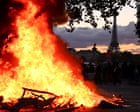
Blaming radical factions for street unrest while reaching for partial curfews turns a complex public-order problem into a two-part political gamble. The first part assigns blame to a defined ideological target; the second part restricts movement in targeted zones to restore calm without shutting down an entire city or country. Both moves carry real trade-offs. Overstating outside agitators can alienate peaceful demonstrators and obscure deeper grievances, while poorly calibrated curfews can inflame tensions, strain police capacity, and disrupt ordinary life.
Standard live-blog coverage tends to treat political blame and curfew proposals as separate headlines rather than parts of a single feedback loop. A sharper approach maps how leaders frame protest escalation, how movement restrictions operate in practice, and where the causal chain between rhetoric, street tactics, and public compliance either stabilizes or fractures a crisis.
The Attribution and Containment Loop
When a prime minister links street protests to "ultra-left" actors and proposes partial curfews, two distinct mechanisms are set in motion at the same time: narrative framing and spatial containment. Narrative framing shapes how the public and political allies interpret disorder. Spatial containment attempts to lower the frequency and severity of clashes by shrinking the time and geography available for confrontation.
In public-order analysis, treating these two actions as independent is a mistake. Blame influences legitimacy, and legitimacy shapes compliance. If residents view a partial curfew as a targeted safety measure against recurring violence, compliance tends to be higher and enforcement stays manageable. If residents view the same measure as collective punishment or a pretext to curb legitimate dissent, friction rises even in areas that were quiet before the restriction took effect.
Consider a stylized district where evening demonstrations begin peacefully near a transit hub, then give way to property damage after dark. If officials attribute the entire arc of the protest to hardened militants, moderates who marched earlier may feel lumped in with arsonists or vandals. Once that sense of unfairness takes hold, a partial curfew covering the surrounding neighborhood faces a steeper credibility hurdle, even if local merchants welcome extra protection.
The operational reality of street unrest is rarely tidy. Protests typically involve overlapping groups with different goals and risk tolerances:
- Peaceful demonstrators marching over policy, economic, or governance grievances who intend to remain lawful.
- Opportunistic or confrontational actors who use crowd cover to clash with security forces or damage property.
- Organized militant networks that arrive with coordination, equipment, or pre-planned tactics to escalate disorder.
- Bystanders and local workers caught between transit disruptions, shop closures, and police perimeters.
Because crowds are fluid, officials rarely have real-time, verified counts showing what share of any given gathering belongs to each category. Attributing the disorder primarily to an "ultra-left" vanguard simplifies a messy crowd into a legible antagonist. That simplification helps build a political case for tough measures, yet it can also blur the line between genuine agitators and ordinary citizens who are angry for unrelated reasons.
How Partial Curfews Work on the Ground
Unlike a blanket lockdown or total ban on assembly, a partial curfew narrows restrictions by time window, geographic perimeter, or specific categories of movement. In theory, precision lowers collateral damage. A night-time restriction in high-incident commercial streets or squares aims to separate late-evening disorder from daytime work, schooling, and routine commerce.
In practice, a partial curfew succeeds or fails through four operational links:
- Boundary clarity. Enforcement officers and residents need unmistakable rules on where the curfew starts and ends, which streets or zones are covered, and which exemptions apply (such as shift workers, medical emergencies, or transit corridors). Ambiguous borders create confusion at checkpoints and arguments in the street.
- Force-to-space ratio. A curfew on paper does nothing without enough personnel to monitor access points, clear lingering crowds, and respond to incidents elsewhere. Spreading police across too many partial zones can thin out reserves needed for rapid response.
- Crowd displacement. Tightening one neighborhood often pushes gatherings or skirmishes into adjacent districts, outer transit stops, or earlier hours of the evening. Containment in one spot can become migration to another.
- Escalation threshold. Every street stop or dispersal carries risk. Heavy-handed enforcement against minor infractions can turn a quiet night into a flashpoint, whereas inconsistent enforcement makes the order look hollow.
Look at what happens when authorities announce a partial curfew for a central plaza starting at 9:00 p.m., while metro lines into neighboring districts keep running normally. People leaving work or gatherings near the edge of the zone may cluster just outside the perimeter. If police push them back aggressively, clashes can spark on side streets that were not originally the main stage. Conversely, if officers wave groups through to avoid confrontation, the restriction loses deterrent force.
Second-Order Effects Missed in Fast Coverage
Fast-moving live coverage often stops at the announcement: what the prime minister said, which opposition figures objected, and where curfews are being considered. That leaves out the slower second-order effects that determine whether unrest subsides or hardens.
Political Polarization and Coalition Strain
Calling out the "ultra-left" signals resolve to conservative voters, security unions, and law-and-order allies. At the same time, it creates friction with left-leaning or centrist partners who may worry that broad labels sweep in mainstream union members, students, or municipal activists. If the political coalition fractures over how to define the threat, executive authority looks more contested even as the government projects toughness.
Information Gaps and Rumor Cycles
During periods of acute tension, official statements compete with unverified videos, rumors of police overreach, and claims of planted agitators. When government framing feels one-sided to skeptical communities, trust in official tallies of arrests, injuries, or property damage drops. Lower trust makes de-escalation harder because fewer intermediaries can credibly calm the streets.
Economic Friction Without Full Shutdowns
Partial curfews spare the broader economy compared with full closures, yet localized costs still accumulate. Evening hospitality, retail, delivery logistics, and cultural venues inside restricted zones take direct hits when foot traffic vanishes or transit stops early. Over weeks, repeated partial curfews wear down local businesses and test the patience of residents who are not protesting at all.
The Legitimacy Trade-Off in Policing
Public order in democratic systems depends heavily on perceived legitimacy—the belief among most citizens that laws and police actions are fair, proportionate, and lawful. When enforcement relies mainly on coercion without clear proportionality, short-term order can come at the expense of longer-term civic trust. Once trust erodes, every future protest starts closer to confrontation.
Limits of Both Blame and Curfews
Neither sharp ideological attribution nor partial curfews is a standalone cure for recurring street unrest.
Assigning blame to radical activists cannot resolve underlying grievances if significant segments of the public feel ignored on wages, cost of living, public services, or democratic responsiveness. Even when hardened agitators do exploit a protest—a documented pattern across many countries and eras—they rarely manufacture mass frustration out of thin air. Treating a symptom of grievance purely as a fringe conspiracy risks misdiagnosing why so many people were willing to step into the street initially.
Partial curfews have limits of their own. They are blunt tools for nuanced social conflicts. A curfew can restrict physical presence in a specific area during set hours, yet it cannot easily police grievances organized online, stop daytime demonstrations, or prevent grievances from simmering beneath the surface. Worse, if curfews are extended repeatedly without visible progress or clear exit criteria, public fatigue can shift from supporting order to resenting the restrictions.
Strategic Play for Managing Escalation
When confronting street unrest that mixes legitimate protest with violent disruption, leadership should separate investigative attribution from public de-escalation, while tying any partial curfew to strict operational discipline.
First, keep public rhetoric disciplined and specific. Condemn violence, arson, and attacks on officers or property in plain, factual terms, and let judicial and intelligence findings—rather than broad political labels—carry the weight of naming specific groups or criminal actors as evidence is established. Preserving a clear distinction between peaceful protesters and violent offenders helps isolate disruptors instead of uniting broader crowds against the state.
Second, treat any partial curfew as a time-bound containment measure with explicit metrics and sunset triggers. Define tight geographic boundaries, publish plain-language exemptions before enforcement begins, protect essential transit and emergency access, and pair perimeter control with visible efforts to lower flashpoints. Measure success not by how harsh the order sounds, but by whether nighttime violence drops without triggering wider clashes across neighboring districts.