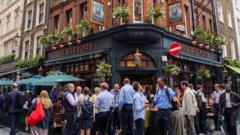
The modern British pub crawl has a spatial problem. For generations, the unwritten social contract of central London drinking was simple: buy a pint, step outside onto the pavement, and block the thoroughfare until a policeman or a disgruntled bus driver told you to move. Today, that informal arrangement has triggered a bureaucratic turf war that pits historic licensing laws against the brute economic survival of urban hospitality.
At the center of this friction is a fundamental clash over street use, noise pollution, and municipal revenue. Local councils want orderly walkways for commuters and tourists. Publicans need maximum foot traffic spilling out of cramped Victorian interiors just to break even against soaring commercial rents and energy bills. The result is a persistent row about standing up with a drink on the public highway, transforming neighborhood streets into contested zones where every square foot of concrete carries a financial and legal weight.
To understand why standing outside with a beer has become a flashpoint, you have to look at the anatomy of central London pubs. Most of these establishments occupy cramped footprints built during the Victorian or Edwardian eras. Inside, floor space is fiercely limited. A traditional boozer might hold forty people comfortably indoors, but modern operating costs demand triple that volume to survive a quarter. When the weather turns mild, the overflow spills naturally onto the pavement. For decades, local authorities looked the other way. A crowd outside signified a thriving business and a vibrant neighborhood.
Then came the post-pandemic shifts in drinking habits and municipal governance. Councils facing budget shortfalls began looking closely at public spaces as regulated assets rather than communal commons. Temporary pavement licensing regimes, introduced during the pandemic to keep hospitality afloat, forced a reckoning. Once councils started issuing specific permits for outdoor tables and barriers, they also started enforcing the boundaries. Drinkers who traditionally stood a few yards outside the designated barrier—or those patronizing pubs without a formal pavement license—suddenly found themselves in violation of highway obstruction laws.
The legal mechanics driving this conflict are surprisingly rigid. Under the Highways Act 1980, it is an offense to willfully obstruct the free passage of a highway. For years, this statute was applied selectively. Police and council wardens used common sense, reserving enforcement for cases of severe blockage or antisocial behavior. However, the modern urban environment has zero tolerance for friction. Pedestrian congestion metrics, accessibility mandates for wheelchair users, and complaints from residential neighbors have turned pavement management into an exact science. When three deep crowds of drinkers block a narrow Westminster sidewalk, the physical obstruction is real, and the legal liability falls squarely on the venue holding the license.
Publicans find themselves trapped between competing pressures. If they police their customers strictly, telling regulars they cannot step outside with a pint, those patrons simply walk down the block to a competitor with looser door staff. If they let the crowd drift onto the public pavement, they risk enforcement action, hefty fines, or the revocation of their premises license. The economic margins of running a pub in central London leave zero room for error. A single licensing review or a string of fines can push a profitable quarter into the red.
The Licensing Bureaucracy Trap
Navigating the licensing apparatus in boroughs like Westminster, Camden, or the City of London requires patience and capital. Obtaining a pavement license is no longer a simple rubber-stamp exercise. Venues must submit detailed architectural scale drawings, prove minimum pedestrian clearance zones—often requiring a clear two-meter path for foot traffic—and submit to public consultation periods where local residents can voice objections over noise and litter.
This administrative burden heavily favors corporate hospitality chains over independent operators. A large managed-house group can afford the legal fees, the specialized consultants, and the premium insurance required to manage outdoor seating zones meticulously. The independent Victorian corner pub, operated by a couple facing triple-net lease renewals, often lacks the resources to navigate this bureaucratic maze. Consequently, the crackdown on standing outside disproportionately threatens the independent character that defines London's drinking culture.
Neighborhood dynamics have shifted dramatically over the past two decades. Areas like Soho, Covent Garden, and Fitzrovia, once mixed commercial and residential districts, have seen a massive influx of luxury residential conversions and high-end apartments. New residents moving into multi-million-pound flats above historic pubs rarely arrive with an appreciation for traditional street noise. The acoustic reality of fifty people laughing outside a pub at eleven o'clock on a Thursday night sounds very different when your bedroom window opens directly onto the alleyway.
Resident associations have become formidable political lobbies within local councils. Armed with smartphones, decibel meters, and direct lines to local councilors, these groups document every infraction. They log instances of blocked doorways, discarded plastic cups, and late-night shouting. Councils, sensitive to voter complaints, respond by tightening restrictions, shortening permitted drinking hours, and deploying enforcement officers to patrol nightlife hotspots.
The Economics of the Spillover
The fundamental tension cannot be resolved simply through better policing or stricter fines because the economic model of the British pub relies on density. Unlike continental European café culture, which is built around seated service at designated tables, British drinking culture has historically been fluid, vertical, and communal. People stand shoulder-to-shoulder at the bar, and when the bar is full, they move outside.
This vertical drinking model generates high turnover. A pub can process three times as many customers in an evening if patrons are standing rather than occupying chairs. Forcing pubs to operate strictly within their seated capacity reduces their revenue potential overnight. In a climate where the price of a pint in central London routinely breaches seven pounds due to duty increases, business rates, and inflation, volume is the only shield keeping doors open.
The enforcement approach varies wildly from one borough to the next, creating a fragmented regulatory landscape. Walk across a council boundary in central London, and the rules change entirely. One side of a street might tolerate customers standing within a chalked boundary line, while the other side deploys civil enforcement officers issuing immediate dispersal orders and fixed penalty notices. This inconsistency frustrates publicans and confuses patrons, who assume that a pint purchased legally inside a licensed premises carries the right to be consumed immediately outside its doors.
Industry trade bodies have repeatedly called for a comprehensive overhaul of urban licensing laws to reflect the realities of modern city life. Proposals include designated entertainment zones where pedestrianized streets can accommodate heavy evening crowds without blocking essential transport corridors, as well as streamlined temporary licensing for peak summer months. Yet progress remains painfully slow, bogged down by red tape and competing municipal priorities.
The physical streetscape of London will continue to be a battleground. As long as commercial rents remain astronomical and the desire for social connection drives people into the urban core every evening, the pavement outside the pub will remain the ultimate contested frontier of the city.