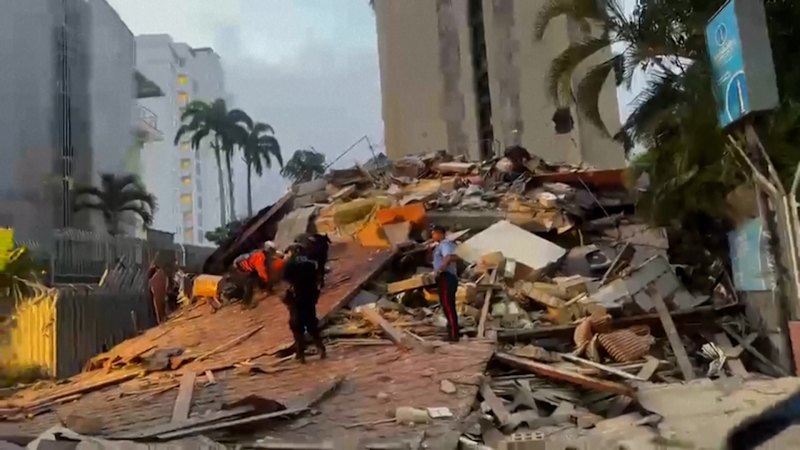
The ground under Caracas didn't just shake on June 24, 2026. It twisted, fractured, and shattered decades of structural neglect in a matter of seconds. When two massive earthquakes hit Venezuela's coast in less than a minute, the initial media reports focused entirely on the immediate panic. They showed the videos of swaying high-rises and dust clouds swallowing the Altamira neighborhood.
But looking at the raw numbers tells a much more terrifying story. This wasn't a standard earthquake followed by an aftershock. This was a rare, ultra-destructive seismic event known as a doublet.
The first hit was a magnitude 7.2 foreshock. Exactly 39 seconds later, a massive magnitude 7.5 mainshock ripped through the same fault line. The U.S. Geological Survey pointed the epicenter right near Moron, along the Caribbean coast. That's about 168 kilometers west of Caracas. Because the second quake triggered at a shallow depth of just 10 kilometers, the energy didn't dissipate before reaching the capital. It hammered a city completely unprepared for it.
Acting President Delcy Rodriguez quickly declared a state of emergency. Initial government reports listed 32 dead and 700 injured. Honestly, those numbers are just a fraction of what's coming. The USGS models estimate the potential death toll could reach between 10,000 and 100,000 people. To understand why this disaster is so widespread, you have to look past the breaking news banners and look at the actual state of Venezuela's infrastructure.
The Anatomy of a Seismic Doublet
Most people think of earthquakes as a single big jolt followed by smaller, weaker rumblings. This was completely different. Northern Venezuela sits right on the boundary where the Caribbean and South American tectonic plates grind past each other. This boundary creates a complex network of strike-slip faults, including the San Sebastian and El Pilar fault systems.
When the 7.2 foreshock hit at 22:04 GMT, it didn't relieve all the stress on the fault. Instead, it instantly loaded extra pressure onto an adjacent segment. The rock couldn't take the strain. Less than a minute later, the 7.5 mainshock went off.
Think about what that does to a building. The first quake fractures the concrete core, snaps internal supports, and weakens the foundation. The building is already hanging by a thread. Then, before the structure can even stop swaying, the bigger 7.5 wave hits. Buildings that might have survived a standalone 7.5 quake collapsed instantly because they were already structurally compromised 39 seconds earlier.
Residents in Caracas described the sensation as an endless nightmare. You manage to run down the shaking stairs of your apartment building, you reach the street, and then the real earthquake hits. The ground literally tosses you around.
Why Caracas Was a Ticking Time Bomb
The economic crisis in Venezuela over the last decade has been well documented, but people rarely talked about how that crisis impacted engineering and building maintenance. Caracas is a dense valley packed with fragile architecture. You have high-end, older high-rises in areas like Chacao and Altamira, and then you have the sprawling barrios climbing up the steep hillsides, like Petare.
Neither side of that economic divide was ready for a doublet.
In the wealthier districts, many apartment blocks were built during the oil boom decades ago. They were designed well for their time, but concrete degrades. Regular structural inspections cost money that building associations haven't had for years. When the walls started cracking on Wednesday evening, the internal rebar simply snapped. In the Baruta and Chacao districts, rescue workers have already pulled dozens of survivors from pancaked concrete blocks.
The hillsides are an even bigger nightmare. The homes there are built out of unreinforced brick and corrugated iron, stacked precariously on top of each other. They have zero seismic resistance. The shaking caused massive landslides, burying entire blocks under tons of dirt and debris.
The state of La Guaira, just north of the capital, has been officially designated a disaster zone. Dozens of buildings there simply ceased to exist. Because La Guaira sits right on the coast, close to the epicenter, the ground acceleration was violent enough to sheer structures clean off their foundations.
The Total Breakdown of Critical Infrastructure
When a disaster of this scale hits a modern city, emergency plans kick in. Power grids isolate damaged sectors, back-up communication networks go live, and emergency transport routes open up. In Caracas, everything failed at once.
The city lost power almost immediately. Cellphone signals dropped across multiple states, leaving millions of Venezuelans inside the country unable to contact their families. This caused immediate panic for the global Venezuelan diaspora. Over 7.7 million people have left the country in recent years. For hours, millions of immigrants in Miami, Madrid, and Bogota could only watch terrifying social media videos of their hometowns covered in dust, unable to check if their parents or siblings were alive.
Interior Minister Diosdado Cabello went on state television to urge motorists to clear the roads. Ambulances couldn't get through because fallen electric poles, dangling wires, and chunks of concrete blocked major avenues.
The broader logistical nightmare is even worse:
- Simón Bolívar International Airport suffered severe structural damage and closed down completely.
- The Caracas underground subway system halted all operations.
- The government cut off central natural gas pipelines to prevent massive fires from ruptured lines.
Without gas, electricity, or running water, hospitals are running entirely on diesel generators. Healthcare professionals were ordered to report to work immediately, but many couldn't even reach the hospitals due to the blocked roads and lack of public transport.
The App Controversy and a Fragmented Relief Effort
The government's response has already run into political complications. Acting President Rodriguez told citizens to use the state-run "VenApp" to report missing persons and structural damage. That instruction immediately raised red flags for human rights watchdogs.
VenApp has a dark history. It started out in 2022 as a tool for citizens to report local issues like broken water pipes or power outages. During the political unrest of 2024, the government repurposed the app. They asked users to report the names and locations of anti-government protesters. Because of that, tech companies removed it from the Google Play and Apple App stores.
Telling a panicked, terrified population to rely on a flagged piece of software during a humanitarian crisis shows the deep trust deficit between the public and the state. People want to find their loved ones, but they're scared of how their data will be used.
International aid is starting to mobilize, but navigating Venezuela's geopolitical landscape makes delivery incredibly complicated. Offers of search and rescue teams have come from all over, including the United States, El Salvador, Brazil, and Ecuador. U.S. Secretary of State Antony Rubio stated that emergency teams and medical resources are being deployed. Qatar and Mexico are also flying in specialized rescue personnel.
Even political adversaries are stepping up. Ecuadorian President Daniel Noboa noted that despite deep political differences, humanity has to guide leadership during a tragedy. The challenge now is getting these international teams onto the ground when the main airport is broken and the local authorities are completely overwhelmed.
What Happens in the Next 48 Hours
The window to save people trapped under the rubble closes incredibly fast. In a doublet earthquake scenario, aftershocks are frequent and dangerous. Every minor tremor can cause a partially collapsed building to finish falling, threatening both the survivors inside and the rescue teams trying to dig them out.
If you have family in the affected areas or want to understand how to track this crisis, you need to look at specific operational realities rather than generic news feeds.
First, check alternative local reporting networks. With state media controlled and main networks suffering outages, independent journalists on ground-level radio and specific messaging channels are providing the most accurate maps of blocked roads and functional shelters.
Second, watch the logistical hubs. Since the main airport in Caracas is closed, international aid will have to route through smaller regional airfields or come via maritime ports. Tracking the arrival of these shipments will give you a real indicator of when aid will actually hit the streets.
Third, ignore the early, conservative death tolls. The official count of 32 will rise dramatically as rescue teams finally cut into the large structures that collapsed in Altamira and La Guaira. The true scale of this disaster won't be clear for days. The immediate focus has to stay entirely on heavy lifting gear, medical supplies, and clean water delivery to stop preventable deaths in the aftermath.