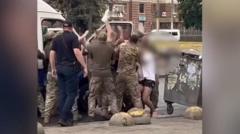
A crowd swarms a military vehicle in a darkened neighborhood in Lviv. People are screaming. They slash the tires, tear off the front bumper, and eventually flip the entire car upside down. They chant "Shame!" at the officers inside, even tearing the uniform off one of them.
This isn't a scene from an occupied territory. It happened in western Ukraine, deep in the rear, far away from Russian lines.
The people flipping the car were local Ukrainian civilians. The men inside were their own military recruiters from the Territorial Recruitment Center (TRC).
For anyone watching the war from a distance, these images are jarring. We are used to seeing a nation united against foreign aggression. But beneath that genuine patriotic solidarity, a dangerous internal crisis has broken out. Ukrainian military recruiters are facing unprecedented levels of blowback, resistance, and direct physical violence from the very citizens they are trying to draft.
If you want to understand why this is happening, you have to look beyond the simplistic headlines. It isn't about a sudden lack of patriotism. It's about systemic failure, institutional corruption, and the sheer human terror of an endless war.
The Escalating Body Count in the Deep Rear
Serving as a draft officer in Ukraine used to be seen as a safe, bureaucratic job. Not anymore. National Police records show that assaults on recruitment officers have skyrocketed, jumping from just five reported cases in 2022 to well over 600.
The violence took a deadly turn earlier this year when several recruiters were stabbed during street patrols. One of them died. In another incident, a veteran machine gunner named Vasyl Krupych—who survived brutal battles in the Donbas only to be reassigned to a recruitment unit—was attacked with a crowbar by two men who refused to show their papers. He spent six weeks in the hospital with a broken rib, struggling to breathe.
Krupych asked a question that gets to the heart of the crisis. What did we fight for if soldiers can now get beaten by their own people?
To answer that, you have to see what happens on the streets every single day. The consensus that held the country together in 2022 is fraying under the weight of a five-year war.
The Fear of Busification and the Loss of Trust
The street-level tension is driven by a practice Ukrainians call "busification." Because hundreds of thousands of men have ignored mail-in draft notices, recruitment squads have resorted to roaming public spaces, checking IDs, and forcing eligible men into the back of civilian minibuses.
Videos of these forced detentions flood Ukrainian Telegram channels daily. You see men being dragged out of gymnasiums, intercepted on their way to work, or pulled out of public parks. Sometimes they fight back. Sometimes crowds of local women form human walls to block the recruiters from leaving.
This raw physical coercion has severely damaged public trust. According to data from the Rating Group, trust in enlistment offices cratered to just 24%.
It doesn't help that the system has been rocked by high-profile corruption scandals. Ukrainians watch news reports of regional recruitment chiefs buying multi-million dollar villas in Spain or charging thousands of dollars for fraudulent medical exemptions. While wealthy draft dodgers buy their way out, working-class men feel they are being hunted down to fill quotas.
Human Rights Commissioner Dmytro Lubinets pointed out that complaints regarding recruitment office abuses more than doubled last year. People feel that their legal rights are being ignored, and when legal avenues fail, the reaction on the street becomes radicalized.
Former Frontline Soldiers Caught in the Middle
There is a tragic irony that outside observers completely miss. The recruitment officers targeted by these angry crowds are not draft dodgers or desk jockeys.
The vast majority of them are wounded combat veterans. They are men who volunteered in 2022, fought in the trenches of Bakhmut or Avdiivka, suffered severe injuries, and were reassigned to recruitment centers because they were no longer fit for frontline assault units.
When a crowd surrounds a recruitment vehicle, they aren't just attacking a bureaucratic system. They are attacking men who already bled for the country.
The state finds itself in an impossible position. The frontline units are exhausted. Soldiers who have been fighting continuously need rotation, and the military desperately needs fresh manpower to hold back ongoing Russian offenses. Yet the methods used to gather that manpower are alienating the civilian population.
Fixing a System on the Brink
The current strategy is unsustainable. Resorting to physical coercion on the streets creates a toxic domestic environment that threatens the country's internal stability.
First, Ukraine needs to completely remove wounded combat veterans from direct, street-level mobilization duties. Pitting traumatized frontline survivors against terrified civilians is a recipe for social explosion. Veteran Military Ombudswoman Olha Reshetylova has actively pushed for this separation, and it must happen immediately.
Second, the government must enforce strict transparency in the medical exemption process to eliminate bribery. If the public sees that the draft applies equally to everyone—not just those who cannot afford a bribe—the resistance will lose much of its moral weight.
Finally, recruitment must pivot fully toward digital registry tracking and targeted, role-specific incentives rather than random street snatches. The focus should be on clear terms of service and predictable rotations so that enlistment does not feel like a one-way ticket with no return date.
The street war over mobilization is a warning sign. Ukraine cannot successfully defend its borders if it destroys the civic solidarity that kept it alive in the first place. Addressing the recruitment crisis with institutional reform, rather than brute force, is the only way forward.