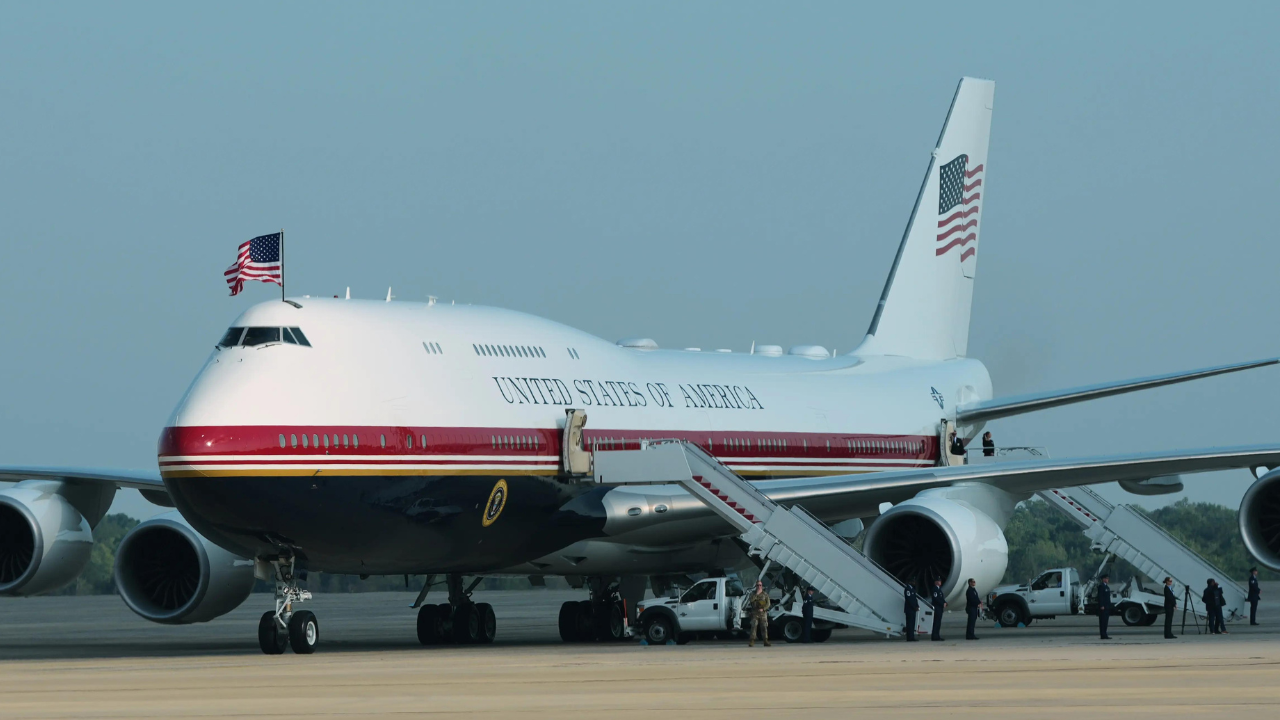
President Donald Trump just completed an 18,000-mile diplomatic swing across Asia aboard the Boeing 747-8 gifted to the United States by Qatar’s royal family, and the coverage around it misses the real aviation story. Headlines focused on whether the jet was "perfectly safe" or properly "maxed out" before crossing the Pacific. That framing confuses basic flight safety with full military survivability.
Here is the reality. The aircraft—officially designated by the U.S. Air Force as the VC-25B Bridge—is completely airworthy for international travel, yet it still lacks the full suite of defensive systems installed on the older VC-25A fleet. Understanding why the White House flew it to Manila and Shenzhen anyway requires separating political promises from aerospace engineering.
The Gap Between Airworthy and "Maxed Out"
When then-White House press secretary Karoline Leavitt stated that the aircraft was "perfectly safe" for domestic and international flights, she was speaking in literal aviation terms. An airframe built in 2012 for the Qatar Amiri Flight and maintained to commercial and VIP standards isn't going to fall out of the sky over the Pacific.
Safety in presidential aviation means something entirely different.
Standard Air Force One aircraft—the two heavily modified Boeing 747-200Bs known as the VC-25A—aren't just luxury transports. They are flying command centers built to survive worst-case scenarios. That includes electromagnetic pulse hardening, advanced infrared missile countermeasures, encrypted nuclear command-and-control links, and aerial refueling capability.
The VC-25B Bridge went through roughly ten months of initial modification work after the Pentagon accepted it in May 2025, debuting as Air Force One on July 1, 2026. That timeline was remarkably fast. Too fast, according to defense analysts and former Air Force officials.
Why the 60-Day Upgrade Promise Didn't Happen
In July 2026, following reports that Secret Service and security officials advised against using the Qatari jet for higher-risk legs—including a return trip from a NATO summit in Ankara, Turkey, where Trump switched back to an older VC-25A—the president promised the jet would soon go offline to get "maxed out". He initially pegged that overhaul at 30 days. By September, his estimate stretched to "about 60 days".
Neither downtime actually happened before November.
Instead, the jet stayed in constant rotation:
- Flying over Washington, D.C. during August events
- Carrying Trump to Ireland in September
- Serving as his primary campaign transport during the October midterm push
- Departing for Asia in mid-November for ASEAN meetings in Manila and the APEC summit in Shenzhen
Anyone who has worked around heavy aircraft maintenance, repair, and overhaul knows you cannot strip a widebody airframe, rewire its avionics, install directed infrared countermeasures, and recertify the electrical load in 30 or 60 days. Former Air Force Secretary Frank Kendall and aerospace engineers have noted that bringing an interim commercial VIP jet up to true VC-25A defensive parity takes three to four years, not two months. Reports indicate the work completed so far focused largely on communications, basic security, and interior updates—while the heavier defensive upgrades remain deferred.
What Actually Happened on the November 2026 Asia Trip
Watching how the U.S. Air Force operated the VC-25B Bridge during the November 2026 Asia tour tells you everything about how planners managed those technical limits. You don't have to guess what upgrades are missing when you look at the flight logs and operational workarounds.
First, the jet didn't fly alone. When extreme weather forced a last-minute refueling diversion from Anchorage to Fairbanks, Alaska, on November 16, tarmac photos captured an older blue-and-white VC-25A parked right across the ramp serving as the dedicated backup aircraft. While traveling with a backup plane isn't unheard of for major overseas presidential trips, pairing the newer 747-8 with a legacy VC-25A gave the Secret Service an immediate fallback option if threat levels shifted in East Asia.
Second, the aircraft proved its raw commercial endurance on the way home. On November 19, the VC-25B Bridge departed Shenzhen, China, and flew nonstop to Joint Base Andrews in Maryland.
Look at the numbers from that return leg:
- Distance covered: Roughly 7,500 nautical miles across the Pacific, passing over Shanghai, Tokyo, Shemya, Winnipeg, and Cleveland
- Flight time: Approximately 15 hours without touching down
- Takeoff weight: Nearly one million pounds (close to the 747-8's 987,000-pound maximum takeoff weight), making it the heaviest takeoff in U.S. Air Force history
That single flight exposes the core trade-off the Air Force is making right now. Because the VC-25B Bridge lacks aerial refueling capability, it relies entirely on the massive fuel capacity and modern GEnx engines of the 747-8 airframe to make long-haul legs that would force an older VC-25A to stop and refuel. It flies farther and carries more weight efficiently, even while operating without the full defensive shield of the 1990-era jets.
The Hidden Operational Friction Nobody Mentions
Most political coverage treats a presidential jet like an oversized private charter. It isn't. Operating a 987,000-pound Boeing 747-8 as Air Force One creates massive logistical headaches that smaller or older aircraft avoid.
Airports built decades ago weren't designed for the 224-foot wingspan and pavement load of a fully fueled 747-8. When the VC-25B Bridge lands at international hubs or regional stops, host airports often have to shut down adjacent taxiways, clear entire terminal gates, and verify runway weight tolerances days in advance.
There is also the parts and maintenance reality. The two permanent VC-25B replacements being built by Boeing aren't expected until 2027 or 2028, with the legacy VC-25A fleet scheduled to retire around 2029. To keep the Qatari-gifted Bridge aircraft flying reliably in the meantime, the Air Force had to acquire a separate ex-Lufthansa 747-8 simply to strip for spare parts. Running a one-off VIP airframe inside a military fleet requires custom supply chains, specialized ground crews, and constant compromises between availability and modification downtime.
How to Read Presidential Aviation Claims Going Forward
Political spokespeople will always describe Air Force One in absolute terms—either calling it the greatest presidential plane ever built or dismissing every question as partisan noise. Critics, on the other hand, often imply that anything short of full Cold War survivability makes the plane dangerous to fly. Both views miss how presidential airlift actually works.
If you want to track whether the VC-25B Bridge ever gets those deeper security upgrades, stop listening to 30-day or 60-day press estimates and watch three concrete indicators instead:
- Sustained hangar downtime: True defensive retrofits—like missile approach warning sensors and hardened wiring—require taking the tail number off the flight schedule for at least four to six months at a major defense modification facility, not a few weeks between campaign rallies.
- Backup aircraft assignments: Watch flight-tracking logs for SAM (Special Air Mission) callsigns shadowing international trips. Whenever a legacy VC-25A flies alongside the Bridge jet on overseas routes, planners are hedging against airspace risk or uncompleted communications upgrades.
- Destination risk profiles: Notice where the Bridge jet doesn't go. Until heavy defensive suites are installed and certified, high-threat airspace zones will still require switching back to the older VC-25A fleet, just as happened after the Ankara summit.
For now, the Qatari 747-8 is doing exactly what its "Bridge" designation implies. It is buying time and nonstop range for the White House while Boeing works through the long-delayed VC-25B program—proving that in presidential aviation, you can have a safe, record-setting airplane long before you have a finished one.



