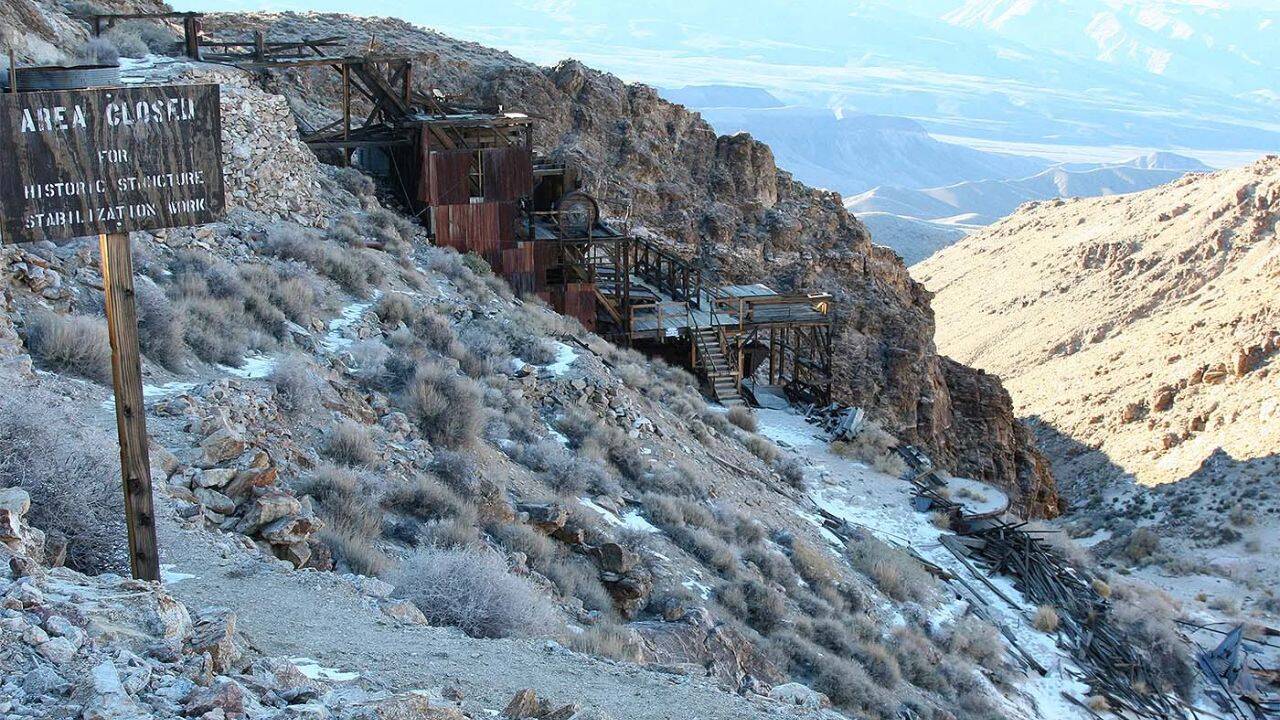
Most ghost towns in the American West look like Hollywood movie sets, all weathered planks and swinging saloon doors. Skidoo isn't like that at all. Sitting high in the Panamint Mountains of Death Valley National Park, this 1906 boomtown leaves behind almost nothing except rusting tin cans, concrete foundations, and a lonely iron stamp mill perched on a rocky ridge.
Yet for a brief, wild stretch in the early twentieth century, Skidoo attracted roughly 700 people who braved brutal desert isolation for a shot at high-grade ore. If you think Death Valley mining was just a bunch of lone prospectors with mules and pickaxes, Skidoo will completely change your mind. It was a heavily capitalized, industrial gamble that featured a massive 23-mile water pipeline, a telephone line, a newspaper, and one of the most notorious double hangings in California history.
How Two Lost Prospectors Started the 1906 Skidoo Boom
The whole thing started because two guys got lost in the fog.
In the spring of 1906, prospectors Harry Ramsey and John "One-Eye" Thompson were wandering through the Panamint Range when a dense mountain fog rolled in and blinded them. Instead of panicking, they camped out on a high plateau overlooking Death Valley. When the fog finally cleared, they looked down at the ground beneath their boots and saw quartz veins thick with visible gold.
Word got out fast. In early twentieth-century Nevada and California, mining news traveled like wildfire, and stampeders poured into the Panamints from Rhyolite, Bullfrog, and Ballarat. By late 1906, a tent city had erupted on the windswept bench at around 5,600 feet elevation.
People often wonder where a weird name like "Skidoo" came from. Back in 1906, "23 Skidoo" was the hottest slang phrase in America, basically meaning "get out while the getting is good." According to local lore and National Park Service records, the town's main financial backer, E.A. "Bob" Montgomery, named the camp Skidoo because the water pipeline he planned to build to supply the mine would measure 23 miles long. Other accounts claim it was named simply because the phrase was everywhere that year. Either way, the name stuck, and the camp quickly outgrew its canvas tents.
Why Skidoo Wasn't Your Average Desert Tent Camp
Walk through most historic mining districts in the Mojave Desert and you'll find makeshift camps that died the second the surface ore ran dry. Skidoo had serious money behind it from day one.
Bob Montgomery had already made a fortune at the Montgomery-Shoshone Mine in Rhyolite, Nevada, and he bought up the Ramsey-Thompson claims with plans to build a permanent industrial operation. He incorporated the Skidoo Mines Company and poured hundreds of thousands of dollars into infrastructure that seemed completely insane for such a remote location.
The 23-Mile Pipeline Engineering Feat
Water is everything in Death Valley. Without it, you can't run a stamp mill to crush gold-bearing rock, and you certainly can't keep 700 miners alive.
Montgomery engineered an extraordinary solution. His crews laid 23 miles of steel pipe from Birch Spring high up near Telescope Peak all the way across rugged canyons to Skidoo. Hauling those heavy pipe sections up steep desert grades required massive teams of horses and mules, and the project cost around $250,000—an astronomical sum in 1907. The pipeline worked, delivering fresh mountain water straight to the town and the 15-stamp mill.
If you visit the site today, you can still spot sections of that rusted steel pipe snaking across the desert floor. It remains one of the most impressive surviving pieces of early mining engineering in the entire park.
Life at 5,600 Feet Elevation
Because of the elevation, Skidoo didn't suffer the 120-degree summer inferno of the Death Valley floor below, though winters brought biting winds and heavy snow. Thanks to steady water and corporate payrolls, the town developed real amenities.
At its peak between 1907 and 1908, Skidoo boasted:
- The Skidoo News, a weekly newspaper that chronicled everything from ore assays to local gossip
- A telephone line connecting the remote camp to Rhyolite, Nevada
- A bank, a post office, a school, and a general store
- Multiple saloons, hotels, and restaurants catering to miners earning four dollars a day
It wasn't a lawless anarchy, at least not at first. Families actually moved there. Kids attended classes while their fathers worked underground shifts in the hard quartz veins.
The Infamous 1908 Hanging of Hootch Simpson
You can't talk about Skidoo without talking about Joe "Hootch" Simpson, because his story ruined the town's reputation for decades.
In April 1908, Simpson—a local saloonkeeper with a reputation for drinking his own supply—walked into the Skidoo Trading Company store and demanded money from the manager, Jim Arnold. Arnold was a beloved local figure and a friend of Bob Montgomery. When Arnold refused, Simpson pulled a revolver and shot him dead in front of witnesses.
Townspeople tackled Simpson and locked him up under guard. The county seat in Independence was over a hundred miles away across brutal terrain, and the angry residents of Skidoo had zero patience for the legal system. On the night of April 22, 1908, a vigilante mob took Simpson from his guards and hanged him from a telephone pole.
Here is where the story takes a bizarre turn. A few days later, a reporter from the Los Angeles Herald arrived in Skidoo to cover the lynching, upset that he had missed getting a photograph of the event. According to widely documented historical accounts, the townspeople actually dug up Simpson's body, propped him back up on the telephone pole, and let the photographer take his picture.
That single gruesome episode cemented Skidoo's place in Wild West folklore, overshadowing the actual mining history that paid everyone's bills.
What Actually Killed the Skidoo Gold Mine
Movies love to blame ghost towns on sudden disasters or ghostly curses. In reality, Skidoo died from plain old geology and economics.
The gold veins in the Panamint Range were rich near the surface, which is why Ramsey and Thompson spotted free gold right after the fog cleared. However, those quartz veins were narrow, fragmented, and heavily faulted. Once miners dug deeper underground, the veins pinched out or shifted unpredictably, making extraction wildly expensive.
By 1913, the best ore had already been pulled from the mountain. Fires damaged the mill, and the company struggled to cover operating costs. When World War I broke out and industrial prices shifted, large-scale mining became unprofitable.
The death blow came in 1917. Scrap metal prices skyrocketed during the war, and the owners realized the steel in their famous 23-mile pipeline was worth more as salvaged metal than the remaining gold in the ground. Crews ripped up most of the pipe and hauled it away. Without water, the mill shut down for good, the remaining residents packed up, and Skidoo officially became a ghost town.
In total, the Skidoo mines produced roughly $1.5 million in gold during their active years—respectable, certainly, but nowhere near the massive bonanzas of Nevada camps like Goldfield or Tonopah.
Visiting Skidoo in Death Valley Today
If you're planning a trip to Death Valley National Park and want to see Skidoo for yourself, don't expect a curated tourist attraction with gift shops and guided tours. You're going to see an authentic, minimally preserved archaeological site.
Getting There Safely
Skidoo sits off Emigrant Canyon Road on the western side of Death Valley, south of Stovepipe Wells. The turnoff onto Skidoo Road puts you on roughly seven miles of graded dirt road.
You don't necessarily need a heavy-duty rock crawler in good weather, though a high-clearance vehicle makes the washboard bumps much less miserable. Standard rental sedans frequently bottom out on the rocks and ruts, and getting a tow truck out there will easily cost you over a thousand dollars. Always check current road conditions with the National Park Service at the Furnace Creek or Stovepipe Wells visitor centers before turning off the pavement, as flash floods regularly wash out sections of the dirt track.
What You Can Still See
Once you reach the townsite, almost all the wooden buildings are gone—salvaged decades ago for lumber in a desert where trees don't grow. Look closely at the ground, though, and the layout of the town comes into focus. You'll find flat graded terraces where tents and cabins stood, stone foundations, rusted food cans, and purple sun-bleached glass fragments.
Keep driving a bit further past the townsite to reach the crown jewel of the area: the Skidoo Mill. Perched dramatically on the edge of a steep canyon, this massive wooden and steel structure is one of the few surviving stamp mills in the park. The Park Service has stabilized the structure so visitors can view it safely from the outside, though entering the fragile interior is strictly prohibited.
Practical Rules for Exploring Historic Mining Sites
Death Valley protects its ghost towns aggressively, and for good reason. Every artifact left on the ground tells part of the story of those 700 people who lived on that windy ridge in 1906.
If you make the drive out to Skidoo, follow these essential ground rules:
- Leave every artifact where it lies. Under the federal Antiquities Act and National Park Service regulations, picking up even a single rusted square nail, a piece of purple glass, or an old tin can is a federal offense. Take photos, not souvenirs.
- Stay out of open mine shafts and adits. The hills around Skidoo are riddled with unmarked vertical shafts and unstable tunnels. Rotten timbers and false floors collapse without warning, and cell service is practically nonexistent.
- Carry twice the water you think you need. Even though Skidoo sits higher and cooler than Badwater Basin, the dry mountain air dehydrates you fast. Bring at least a gallon of water per person, extra food, and a full-size spare tire before leaving Highway 190.
- Time your visit for spring or fall. October through April offers the best weather for exploring the Panamints. Summer temperatures still regularly top 100 degrees at the townsite, and winter storms can dump snow across Emigrant Canyon Road with little notice.
Start your trip early in the morning from Stovepipe Wells, grab a physical park map at the ranger station so you aren't relying on spotty GPS signals, and give yourself at least half a day to explore both the townsite foundations and the stamp mill ridge at your own pace.