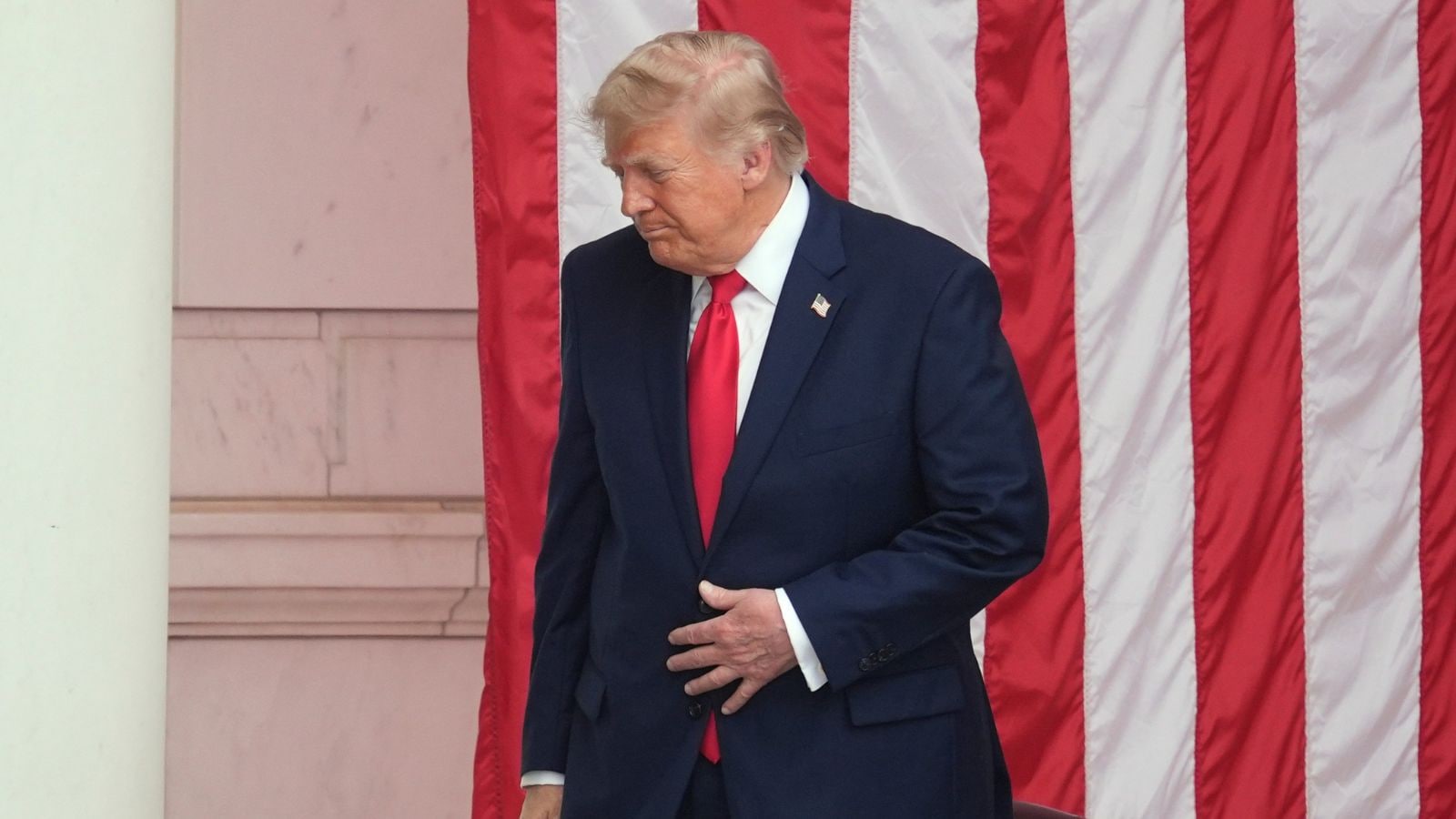
Donald Trump doesn't like to be boxed in by his own words. If you watched his recent, tense interview on NBC’s Meet the Press, you saw that reality play out in real time. When pressed by host Kristen Welker about whether the current US-Israel military campaign against Iran betrays his fierce campaign pledge of "no new wars," Trump offered a blunt revision of history.
"I didn't guarantee no war," Trump said before abruptly cutting the interview short and walking out. He defended his record by pointing to military spending. "Why would I have built the strongest military in the world? I built our military."
It is a striking pivot. For years, the core of Trump’s populist foreign policy pitch was a distinct, unyielding opposition to foreign interventions. His official White House biography openly bragged about "putting a stop to endless wars." Now, with US forces entangled in a fast-moving conflict in the Middle East that began in February 2026, the rhetorical script is changing.
To understand how we got here, you have to look at what Trump actually told voters over the last decade, versus how he frames executive power today.
The Receipts of the No New Wars Rhetoric
The claim that he never promised to keep America out of conflict simply doesn't hold up under scrutiny. Trump’s political identity was largely forged in opposition to the post-9/11 military interventions favored by both traditional Republicans and Democrats.
- The 2024 Victory Speech: On November 6, 2024, as he accepted victory in the presidential election, Trump explicitly tied his upcoming term to global stability. He told the crowd, "They said, 'He will start a war.' I'm not going to start a war. I'm going to stop wars."
- The State College Rally: Just a month prior, on October 5, 2024, in Pennsylvania, Trump told parents they wouldn't have to worry about their children being deployed to distant lands. "You don't have to send your kids out to war, have your kid blown up for a country that you've never heard of," he said. "I will not send you to fight and die in a foolish, never-ending foreign war."
- The Adin Ross Stream: Speaking to a massive online audience in August 2024, Trump claimed that avoiding conflict was a rare historical feat he achieved during his first term. "We had no wars under the Trump administration... It was I think 82 years since that's happened. And we won't have wars again."
- The Modern History Claim: At the 2023 CPAC convention, he proudly declared himself "the only president in modern history who did not have any new wars." He argued his specific "personality type" naturally kept adversaries from pushing the US into combat.
Going back even further, to a 2016 primary debate in South Carolina, Trump broke conservative orthodoxy by calling the Iraq War a "big, fat mistake" engineered by George W. Bush. Anti-interventionism wasn't a minor talking point. It was his signature foreign policy position.
The Reality of the Present Conflict
So, what changed? According to Trump, the current conflict with Iran doesn't break his promise because it fails to meet his definition of a permanent quagmire.
"I don't like these endless wars," Trump explained during the same NBC interview. "This is not an endless war. We've been doing this for three months."
The administration views the military strikes as a necessary, time-bound defensive measure designed to permanently block Tehran from developing a nuclear weapon. In March, Trump threatened devastating strikes on Iranian energy sites, desalination plants, and the Kharg export terminal if diplomatic talks failed. By April, the conflict saw US blockades and active engagements in the region, aimed at forcing a fast resolution rather than maintaining a long-term occupation.
This reveals the core tactical logic of Trump's foreign policy. He does not view targeted, high-intensity military actions as a betrayal of his anti-war stance, provided they are short and transactional. The distinction he makes is between a "foolish, never-ending foreign war" like Afghanistan and a sharp, aggressive strike intended to force an adversary to negotiate.
Peace Through Strength Versus Absolute Pacifism
The tension in Trump's rhetoric comes from a misunderstanding of his actual doctrine. Trump was never a pacifist. He is a nationalist who believes in "peace through strength."
When Trump points to his massive defense budgets and asks why he would build the strongest military in the world if he never intended to use it, he is revealing his true philosophy. In his view, military might is the ultimate leverage. If an adversary refuses to fold under economic sanctions or rhetorical threats, Trump believes the deployment of that military power is justified to protect American interests, as long as it doesn't drag the country into a decades-long nation-building project.
Critics point out that this distinction matters little to the service members deployed to dangerous zones or to the taxpayers funding the operations. The gap between campaign trail rhetoric and the harsh realities of global governance is an old story in American politics. Trump's recent comments simply prove that even the most anti-interventionist platforms often crumble when faced with shifting geopolitical crises.
Navigating the Echoes of Foreign Policy Shifts
If you are trying to make sense of where American foreign policy goes from here, look at actions rather than absolute statements. Relying on campaign promises of absolute non-intervention usually leads to miscalculating how a leader responds to an active crisis.
Pay close attention to how the administration manages the timeline of current operations. The ultimate test of the "not an endless war" defense will be whether these operations actually wind down quickly, or if they turn into the exact type of long-term foreign entanglement Trump spent ten years campaigning against. Keep an eye on global energy markets and military deployment numbers over the coming weeks to see if the reality matches the rhetoric.
The US President Donald Trump denies promising 'no new wars' - BBC News video offers a direct look at the specific campaign speeches that conflict with the president's latest statements, providing essential context on this sudden shift in foreign policy rhetoric.