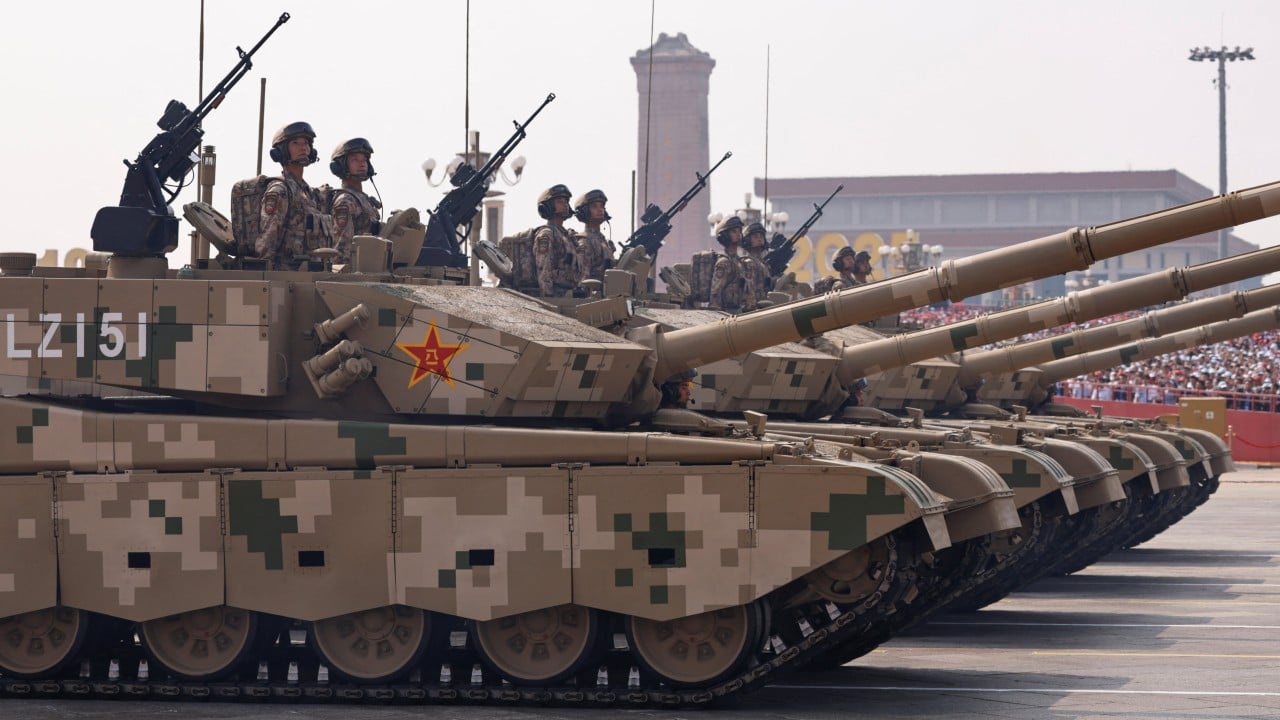
Every defense blog on the internet is currently drooling over Beijing's supposed twenty-year roadmap for a nuclear-powered, railgun-toting armored vehicle with a four-hundred-and-fifty-kilometer operational leash. The headlines write themselves. Giant atomic engines. Relativistic projectiles slicing through air like hot wire through foam. Total battlefield dominance.
It is a fantasy. It is military science fiction designed to look good in glossy state media spreads and terrify congressional budget committees into approving another round of black-budget funding.
I have spent two decades watching defense contractors pitch impossible metal boxes to generals who should know better. Every few years, someone dusts off the same tired tropes from 1950s atomic-age comic books, slaps a modern battery or nuclear micro-reactor label on the CAD rendering, and calls it innovation.
Let us look at the mechanical reality. A nuclear-powered tank armed with a railgun is not an apex predator. It is a brilliant, highly radioactive self-destruction kit that solves zero modern tactical problems while multiplying every vulnerability ground combat forces already face.
The Physics of Thermal Signature Suicide
The entire premise of armored warfare changed the moment high-resolution thermal optics and drone-guided loitering munitions became ubiquitous. Modern combat is no longer about who has the thickest slab of rolled homogeneous steel or the highest muzzle velocity. It is about signature management.
A nuclear reactor produces heat. Lots of it. Even small modular fission systems require aggressive cooling architectures to prevent core meltdowns under combat stress. In the confined interior volume of an armored fighting vehicle, dissipating megawatts of thermal energy without baking your own crew or screaming a neon sign at every infrared sensor within fifty kilometers is an unsolved engineering riddle.
When you strap a railgun on top of that reactor, the energy demands become absurd. A railgun does not just fire a bullet; it dumps gigajoules of electrical energy into twin rails in milliseconds, vaporizing part of the armature with every shot. Generating that kind of instantaneous discharge requires massive capacitor banks that weigh tons and demand immense charging cycles.
You are asking a five-man crew to drive around inside a rolling nuclear power plant topped with a capacitor bank the size of a minivan, operating in an environment where a cheap drone can drop a shaped charge right down the exhaust port. One precision hit on your cooling loop turns your elite weapon into a localized dirty bomb. No commander in their right mind signs off on fielding thirty million dollars of fissile material that can be disabled by a ten-thousand-dollar quadcopter.
The Railgun Fetish is Dead
We need to talk about the railgun obsession. The United States Navy spent over a decade and half a billion dollars trying to make naval railguns a reality before quietly shelving the program in favor of hypersonic cruise missiles. Why? Because the physics are brutal.
The intense friction and electromagnetic stress of launching a projectile at Mach 7 destroys the barrel after a handful of shots. The conductive rails erode, arc, and fail. You cannot swap a railgun barrel in the middle of a muddy engagement while enemy artillery is ranging your position.
Powder-actuated hypervelocity projectiles already exist, and they do not require thousands of volts of electrical capacitance to leave the barrel. Modern tank rounds using advanced propellants achieve terminal velocities that punch clean through composite armor without needing a nuclear reactor to juice them up. The marginal gain of a railgun on a land vehicle is completely negated by logistics, maintenance overhead, and vulnerability to battle damage.
The military analysts hyping this twenty-year Chinese roadmap are ignoring the lessons of the current conflicts in Eastern Europe and the Middle East. Heavy armor is not dying because it lacks nuclear engines. It is dying because artillery, mines, and autonomous drones have turned the traditional front line into a transparent killing zone.
The Logistics Nightmare of Atomic Armor
Proponents of nuclear ground vehicles love to talk about infinite range. They claim that because a micro-reactor can theoretically run for years on a single fuel loading, your tank division can drive from Beijing to Berlin without stopping for a fuel truck.
This is where the theory completely collapses into operational lunacy.
Armored units do not just need fuel. They need tracks, road wheels, transmission fluid, hydraulic seals, electronics replacements, optics, rations, and medical supplies. A tank is a mechanical blender that chews through its own running gear every few hundred miles regardless of what is spinning the crankshaft. The logistical tail does not shrink because you removed the diesel tank; it expands exponentially because now every maintenance depot requires certified nuclear technicians, heavy shielding equipment, and hazardous waste containment protocols just to patch a blown track.
Imagine a recovery vehicle trying to drag a disabled, radiation-leaking nuclear tank out of a contested urban mud pit while hostile infantry swarm the area. It is an operational nightmare. Armies do not lose wars because their diesel fuel range is too short. They lose wars because their supply chains break under friction, terrain, and enemy interdiction.
What the Defense Establishments Are Actually Doing
While journalists chase shiny press releases about twenty-year sci-fi concepts, real defense engineers are working on boring, unsexy problems that actually win modern engagements.
Active protection systems, distributed aperture camera arrays, counter-drone electronic jamming, hybrid-electric silent watch capability, and lightweight composite armors are where the actual capital is flowing. Silent watch matters infinitely more than nuclear range. Being able to sit in a tree line with your engine off, running purely on lithium-ion batteries while your thermal signatures drop to ambient background temperature, is what keeps a crew alive.
A hybrid diesel-electric drive gives you the best of both worlds. It offers high torque, instant acceleration, quiet mobility for scouting, and a fallback to standard logistics chains if the grid goes down. It does not require a meltdown risk to achieve its goals.
The next time you see a breathless headline about a revolutionary super-weapon scheduled for rollout decades from now, look past the rendering. Ask yourself how much it costs, how fast it breaks, and whether it survives the first five minutes against a cheap drone swarm.
Until physics changes, heavy atomic armor remains what it has always been: a distraction for people who prefer drawing cool spaceships to winning actual wars.