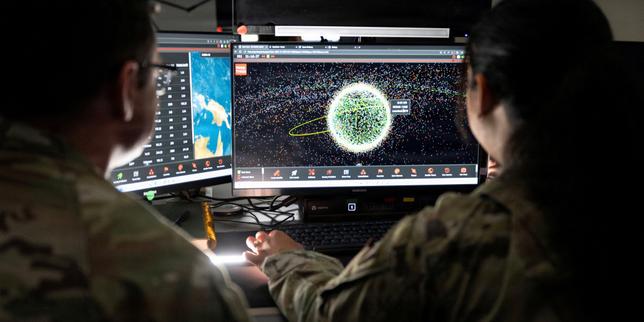
For decades, the official doctrine of Washington treated Earth's orbit as an inviolable sanctuary of peace, governed by Cold War treaties and polite diplomatic fictions. That curtain dropped entirely when senior Department of the Air Force leadership officially confirmed that the United States has deployed active space control weapons directly into orbit.
The admission, delivered during a major aerospace defense conference, stopped short of detailing specific kinetic kill vehicles or classified hardware payloads. Yet it shattered a long-standing diplomatic taboo. Space is no longer merely a high-altitude highway for reconnaissance, communication, and GPS timing signals. It has formally transitioned into an active theater of military operations, where the nation that blinks first loses the ability to see, navigate, or fight back down below. For a more detailed analysis into similar topics, we recommend: this related article.
To understand why this confirmation matters, one must look past the predictable outrage from Beijing and Moscow and examine the structural vulnerability of modern military forces. Every modern aircraft carrier strike group, missile defense battery, and tactical infantry battalion relies utterly on commercial and military satellites. Generals often repeat an old adage about modern warfare: if you are blind, you are dead. Adversaries like China and Russia understood this axiom years ago, quietly building out a diverse arsenal of ground-based lasers, cyber-attack tools, and co-orbital inspector satellites capable of disabling or blinding Western orbital assets.
For years, the Pentagon played a dangerous game of strategic ambiguity. Officials insisted that American satellites were purely defensive, equipped only with basic maneuvering thrusters or electronic shielding. But military analysts who have tracked orbital mechanics for decades recognized the mathematical reality long before any official admission. In the vacuum of space, traditional defensive positioning is a losing strategy. As senior Space Force commanders have noted privately, you cannot dig a trench in the thermosphere, and you cannot permanently run away from an aggressor closing in on your orbital plane. For further context on this development, comprehensive coverage is available at Gizmodo.
The strategic shift toward active on-orbit defense reflects a grim realization. Passive hardening against electronic jamming or cyber intrusion is no longer sufficient when an adversary possesses physical or directed-energy means to destroy high-value assets. If a hostile satellite maneuvers close enough to snip communication links or blind a missile-warning sensor, waiting for permission from terrestrial command centers to execute evasive actions often arrives too late. The weapon systems now orbiting above us are designed to bridge that dangerous response gap, providing immediate space control capabilities to protect critical national security infrastructure.
This milestone inevitably accelerates a high-stakes competitive cycle. Critics argue that openly acknowledging militarized orbits strips away whatever legal restraints remained from the Outer Space Treaty of 1967, inviting an unchecked arms race above the atmosphere. Yet that argument ignores the timeline. The race began long before the Pentagon press office decided to speak candidly. By ripping the band-aid off decades of strategic hypocrisy, Washington has simply acknowledged the reality of the sky overhead.
The friction will only intensify as more nations normalize the presence of armed hardware circling the globe. The quiet zone above our heads is closed forever, replaced by an unforgiving frontier where deterrence depends entirely on what you can hide, and what you are willing to use.