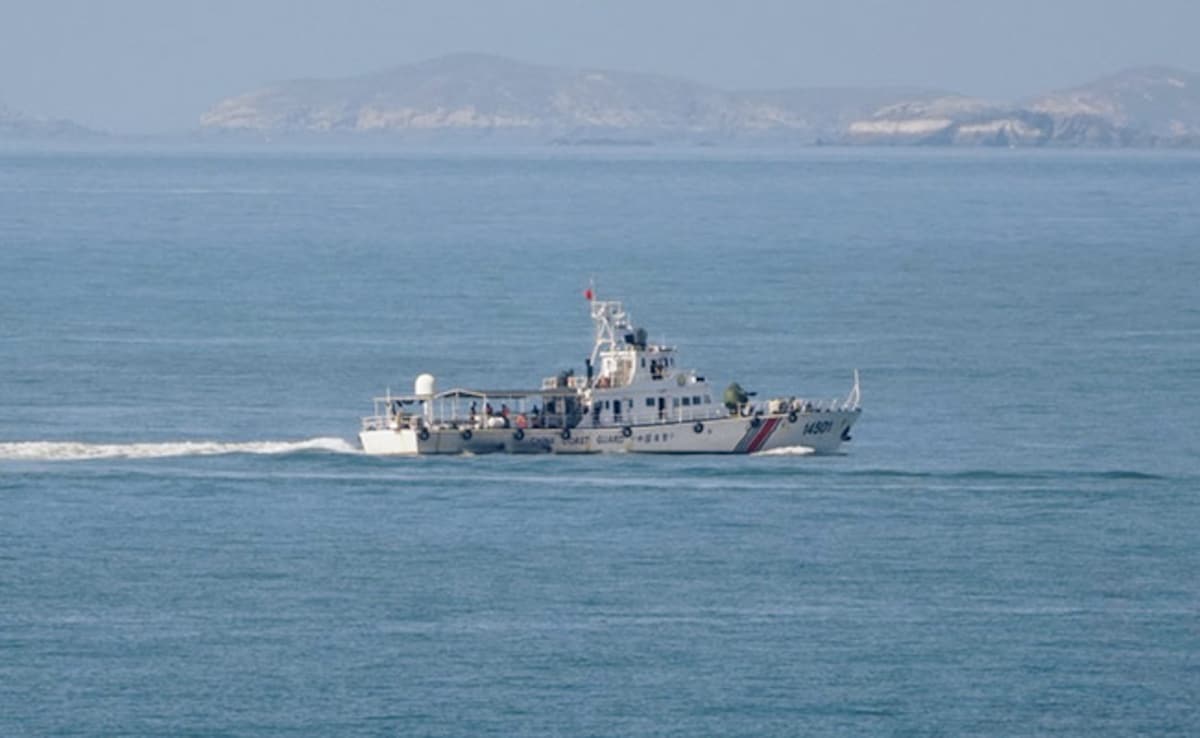
Two ships. A few dozen miles of salt water. A frantic news cycle.
If you are reading the breathless reports about Chinese PLAN (People's Liberation Army Navy) vessels loitering near the Penghu Islands and feeling a sense of impending doom, you are falling for the oldest trick in the book. You are watching the hand that is waving in the air while the other hand is quietly tightening the noose.
The "lazy consensus" among defense analysts and mainstream journalists is that these incursions are a prelude to a kinetic invasion—a literal "storming of the beaches." This narrative is not just tired; it is dangerously wrong. It treats modern geopolitical warfare like a 1944 rerun of D-Day.
The reality? China does not need to land a single boot on Penghu to win. In fact, if they are actually forced to shoot, they have already failed. These naval maneuvers are not "threats." They are calibration exercises for a digital and logistical stranglehold that most Western observers are too distracted to see.
The Myth of the "Invasion" Trigger
Every time a Type 052D destroyer nudges the contiguous zone, the media screams "escalation."
Let’s dismantle that.
For the PLA, these transits are high-fidelity data-gathering missions. They aren't looking for a fight; they are mapping the acoustic signatures of Taiwan’s underwater sensor arrays and testing the latency of the Republic of China (ROC) Navy’s response times.
I have spent years analyzing regional logistics and supply chain vulnerabilities. What I see isn't an invasion fleet. I see a Blockade-as-a-Service (BaaS) model.
By normalizing these "incursions," Beijing is effectively eroding the concept of a border. When the "abnormal" becomes the "daily routine," the tactical advantage of surprise shifts entirely to the aggressor. If a ship is there every Tuesday, you won't notice when it carries a different payload on Wednesday.
The focus on "defending the islands" is a distraction. The islands are rocks. The real target is the flow of liquid natural gas (LNG) and the silicon arteries that keep the global economy breathing.
The Kinetic Fallacy: Why You’re Looking at the Wrong Weapons
The standard PAA (People Also Ask) question is: "Can Taiwan’s missiles sink Chinese warships?"
It’s the wrong question. It assumes a localized, ship-to-ship conflict.
The real question is: "Can Taiwan’s economy survive a three-week 'quarantine' that never fires a single shot?"
China’s strategy is Cognitive Warfare. By placing ships near Penghu—the strategic gateway to the Taiwan Strait—they are performing a psychological stress test on global insurance markets.
Imagine a scenario where Lloyd’s of London decides the Taiwan Strait is a "war zone" for insurance purposes because of these persistent sightings. Shipping rates skyrocket. TSMC’s logistics costs quadruple. Foreign direct investment dries up.
Beijing wins by making Taiwan "too expensive to defend" and "too risky to partner with." You don't need to sink a destroyer to sink a GDP.
The Technology Gap: It's Not About Tonnage
Western commentators love to compare hull counts. "China has more ships!" "The US has more carriers!"
This is bean-counting for the unimaginative.
The naval presence near Penghu is a front for a much more sophisticated electronic warfare (EW) play. Every time Taiwan scrambles jets or paints these ships with radar, they are giving away their electronic order of battle (EOB).
- Signal Intelligence (SIGINT): These ships are giant vacuum cleaners for data. They are mapping how Taiwan’s command and control (C2) centers talk to each other.
- Acoustic Mapping: The waters around Penghu are shallow and tricky. The PLAN is perfecting the art of hiding sub-surface drones in the noise of commercial shipping.
- Salami Slicing: Each incursion moves the "median line" an inch to the east.
If you think this is about a territorial dispute over some islands, you are missing the forest for the trees. This is about the total dominance of the electromagnetic spectrum in the First Island Chain.
The High Cost of the "Status Quo"
We have been told for decades that the "Status Quo" is the goal.
The Status Quo is dead.
By reacting to every ship sighting with a formal protest and a frantic deployment, Taiwan and its allies are burning through resources. Airframes are hitting their fatigue limits. Crew exhaustion is real.
China is playing a game of attrition without spending a single bullet. They are using their massive industrial base to out-produce and out-rotate the defenders.
If I were advising a nation on its defense posture, I would tell them to stop chasing shadows. Every time you scramble an F-16 to intercept a ship that isn't going to fire, you are losing. You are trading a multi-million dollar flight hour for a few gallons of Chinese diesel.
The math doesn't work.
Stop Asking "When?" and Start Asking "How?"
The world is obsessed with a "2027 timeline" for an invasion. This obsession is a gift to the PLA. It makes us look for a "start date."
There is no start date. The conflict is already happening. It is happening in the cyber domain, in the insurance markets, and in the "gray zone" maneuvers near Penghu.
The "Penghu Incident" isn't a news story. It's a status report.
If you want to understand the threat, look at the fiber optic cables on the seabed, not the gray paint on the horizon. Look at the pressure on the New Taiwan Dollar. Look at the stockpile of food and fuel.
The ships are just the garnish. The main course is the slow, methodical isolation of an island that the world cannot afford to lose, but is too scared to truly protect.
We need to stop treating these sightings as military anomalies and start treating them as what they are: a relentless, non-kinetic siege designed to force a surrender before the first shot is ever fired.
If you're waiting for the "invasion" to start, you've already missed the war.