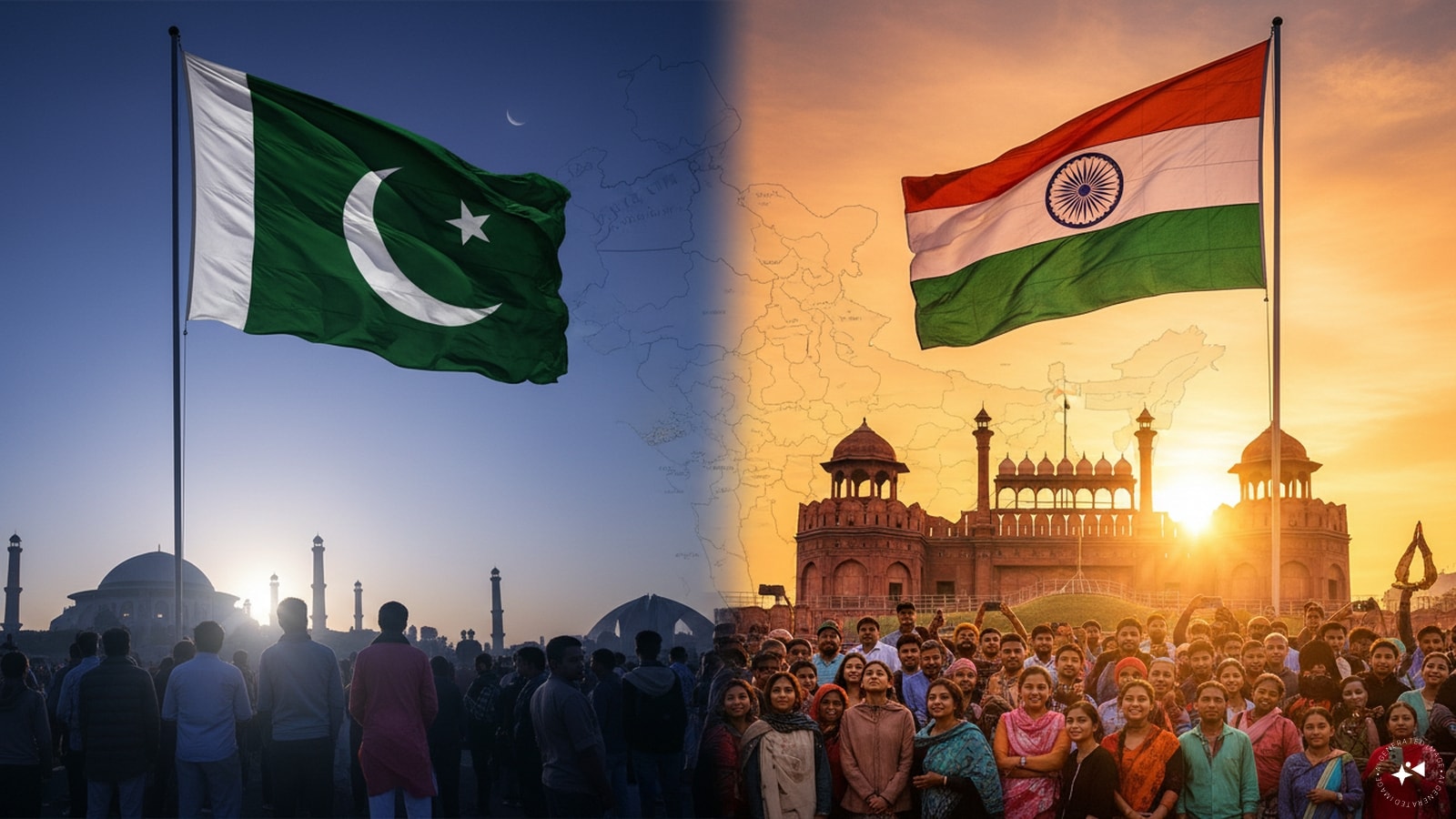
History books often treat the 1947 partition of British India as a political boundary drawn on a map. That is a lazy lie. It was a human earthquake. Up to twenty million people packed their entire lives into bullock carts, trains, and desperate foot columns. They crossed newly minted borders in both directions, leaving behind ancestral homes, businesses, and buried family histories.
Most people think the story ends with the trauma of refugee camps and government rations. They are dead wrong. The real story begins the morning after the smoke cleared. Building on this idea, you can also read: The Economics of Imperial Erasure Quantifying the Liu He Tomb Discrepancy.
Millions of broken families arrived in towns like Delhi, Bombay, and Calcutta with empty pockets and torn clothes. They didn't wait for handouts to fix their lives. They rolled up their sleeves and built the economic and cultural spine of modern India. You can trace the grit of partition survivors in almost every major commercial hub today. They changed the DNA of South Asian ambition forever.
The Brutal Reality of Starting From Scratch
Imagine stepping off a crowded refugee train at Kurukshetra or Kingsway camp with zero possessions. Your clothes are ruined. Your elderly parents are sick. Your children are starving. Observers at Bloomberg have shared their thoughts on this matter.
That was the daily reality for millions in late 1947. The newly independent Indian state was barely surviving its own birth pangs. Jawaharlal Nehru's government faced severe food shortages, a treasury splitting at the seams, and an administrative apparatus stretched to the absolute breaking point. The government simply lacked the resources to hand out comfortable lives to millions of displaced citizens.
Survival demanded immediate action. Pride had to go out the window.
Professors became manual laborers. Landowners took up street vending. Women who had never stepped outside the courtyard without a veil started sewing clothes or teaching in makeshift tents to feed their younger siblings. This wasn't graceful. It was a desperate scramble against starvation.
Yet, out of this profound humiliation emerged an unyielding mindset. If you lose everything overnight, you stop fearing risk. You realize that security is an illusion anyway. That single psychological shift turned an entire generation into aggressive risk-takers.
How Refugee Camps Turned Into Industrial Incubators
Government camps like Faridabad or Nilokheri were designed as temporary holding pens. The refugees treated them as launchpads.
Take the township of Faridabad, just south of Delhi. Around thirty thousand refugees from the North-West Frontier Province were dumped there in mud huts. Instead of remaining perpetual dependents on state dole, they formed cooperatives. They bargained for machinery, built brick kilns with their own hands, and turned a barren stretch of scrubland into a manufacturing cluster.
They didn't wait for venture capital or foreign direct investment. They pooled spare rupees, borrowed from relatives who were equally broke, and started small machine shops.
This hustle translated directly into national prosperity. The small-scale industrial sectors in Punjab, Haryana, and western Uttar Pradesh owe their existence entirely to this refugee work ethic. People who lost textile mills in Lahore built power loom factories in Ludhiana from discarded scrap metal. They didn't complain about unfavorable market conditions. They created the market.
The Cultural Shift in Education and Work
Traditional social hierarchies took a massive beating during the partition migration. Caste and class lines mattered very little when everyone was sleeping on the same dirt floor in a refugee camp.
Education became the only currency that mattered because it couldn't be stolen at gunpoint. Families would starve themselves for months to pay school fees for their children.
I have spoken with descendants of refugees who remember eating single meals a day so their older brother could afford engineering textbooks. That intense laser focus on education created a massive talent pool. The children and grandchildren of these survivors went on to populate the upper echelons of Indian bureaucracy, science, corporate leadership, and global technology firms.
They also brought a unique business philosophy to urban India. Traditional trading communities in certain regions had conservative approaches to capital. Partition survivors introduced a hyper-aggressive, high-turnover retail model. Look at the bustling markets of Lajpat Nagar, Karol Bagh, or Chandigarh's sector markets. These commercial ecosystems were forged by people who knew that standing still meant dying.
Why This History Matters Right Now
We live in an era where minor inconveniences trigger existential meltdowns. We obsess over comfort zones and work-life balance while forgetting what real disruption looks like.
Studying the partition generation offers a harsh antidote to modern fragility. These people didn't have therapy apps or motivational podcasts. They had raw survival instinct and a refusal to play the victim.
They refused to let their worst day define the rest of their century. When the British drew lines that tore their world apart, they didn't spend decades crying over spilled milk. They picked up the pieces, crossed the border, and built a country worth living in.
Next time you face a career setback or a broken business deal, remember the people who stepped off those trains in 1947 with nothing but the dust on their feet and built an empire from the ground up. Stop waiting for ideal conditions. Start building.