Ink on paper carries weight long after the printers fall silent. Sometimes, that weight crosses an ocean. It lands on a doorstep in Florida or a mahogany desk in New York, demanding an answer to a question asked thousands of miles away.
Think about how a courtroom operates. It is a chamber of gravity. Every word spoken under oath is meant to anchor a floating truth. But what happens when the anchor is held by someone who refuses to drop it? What happens when the dispute spans continents, pitting a historic broadcasting institution against a family whose surname is synonymous with relentless visibility?
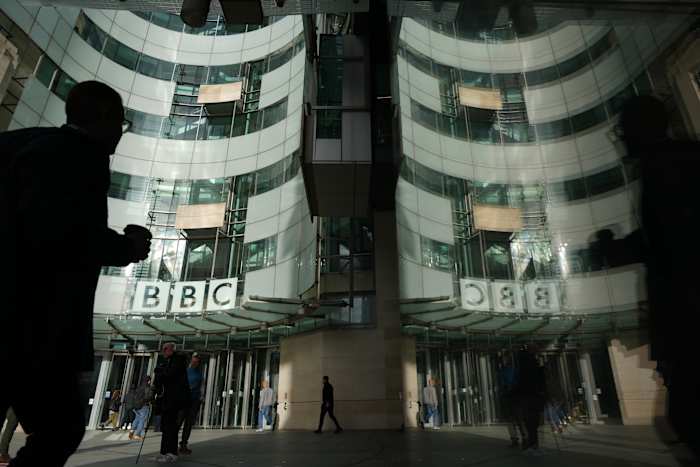
The British Broadcasting Corporation stands for a specific kind of institutional permanence. Founded nearly a century ago, its voice has crackled through wartime wireless sets and illuminated living room screens during moments of global crisis. When the BBC reports a story, the assumption of careful verification follows. Yet, institutions built on trust are vulnerable. A single disputed broadcast can strike at the heart of that trust, threatening the currency a news organization trades in.
That currency is reputation.
When a defamation lawsuit takes root, it transforms from a legal filing into a slow-moving storm. Every deposition is a flash of lightning. Every subpoena is rolling thunder. And right now, that storm is reaching across the Atlantic, seeking out testimony from the Trump family.
To understand why this matters, step away from the flashing cameras and the endless commentary cycles. Look instead at the mechanics of accountability. Defamation law is notoriously difficult terrain, especially in the United Kingdom, where the scales have historically favored those seeking to protect their honor from stinging words. To defend a broadcast, a news organization must do more than claim it acted in good faith. It must prove the factual bedrock of its journalism. It needs witnesses. It needs corroboration. It needs people who were in the room when decisions were made, words were exchanged, or actions were taken.
Enter the application filed in a United States court.
This is not a casual request. It is a formal invocation of judicial assistance under Section 1782, a legal mechanism that allows foreign tribunals to obtain evidence located within American borders. It is the international equivalent of a knock on a locked door with a locksmith standing behind the deputies. The BBC is not merely asking for a conversation. It is utilizing the muscle of federal procedure to compel individuals—in this case, members of the prominent political family—to sit for depositions and hand over documents.
Why the Trump family? The legal filings point to specific public statements and interactions central to the underlying litigation. When public figures become entangled in disputes involving international media, the boundaries of jurisdiction blur. American citizens residing in Florida or elsewhere find themselves pulled into British legal orbits. The friction between different legal systems creates a peculiar kind of theater, one fought not with closing arguments before juries, but with motions, briefs, and jurisdictional arguments filed by high-priced counsel.
Consider the human element beneath the procedural coldness.
Imagine receiving the notification. For most people, a court summons induces a cold sweat, a racing pulse, the sudden realization that your private life is about to be placed under a microscope. For the Trump family, accustomed to an existence lived entirely inside public view, litigation is a second language. They have spent decades navigating depositions, injunctions, and civil suits. Yet, fighting a subpoena issued on behalf of a British broadcaster adds a distinct layer of complexity. It introduces foreign standards of evidence and the looming threat of cross-examination that carries different rules than its American counterpart.
The legal machinery grinds forward, indifferent to the political lightning rods attached to the names on the court documents. Judges do not care about headlines. They care about statutory interpretation. Does the statute apply? Yes. Is the evidence relevant to a foreign proceeding? The applicants argue yes. Will the respondents contest the reach of the foreign court? Every step of the way.
This is where the invisible stakes reveal themselves.
At its core, this legal maneuver is a contest over who gets to write the final draft of history. The BBC wants to defend its journalism by extracting testimony that could either substantiate or undermine the claims at issue. The Trump family wants to protect their privacy, their strategic positioning, and their peace from a foreign tribunal's probing questions. Every deposition transcript extracted, every email produced, and every text message entered into the record becomes a brick in a wall. One side is trying to build a defense against a crippling defamation judgment. The other is guarding the perimeter of personal autonomy against an international adversary.
We have seen this script before, though the actors change. Powerful organizations collide with powerful individuals, and the resulting sparks illuminate the fault lines of global media accountability. In an era where information flows instantly across borders, accountability has become borderless, too. A broadcast beamed into millions of British homes can trigger legal consequences in a South Florida courtroom. A sentence spoken at a rally can reverberate through the Royal Courts of Justice in London.
The proceedings will take months, perhaps longer. Briefs will be filed. Arguments will be heard in federal courtrooms where spectators check their phones and murmur quietly in the gallery. Attorneys will stand at lecterns, parsing out statutory definitions and historical intent.
Yet, when the briefs are filed and the judges issue their rulings, the core question will remain hanging in the air. Can an international news titan force a prominent American family to testify about events they would rather leave buried? The courts will answer that question with a ruling. But the deeper answer is written in the relentless march of modern litigation, where no secret stays overseas for long, and every spoken word eventually demands its receipt.
The courtroom lights stay on late into the evening. A printer hums in the corner, churning out pages of legal justification. Across the ocean, an archive waits for the testimony that might change everything, or nothing at all.