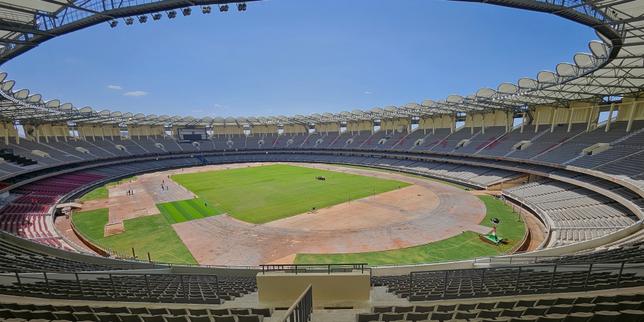
Every two years, the continental football establishment loses its collective mind over concrete pour schedules, stadium turnstiles, and hotel bed counts. Right on cue, the alarmists are screaming that the 2027 Africa Cup of Nations—co-hosted by Kenya, Uganda, and Tanzania—is hurtling toward infrastructure disaster. The lazy consensus in the sports media narrative is simple: construction lag equals administrative failure, and administrative failure means the Confederation of African Football must swoop in with a rescue plan or strip the rights entirely.
It is a remarkably superficial read of how major sports tournaments actually get built, financed, and delivered in the modern era.
I have spent the last fifteen years watching bidding committees over-promise and under-deliver, only for host nations to pull off spectacles that leave western broadcast booth pundits eating their words. The panic over the East African joint bid forgets a fundamental reality of stadium economics and tournament staging: deadlines are artificial constructs, and panic is a cheap commodity traded by people who have never laid a brick or negotiated a broadcast rights package on the continent.
Let us dismantle the panic piece by piece.
The Myth of the Perpetual Construction Crisis
The prevailing narrative treats a delayed concrete slab as an existential threat to the tournament. This is nonsense. Major tournament infrastructure thrives on compressed timelines. When a government stakes its geopolitical prestige on an event like the Africa Cup of Nations, bureaucratic inertia vanishes the moment political will locks in.
Kenya, Uganda, and Tanzania are not stumbling into this blind. They understand the stakes of the East Africa Pamoja bid. It represents a geopolitical realignment of sports diplomacy in the region. Yet, the mainstream press points to missed milestones from six months ago as proof of impending doom.
This ignores how construction velocity shifts exponentially as kickoff approaches. The final twenty percent of any stadium project absorbs eighty percent of the visible progress because that is when the finishing trades—the lighting rigs, the pitch laying, the media boxes, and the security integration—converge.
Worrying about raw structural shells three years out is like panicking that a chef hasn't plated a meal while the ingredients are still marinating. It demonstrates a profound misunderstanding of project management in developing sports economies.
Why a Single-Country Host is a Trap
Another favorite argument of the continental pessimists is that splitting the tournament across three nations multiplies logistical friction and guarantees chaos. They argue that CAF should centralize the event in a single country with pre-existing mega-stadiums.
This logic is dangerously regressive. Single-country mega-hosting models are financial sinkholes. Ask South Africa about the maintenance costs of their white-elephant arenas from 2010. Ask Brazil about the ghost stadiums dotting the Amazon.
The East African joint bid is actually a masterclass in risk mitigation and regional economic integration. By distributing the capital expenditure across three sovereign treasuries, the financial burden on any single taxpayer base is kept manageable. Furthermore, it forces infrastructural investment into secondary transport corridors, regional airports, and hospitality networks that serve local populations long after the final whistle blows.
If a stadium in Kampala experiences a delay, Tanzania’s upgraded facilities and Kenya’s aviation hub absorb the variance. That is not a failure of coordination; that is structural redundancy. Single-nation hosting is a vanity project for the past century. Multi-nation regional distribution is the only sustainable future for continental tournaments.
The Real Threat is Not Concrete, It is Bureaucracy
While the press obsesses over whether a specific grandstand will have its roof installed by next Tuesday, they are completely missing the actual threats to the tournament's success.
The real bottlenecks in African football administration have never been about steel and cement. They are about administrative competence, ticketing transparency, visa friction, and broadcast infrastructure execution. You can build a 60,000-seat architectural marvel in record time, but if accreditation systems crash on day one, or if regional borders require three hours of paperwork for traveling fans, the tournament suffers.
East Africa has a massive opportunity here, but only if they pivot their focus away from appeasing inspection committees and toward fan experience architecture. The infrastructure that matters most isn't just concrete; it's digital connectivity, open skies agreements between the three partner states, and seamless cross-border mobility for supporters who want to follow their teams from Dar es Salaam to Nairobi and Kampala.
If the local organizing committees spend all their energy chasing arbitrary construction checklists dictated by bureaucrats sitting in air-conditioned offices thousands of miles away, they will miss the operational details that actually define a legendary tournament.
What Needs to Happen Right Now
Stop listening to the Cassandras who want every host nation to look like a carbon copy of a European Champions League venue.
Kenya, Uganda, and Tanzania need to stop playing defense against sensationalist headlines. They need to weaponize their timeline. Use the perceived delays as leverage to fast-track municipal reforms, streamline immigration policies between the three nations for the duration of the tournament, and lock in long-term corporate sponsorships that view East Africa as a surging consumer market rather than a charity case.
The 2027 Africa Cup of Nations will happen. The pitches will be green, the floodlights will glare, and millions across the continent and the diaspora will tune in. The only question is whether the host nations will waste their energy trying to satisfy an impossible standard of perfection, or if they will deliver an authentic, high-energy regional showcase that rewrites the playbook on how tournaments are built.
Ignore the noise. Lay the turf. Open the borders. Play ball.


