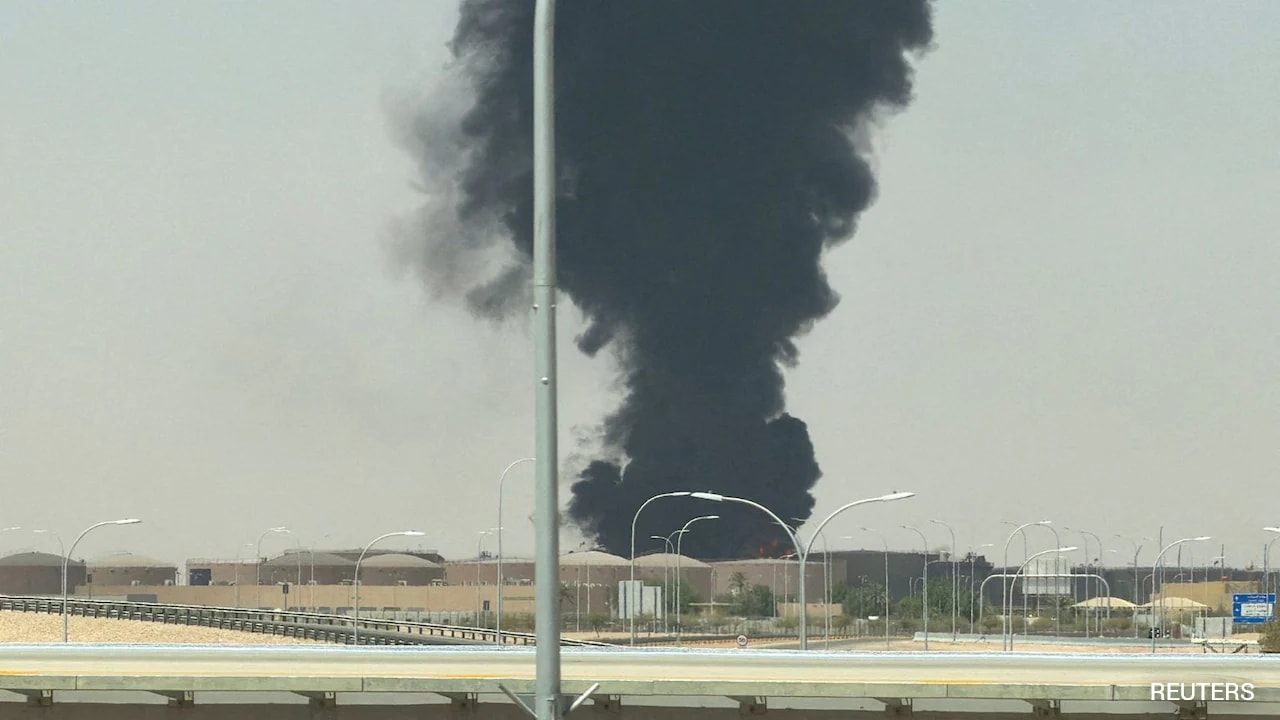
When smoke billowed over the fuel storage depot near King Khalid International Airport, international media outlets instantly defaulted to the lazy consensus. The headline narrative wrote itself: Houthi drones or missiles had breached Saudi air defenses, plunging the kingdom's aviation hub into chaos. Flightradar24 spiked to its maximum disruption index of 5.0, and desk analysts scrambled to rehash tired talking points about an expanding proxy war in the Middle East.
Everyone focused on the fire. Everyone focused on the optics of flames licking against an Aramco-logoed fuel tank within sight of a capital city terminal.
They are looking at the wrong fire.
By obsessing over the tactical pyrotechnics near a tarmac, commentators missed the structural transformation of regional risk. The lazy consensus assumes that a military strike on a capital city airport is an existential threat to Saudi infrastructure. I have watched defense budgets absorb billions and logistics chains pivot on a dime; a single localized fuel tank fire does not cripple a petrostate. What it actually signals is a complete rewrite of how capital markets price physical security in the Arabian Peninsula.
Let us define terms precisely. A missile interception or impact resulting in a localized hydrocarbon fire is an operational nuisance, not a systemic economic collapse. Saudi air defense networks, anchored by Patriot batteries and sophisticated radar arrays, intercept the vast majority of incoming vectors. Yet, the psychological impact on commercial aviation and insurance underwriters vastly outweighs the kinetic damage.
The real story isn't that a fuel tank burned on a Saturday morning. The real story is how quickly modern aviation indices and global insurers panic at the mere proximity of conflict to a high-profile civil node, and how Riyadh's economic planners have already engineered around these vulnerabilities.
Imagine a scenario where every regional skirmish instantly halts civilian air traffic for twelve hours. The traditional analyst screams about supply chain failure. The realist looks at the redundancy built into the Gulf's logistics network. King Khalid International Airport handles massive volumes, but Saudi Arabia’s economic heartbeat is diversified far beyond a single tarmac in Riyadh. When the airport hit peak disruption ratings, cargo didn't vanish; it rerouted, delayed, or absorbed the friction.
Furthermore, look at where else the strikes were claimed: Yanbu on the Red Sea coast. That is the true pressure point. The East-West Pipeline terminus at Yanbu represents the kingdom's strategic escape hatch, designed precisely to bypass chokepoints like the Strait of Hormuz. When Houthi spokesmen claim operations targeting Yanbu alongside Riyadh, they aren't just trying to disrupt domestic flights; they are trying to weaponize the insurance premiums of global crude transit.
Here is the dirty secret that defense journalists won't admit: Saudi Arabia has institutionalized a high-tolerance threshold for these asymmetric attacks. The cost-per-intercept for modern missile defense is astronomical, true. But the kingdom's sovereign wealth and industrial capacity absorb these overhead costs as a cost of doing business in a volatile neighborhood. The state does not wobble because a fuel depot catches fire; it hardens its perimeter, updates its threat matrix, and keeps pumping.
The downside to this contrarian view? It requires admitting that geopolitical risk is no longer an anomaly—it is the baseline operating environment. Investors who panic-sell every time black smoke rises near a Middle Eastern airport are trading on headlines rather than fundamentals. The structural reality of the Yemen conflict's spillover is that local airspaces will experience periodic friction, but the grand architecture of Gulf commerce remains entirely intact.
Stop treating every flare-up as an apocalypse. Start looking at how capital adapts when the smoke clears by noon.