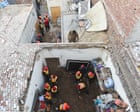
Fourteen children are dead after a roof collapsed at an unregistered tutoring center in Pakistan. The mainstream media has already queued up its standard, predictable script. The talking heads demand more building inspectors. They call for sweeping government crackdowns on "ghost schools" and coaching centers. They scream for stiffer penalties against the building owner.
It is a comforting, lazy consensus. It suggests that if we just print more regulations and hire more bureaucrats, the infrastructure of developing nations will magically stabilize.
It is also entirely wrong.
The tragedy in Pakistan is not a failure of regulation. It is a predictable outcome of regulatory inflation and economic strangulation. When Western journalists and local elites look at a collapsed roof in a low-income neighborhood, they see a governance gap. They fail to see the economic reality: over-regulation is exactly what drives these vital educational hubs into unsafe, underground spaces in the first place.
The Blind Spot of Bureaucratic Absolutism
Every time an infrastructure failure occurs in South Asia, the immediate public knee-jerk reaction is to ask why the government did not prevent it. This question rests on a flawed premise. It assumes that the state possesses the capacity, the capital, and the integrity to police every square meter of real estate.
It does not.
In developing economies, demanding strict adherence to gold-standard building codes for small, private educational startups is a death sentence for literacy. When a state makes it prohibitively expensive, slow, and corrupt to legally register a school building, it does not stop people from teaching. It simply forces them to teach in structures that completely bypass the legal system.
Consider the mechanics of the local "coaching center" economy. These are not elite academies funded by corporate venture capital. They operate on razor-thin margins, charging pennies to children from families desperate to pass standardized civil service or university entrance exams.
If you force these operators to comply with a 500-page structural engineering code—written by bureaucrats who copied it from a British or American textbook—you do not get safer schools. You get closed schools. Or worse, you get what happened here: operations pushed into the shadows, where bribery replaces blueprints.
The Mirage of Enforcement
Let’s dismantle the "People Also Ask" obsession with enforcement. The public asks: Why doesn't Pakistan just enforce its existing building codes?
The brutal, honest answer is that enforcement in a system rife with institutional corruption is just another word for extortion.
Imagine a scenario where the government deploys an army of building inspectors to every neighborhood in Punjab or Sindh. What actually happens on the ground? The inspectors do not pull out lasers and structural testing equipment. They pull out their pockets. The unregistered tutoring center pays a nominal bribe—a fraction of what formal registration would cost—and the inspector signs off or looks the way.
The tragedy is that the "unregistered" status is not a secret to the local municipality; it is a revenue stream.
I have watched public policy initiatives in developing markets pour millions of dollars into training inspectors and digitizing land registries. The result? The paperwork looks beautiful in a World Bank report, but the concrete on the ground remains just as brittle. The structural integrity of a building cannot be legislated into existence when the underlying economic incentives favor evasion.
The Real Culprit: The Formalization Trap
The obsession with formalizing the informal economy kills.
When international observers lament the rise of unregulated tuition centers, they ignore why these centers exist. Public school systems in these regions are broken, underfunded, and ideological. Private coaching centers are a hyper-rational, market-driven response to a failed state monopoly on education. They are agile, effective, and accessible to the poor.
By forcing these centers to meet identical structural standards as a multi-story corporate bank, the state creates an artificial barrier to entry. The elite schools can afford the compliance costs, the setbacks, the architectural fees, and the official grease money. The poor are left with two choices: structural decay in secret, or complete ignorance.
| Educational Model | Compliance Cost | Accessibility | Regulatory Vulnerability |
|---|---|---|---|
| Formal Elite Academy | High | Low (Wealthy only) | Low (Protected by capital) |
| Informal Coaching Center | Low (Zero) | High (Working class) | High (Target for extortion) |
The table makes the trade-off stark. The informal center is a fragile liferaft. Puncturing the liferaft because it does not have regulation-compliant seatbelts is an act of bureaucratic malice, not humanitarian aid.
Stop Demanding Inspectors, Start Decoupling Capital
If the goal is actually saving lives rather than signaling moral superiority on social media, the entire framework of the conversation must shift.
We must stop treating building safety as a top-down police action. Instead, we must treat it as a bottom-up capitalization problem. The roofs of these centers collapse because the owners lack access to cheap, formal credit to upgrade their properties. They cannot get a bank loan because their business is unregistered, and their business is unregistered because registration is a bureaucratic nightmare designed to extract bribes.
It is a vicious, lethal cycle.
The contrarian solution is deeply uncomfortable for statist bureaucrats: deregulate the commercial use of residential spaces for educational purposes, slash the registration process to a single-page notification, and offer micro-loans specifically earmarked for structural reinforcement.
If you remove the threat of closure and extortion, business owners can afford to invest in iron beams instead of payoffs. They can bring their structures into the light.
The Cost of Sentimentality
The media will continue to parade grieving families and demand immediate, sweeping bans on unregistered schools. Politicians will oblige, launching high-profile raids that shut down hundreds of centers, depriving thousands of students of their only shot at upward mobility.
Then, when the news cycle shifts, the raids will stop, the bribes will resume, and the concrete will keep aging.
We must discard the sentimental illusion that a government signature makes a ceiling safe. The fourteen children who died did not perish from a lack of paperwork. They died because the state made safety an unaffordable luxury. Stop asking for more laws. Demand fewer barriers, so that the next generation can study under roofs built with steel, not bought with silence.