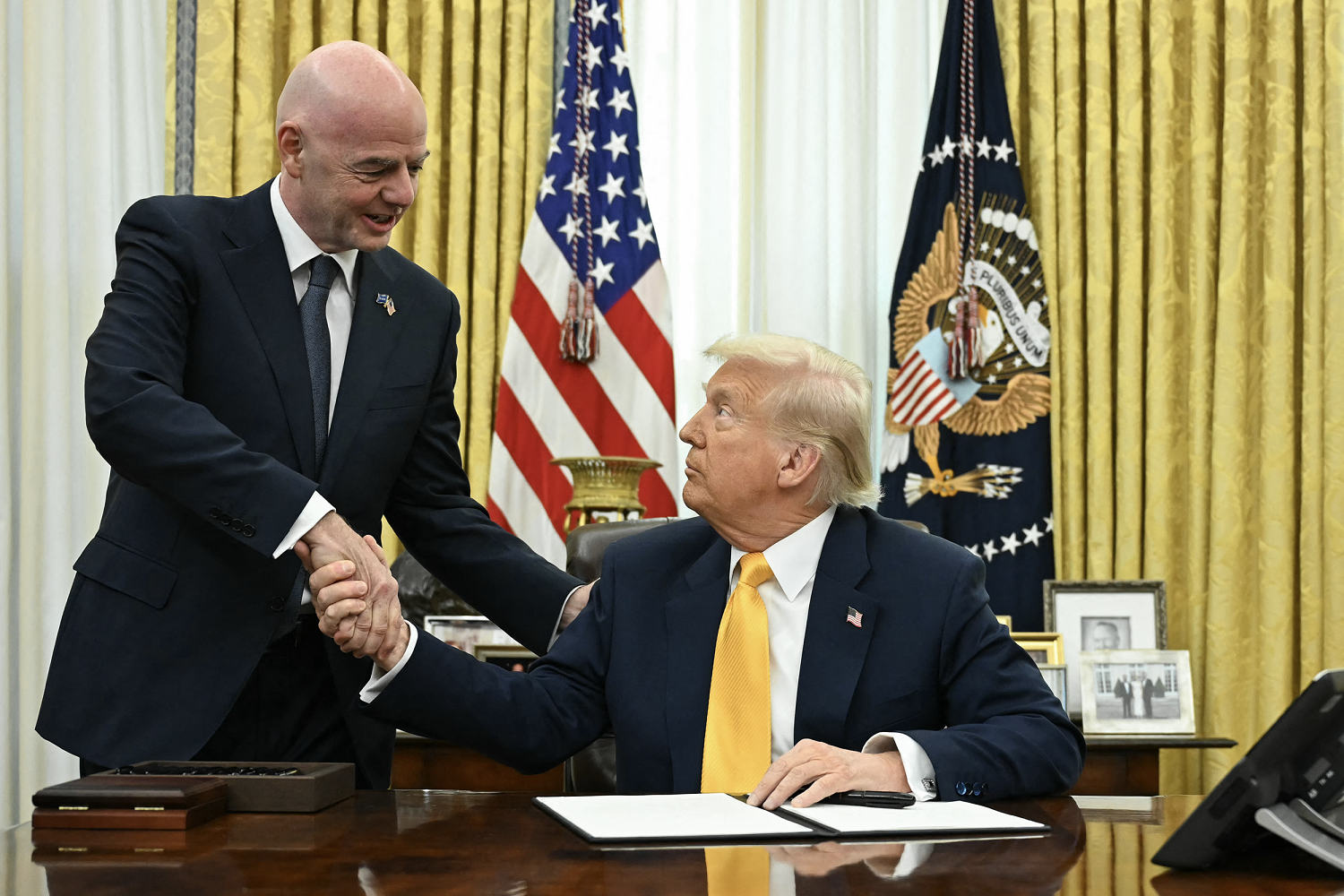
European soccer executives are having a collective panic attack. UEFA is screaming about red lines. The Belgian football association is releasing breathless statements about the death of fair play. The commentariat is weeping into their microphones because Donald Trump picked up a phone, called Gianni Infantino, and suddenly Folarin Balogun is cleared to play in Monday’s World Cup knockout match in Seattle.
They call it an unprecedented disaster. They call it the day the rulebook died.
They are completely wrong.
This is not the corruption of a pure sport. This is the logical culmination of what international soccer has always been. The sports world loves to pretend that the World Cup is a sacred meritocracy governed by untouchable laws written on stone tablets in Zurich. It is a comforting myth designed to keep fans buying jerseys and television networks writing billion-dollar checks.
The reality is far more transactional. FIFA has always functioned as a geopolitical entertainment conglomerate. Trump did not break the system by lobbying to lift Balogun’s automatic one-match ban. He simply utilized the exact mechanism the system was built to accommodate.
The Myth of the Sacred Red Card
Let against-the-grain logic dictate this analysis. The outrage machine is hyper-focused on the sanctity of the automatic suspension. A player gets a red card; the player sits out the next game. That is the baseline rule.
But look at the actual incident from the round of 32 match against Bosnia and Herzegovina. Balogun was running at full speed and tangled feet with Tarik Muharemović. There was no malicious intent. There was no violent conduct. The on-field referee did not even call a foul initially. It was only after a hyper-literal, slow-motion Video Assistant Referee review that the straight red emerged.
Benching a tournament’s marquee talent in the host nation for a mechanical malfunction of the rulebook is bad for the product. FIFA knows this. Article 27 of the FIFA disciplinary code explicitly permits the judicial body to suspend the implementation of disciplinary measures. The rule was already there. It was written by FIFA lawyers specifically to give the governing body an escape hatch when rigid regulations threaten to sabotage their own multi-billion-dollar show.
The critics are acting as if a dictator marched onto the pitch and tore up the referee's notebook. In truth, an entertainment company exercised a corporate waiver to protect its primary asset: host-nation viewership.
International Soccer Has Always Been a Transaction
To believe that this phone call permanently stained the integrity of the game requires a selective amnesia about the history of international sports. Soccer and raw political leverage have been intertwined since the inception of the modern game.
Consider the historical precedents:
- The 1934 World Cup: Benito Mussolini explicitly weaponized the tournament in Italy, influencing referee selection and ensuring naturalized Argentine players suited up for the Azzurri to secure a nationalist propaganda victory.
- The 1978 World Cup: The Argentine military junta used the tournament to mask systemic human rights abuses, with widespread reports of backroom economic deals—including shipments of grain and frozen funds—to ensure favorable match outcomes in the second group stage.
- The Modern Bidding Wars: The entire process of awarding hosting rights over the past three decades has been an exercise in corporate lobbying, state-backed infrastructure promises, and geopolitical maneuvering.
When corporate elites and heads of state lobby for stadium tax breaks, expedited visas, or hosting rights, the soccer establishment calls it diplomacy. When a president calls to complain about a questionable VAR decision that benches a star forward, they call it an existential crisis. The mechanism is identical.
I have seen sports franchises and governing bodies operate behind closed doors for decades. They do not operate on chivalry; they operate on asset protection. Balogun is a 40-million-euro asset playing in a home tournament designed to maximize soccer's commercial footprint in North America. Benching him because of an accidental ankle-clip would be a masterclass in commercial self-sabotage.
The Flaw in the Fair Play Premise
The standard argument from the Belgian FA and European purists relies on a deeply flawed premise: that the rules are currently applied with absolute equity.
They are not. Small nations are routinely squeezed by officiating biases, scheduling disadvantages, and economic disparities that favor the traditional powers of Western Europe and South America. The introduction of VAR was supposed to standardize the sport, but it merely shifted the inconsistency from the field to a dark room filled with monitors.
If the system were truly fair, an accidental collision would not carry the same competitive death sentence as a deliberate, leg-breaking tackle. By utilizing Article 27 to place Balogun on a one-year probationary period instead of enforcing an immediate blackout, FIFA actually achieved a more equitable outcome for the spectacle itself. Mauricio Pochettino noted that the team had already been penalized enough by playing with ten men for over half an hour against Bosnia. Forcing the USMNT to field a depleted squad in a legacy-defining match against Belgium because of an algorithmic officiating error does not preserve fair play—it ruins the competitive validity of the knockout stage.
The Entertainment Imperative
We live in an attention economy where sports compete directly with streaming platforms, video games, and short-form digital media. The 2026 World Cup is the largest expansion in the tournament's history, designed to capture the casual American sports consumer.
Imagine a scenario where the host country’s top scorer is forced to sit in the stands during prime-time television because of a technicality. The casual fan does not tune in to watch a clinical display of administrative compliance. They tune in to watch elite athletes execute at the highest level.
FIFA chief Gianni Infantino understands this perfectly. His job is not to act as a monastic guardian of abstract sportsmanship; his job is to maximize global engagement and revenue. When Trump warned that Balogun’s absence would leave a stain on the event, he was speaking Infantino's language. He was identifying a threat to the value of the television broadcast.
The Operational Reality
Let us break down the mechanics of how power actually flows in modern sports administration.
[Political Pressure / Market Share Threat]
                   │
                   ▼
       [FIFA Executive Leadership]
                   │
                   ▼
     [Invocation of Article 27 Waiver]
                   │
                   ▼
[Protection of Broadcast Value & Star Talent]
The diagram illustrates the loop. The system does not break down under pressure; it executes a pre-programmed self-correction to preserve value. The independent judicial bodies cited by Infantino are independent only until the financial stakes threaten the overarching organization.
Belgium can complain to the Court of Arbitration for Sport. UEFA can issue blistering press releases to satisfy their local fanbases. But they will all show up to the stadium on Monday. The television networks will still broadcast the game. The sponsors will still run their advertisements.
The corporate structure of global soccer has survived decades of actual bribery scandals, structural corruption, and systemic financial mismanagement. It will easily survive a host-nation president demanding that his best striker be allowed to run onto a patch of grass in Seattle.
Stop looking at the sport through the romanticized lens of a schoolyard game. The World Cup is a high-stakes corporate production. The actors are set. The star player is on the field. The show will go on exactly as the corporate and political architects intended.


