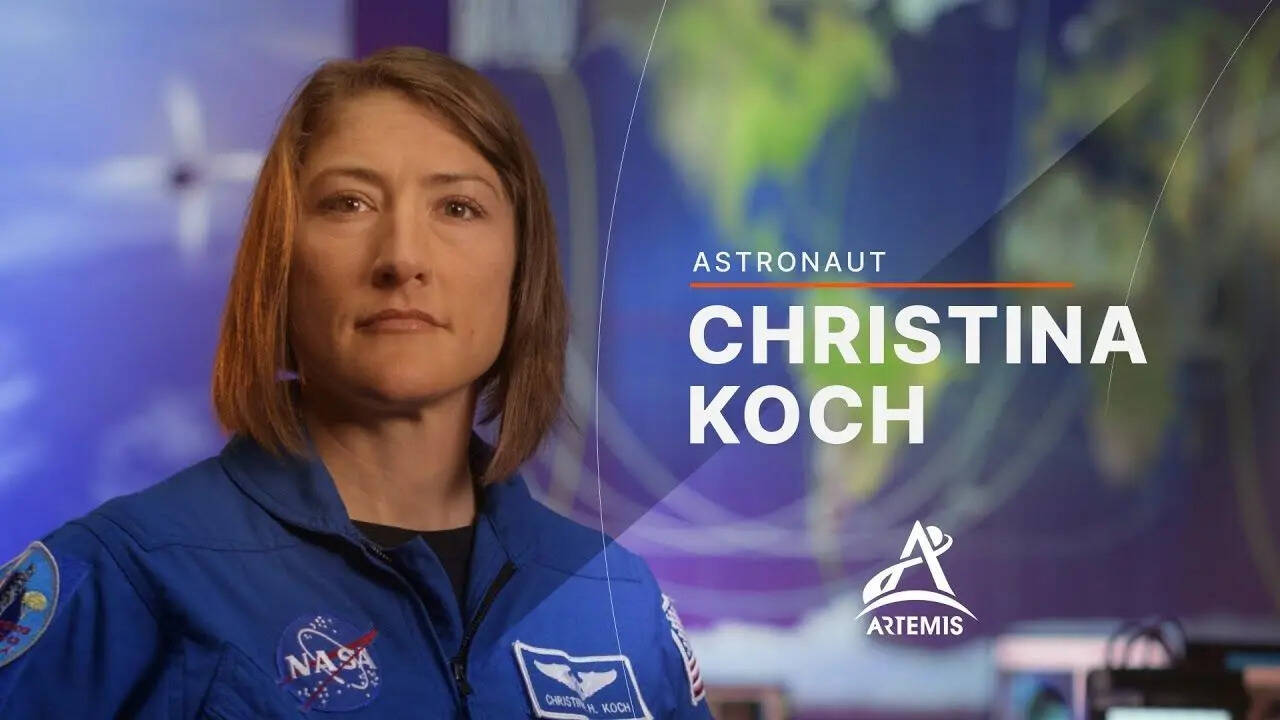
The selection of Christina Koch as the Mission Specialist for Artemis II represents a calculated optimization of human capital for the first crewed lunar flyby in over half a century. While public discourse often focuses on the symbolic milestones of the mission, the technical reality is that Koch’s placement is a response to the specific risk vectors of a 10-day High Earth Orbit (HEO) and Trans-Lunar Injection (TLI) flight path. Artemis II is not a landing; it is a critical systems validation of the Orion spacecraft’s Life Support Systems (LSS) and the Heat Shield’s performance during a high-energy atmospheric reentry. Koch provides the crew with a unique technical redundancy derived from her 328 consecutive days in orbit, the longest single spaceflight by a woman, which serves as the primary dataset for long-duration human physiological response.
The Architecture of the Artemis II Mission Profile
The mission operates on a Free Return Trajectory, a passive safety mechanism designed to ensure that the spacecraft’s momentum will naturally pull it back to Earth using the Moon's gravity. This eliminates the need for a secondary engine burn to return, mitigating the risk of propulsion failure at the lunar far side.
The 10-day duration is divided into two distinct operational phases:
- Phase One: High Earth Orbit (HEO)
Orion will remain in a high-altitude Earth orbit for the first 24 hours. This period is the "go/no-go" window for the Environmental Control and Life Support System (ECLSS). Before the TLI burn, the crew must verify that the spacecraft can maintain a pressurized, oxygenated environment under the stress of rapid orbital maneuvers. - Phase Two: Trans-Lunar Injection and Flyby
Once cleared, the Interim Cryogenic Propulsion Stage (ICPS) will propel the crew toward the Moon. The spacecraft will travel approximately 370,000 kilometers from Earth, reaching a point 10,300 kilometers past the lunar surface. At this distance, the crew will experience the most intense radiation environment of the mission as they exit the protection of the Earth’s magnetosphere.
Koch’s role as Mission Specialist 2 is specific to the "Flight Engineer" archetype. Her primary responsibility involves managing the interface between the Orion’s automated flight software and the manual overrides required during docking or emergency recovery. Her experience on the International Space Station (ISS) with the Canadarm2 and EVAs (Extravehicular Activities) provides the manual dexterity and spatial awareness necessary for high-stakes telemetry monitoring.
Quantifying the Koch Data Set: Physiological and Technical Benchmarks
The value of Christina Koch to the Artemis program is rooted in the "Year in Space" data. NASA’s Human Research Program (HRP) uses her biological data to model the effects of microgravity on bone density, ocular health, and cardiovascular remodeling.
The Bone-Mineral Density Offset
In microgravity, astronauts lose an average of 1% to 1.5% of bone mineral density per month. Koch’s 11-month mission provided a rare look at the plateauing effect of long-term exposure. By analyzing her recovery trajectory post-landing, NASA engineers can better calibrate the exercise equipment (ARED) on Orion. Because Orion is significantly more mass-constrained than the ISS, the exercise systems are less robust. Koch’s data helps determine the minimum threshold of physical activity required to maintain mission-critical strength for a lunar reentry that subjects the body to up to 8Gs.
Radiation Exposure and Sex-Based Risk Modeling
The Artemis II crew will be the first humans since 1972 to leave the Van Allen radiation belts. Historically, NASA’s Career Health Limit for radiation was lower for women than for men due to higher risks of certain cancers. However, recent shifts in the "Risk of Exposure-Induced Death" (REID) framework have moved toward a universal standard. Koch’s mission provides a baseline for how an experienced astronaut’s cellular repair mechanisms respond to high-dose environments. This is a critical variable for the Artemis III landing mission, where the crew will be exposed to solar particle events on the lunar south pole for extended durations.
Engineering the First Woman Milestone: Beyond Symbolic Value
The designation of Koch as the "first woman" to reach the vicinity of the Moon is often framed through a social lens, but from a systems engineering perspective, it represents the closing of a significant data gap. Apollo-era data is exclusively male. Human factors engineering—ranging from suit ergonomics to the design of the Orion waste management system—has historically been biased toward male physiological averages.
Integrating Koch into the first crewed Orion flight forces a rigorous validation of the spacecraft’s ergonomic adaptability. This includes:
- Pressure Suit Articulation: Testing the xEMU and Orion Crew Survival System (OCSS) suits across a broader range of anthropometric data points.
- Life Support Consumption Rates: Women generally have a lower metabolic rate and lower caloric requirements than men. This impacts the consumables budget (Oxygen, Water, Food) of the spacecraft. Refining these mass-to-utility ratios is essential for the long-term goal of a 30-day lunar orbit or a Mars transit.
The Cognitive Load of the Lunar Flyby
Artemis II is a test of human-machine integration under extreme isolation. Unlike the ISS, which is roughly 400 kilometers from Earth and allows for real-time video communication, Artemis II will face latency and high-consequence decision-making without the safety net of an immediate de-orbit.
Koch’s background as an electrical engineer and her time spent at the South Pole Station (Amundsen–Scott) provide a foundation in "Isolated, Confined, and Extreme" (ICE) environment management. Her performance in these settings indicates a high threshold for cognitive load during technical failures. In the event of an ECLSS malfunction, the crew must execute "burn-to-deplete" maneuvers or manual atmospheric scrubbing—tasks that require an instinctive understanding of the spacecraft’s power distribution.
Structural Constraints of the Orion Spacecraft
To understand the challenge Koch and her crewmates (Reid Wiseman, Victor Glover, and Jeremy Hansen) face, one must analyze the limitations of the Orion vehicle itself.
- Mass Fractions: Orion is a "heavy" capsule compared to its Apollo predecessor, designed for deep-space durability. This leaves a very thin margin for weight overruns in the payload. Every gram of "crew gear" is scrutinized against its contribution to mission success.
- Thermal Management: During the return from the Moon, Orion will hit the atmosphere at 11 kilometers per second. The heat shield must withstand temperatures of 2,760°C. Koch’s mission involves monitoring the internal temperature gradients to ensure the passive cooling systems do not saturate before splashdown.
- The Communication Gap: As Orion passes behind the Moon, the crew will experience a total communication blackout with Mission Control in Houston. This period of "autonomous operation" is where the technical seniority of the crew is most vital. They must be capable of diagnosing and repairing critical hardware without ground-side telemetry.
Tactical Transition: From ISS Maintenance to Lunar Navigation
The transition from a "maintenance-heavy" environment like the ISS to a "navigation-heavy" environment like Artemis II is significant. On the ISS, Koch was responsible for the upkeep of a sprawling laboratory. On Artemis II, the focus shifts to orbital precision.
The crew will perform a "Proximity Operations" demonstration shortly after launch. They will use the Orion spacecraft to approach and maneuver around the spent ICPS stage. This tests the vehicle’s handling qualities and the crew’s ability to use the optical navigation sensors. Koch’s experience with robotic captures of visiting cargo vehicles (like the SpaceX Dragon or Northrop Grumman Cygnus) directly translates to the spatial reasoning required for these maneuvers.
The Predictive Model for Artemis III and Beyond
Artemis II is the final gate for the Artemis III landing. If Koch and the crew successfully validate the Orion’s deep-space endurance, the focus will shift to the Human Landing System (HLS), currently being developed by SpaceX as a variant of Starship.
The data gathered by Koch on this mission will determine the final "Human-in-the-Loop" requirements for the lunar landing. This includes:
- Radiation Shielding Effectiveness: Validating if the Orion’s "storm shelter" (an area in the center of the capsule created by stacking supplies) provides sufficient protection during a Solar Particle Event.
- Crew Fatigue Levels: Measuring the impact of the high-vibration environment of the SLS launch and the noise levels of the Orion cabin on decision-making speed.
The success of this mission is predicated on the ability of the crew to function as a redundant system for the spacecraft’s automation. Koch’s presence is not merely a milestone; it is a strategic requirement for the most complex human flight test in the history of the Space Launch System.
The primary objective for the mission remains the verification of the Orion's reentry flight path. Unlike a return from the ISS, which is a steep but relatively low-energy descent, the lunar return requires a "skip entry." The capsule will dip into the atmosphere, skip back out to bleed off velocity, and then reenter for a final time. This maneuver is highly dependent on precise timing and atmospheric modeling. Koch’s technical oversight during this phase will be the final validation of the heat shield's structural integrity before NASA commits to a surface landing.
The strategic play for the Artemis program now hinges on the seamless integration of Koch’s orbital endurance data into the next phase of lunar architecture. The mission does not end at splashdown; it ends when the delta between predicted and actual systems performance is narrowed to zero, enabling the move to a sustained lunar presence. Expect the post-flight analysis to prioritize the metabolic and cognitive performance data of the crew as the new benchmark for all future deep-space crew selections.