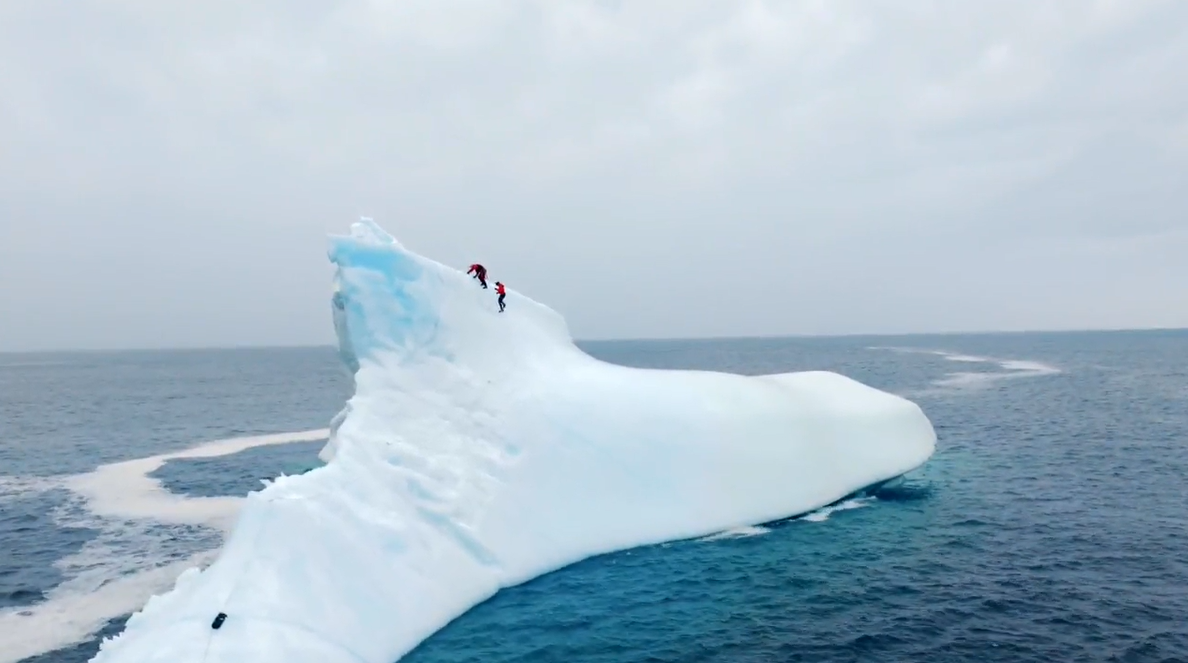
Executing a high-altitude springboard or platform dive from an unanchored glacial iceberg shifts the fundamental physics of competitive diving from a controlled closed-loop system into a chaotic open-environment operation. Standard competitive diving relies on fixed geometry, predictable board flex, regulated water surface tension, and consistent air density. When a Canadian athlete becomes the first woman to execute a dive from an iceberg, the achievement is rarely understood beyond motivational platitudes. In operational reality, the feat represents a complex exercise in environmental risk mitigation, thermodynamic management, and real-time trajectory calculation against a deteriorating structural platform.
The Environmental Hazard Matrix
A standard 10-meter diving platform is engineered from reinforced concrete with a high-friction surface, anchored to a foundation that absorbs kinetic energy without shifting. An iceberg is a dynamic, melting mass of compressed glacial ice floating in seawater, governed by Archimedes' principle where roughly ninety percent of its volume remains submerged. This structural instability introduces four primary failure modes that must be managed before an athlete even approaches the takeoff edge.
Dynamic Center of Gravity and Roll Risk
Icebergs do not maintain static equilibrium. As submerged ice melts faster or slower than exposed ice due to varying water temperatures and solar radiation, the iceberg's center of buoyancy shifts continuously relative to its center of gravity. A mass loss of just a few hundred kilograms from a submerged shelf can trigger an immediate, violent roll. For a diver standing on an upper ledge, the takeoff surface is not merely slippery; it is an active pendulum. Any lateral movement by the athlete or the support crew alters the load distribution, requiring continuous visual monitoring of the waterline for subtle tilt angles before committing to a jump.
Surface Friction and Takeoff Shear
Competitive springboards use sandpaper-like grip tape or textured aluminum to convert horizontal approach momentum into vertical lift without foot slippage. Glacial ice lacks uniform surface friction. Depending on ambient air temperature and direct sunlight, the top millimeter of the iceberg exists either as brittle, fractured crystal or as a thin film of liquid meltwater. Pushing off a melting ice surface generates severe shear stress. If the diver's plantar flexion exceeds the static friction coefficient of the wet ice, the foot slips backward during the final hurdle or press, converting upward rotational torque into an uncontrolled, flat fall directly onto the lower ice shelf.
Subsurface Shelf Geometry
The visual profile of an iceberg above the waterline provides zero reliable data regarding its underwater topography. Wave action at the ocean surface erodes the ice at the waterline faster than the deeper glacial mass, creating a submerged protrusion known as an "ice foot" or underwater ram. A diver entering the water just two meters out from the visible upper edge risks catastrophic impact with solid ice hidden beneath the surface opacity. Mapping this subsurface geometry requires sonar profiling, underwater camera sweeps, or physical depth-sounding by safety divers prior to establishing a safe entry corridor.
Calving and Acoustic Fracture
Glacial ice contains trapped air pockets pressurized over millennia. As the ice warms in seawater, thermal expansion causes internal micro-fractures to propagate rapidly. Calving—the sudden detachment of large ice blocks—occurs without protracted warning signs. The kinetic vibration of an athlete running or jumping on an unstable overhang can act as the terminal trigger for a fracture line, collapsing the takeoff platform beneath the diver's feet mid-approach.
Biomechanical Adaptations in Sub-Zero Conditions
Moving from a climate-controlled aquatic center to sub-arctic waters degrades human neuromuscular performance immediately. The physiological cost of operating in near-freezing air and water requires deliberate modifications to standard diving mechanics.
- Thermoregulatory Vasoconstriction: Exposure to freezing air temperatures triggers peripheral vasoconstriction, reducing blood flow to the extremities to preserve core organ temperature. For a diver, this dulls proprioception in the feet and ankles—the exact sensory receptors required to gauge balance on an uneven ice ledge and time the takeoff extension.
- Muscle Viscosity and Power Output: Cold skeletal muscle fibers contract more slowly and generate less peak explosive force than warm muscles. A diver cannot hold a static position on the ice edge for extended periods while waiting for camera cues or boat positioning; doing so drops muscle temperature and degrades vertical jump height.
- Thermal Protection Constraints: Standard competitive swimwear offers zero thermal insulation, leaving the athlete vulnerable to cold shock response upon water entry. Conversely, wearing a thick neoprene wetsuit restricts shoulder flexion and hip compression, making tight pike or tuck positions mechanically difficult while adding positive buoyancy that alters underwater deceleration dynamics. The athlete must balance thermal survival against aerodynamic and hydrodynamic drag.
- Spotting and Visual Reference Deprivation: During multi-rotation dives, athletes rely on "spotting"—locking their eyes onto fixed horizontal and vertical reference points (such as the pool wall, ceiling beams, or water surface) to track spatial orientation and time their entry kick-out. Open ocean water lacks a contrasting pool bottom, and overcast polar skies blend seamlessly into white glacial walls. This sensory homogeneity induces spatial disorientation, forcing the diver to rely almost entirely on vestibular timing and muscle memory rather than visual confirmation.
The Cold Shock Response and Water Entry Physics
Water entry in polar conditions introduces physiological hazards that do not exist in standard aquatic environments. Seawater freezes at approximately minus 1.8 degrees Celsius due to salinity, meaning the ocean remains liquid at temperatures that cause immediate cellular distress.
When an unprotected or lightly suited human body impacts water below 5 degrees Celsius at speeds exceeding 40 kilometers per hour, the skin's cold receptors fire instantaneously. This triggers the cold shock response, an involuntary autonomic reflex characterized by an immediate inspiratory gasp, hyperventilation, tachycardia, and a spike in blood pressure. If the diver's face is still submerged when the gasp reflex occurs, water aspiration and drowning follow within seconds.
To counteract this, the dive execution must incorporate specific entry and recovery protocols:
- Controlled Breath-Hold Conditioning: Pre-dive acclimatization and hypercapnic tolerance training are necessary to suppress the involuntary gasp reflex during the first ten seconds of immersion.
- Modified Entry Rip: Standard competitive divers punch a hole in the water with flat hands to minimize splash and decelerate rapidly. In glacial waters, minimizing immersion time takes precedence over aesthetic entry mechanics, requiring an immediate transition from vertical deceleration to horizontal surface swimming toward the extraction vessel.
- Cold Incapacitation Window: Peripheral nerve conduction velocity slows rapidly in freezing water. Within three to five minutes, fine motor control in the fingers fails, making it impossible for the diver to grip a boat ladder or secure a rescue line unassisted. Surface extraction must occur within a strict sub-sixty-second window post-entry.
Operational Architecture of an Expedition Dive
Executing a single successful dive from an iceberg requires a logistical footprint vastly disproportionate to the three-second athletic event. Where a standard diving competition relies on one lifeguard and a judging panel, an iceberg operation functions as a coordinated maritime expedition.
Phase 1: Target Acquisition and Bathymetric Reconnaissance
The support team—typically operating from a zodiac or ice-strengthened vessel—must locate an iceberg exhibiting specific structural criteria: a flat or gently sloped upper shelf at a viable launch height, a clean vertical face free of overhanging seracs, and sufficient water depth around the perimeter. Safety divers enter the water first to visually inspect the submerged wall for underwater ice rams, verifying a clear vertical drop zone down to at least five meters below the surface.
Phase 2: Surface Preparation and Access
Because climbing an sheer ice face from the water is slow and energy-depleting, the team must access the iceberg from a low-angle slope on the leeward side, using crampons and ice axes to ascend to the launch ledge. The takeoff point itself is chipped or leveled manually to remove loose snow and create a predictable foot placement zone, though the natural ice structure remains unmodified by artificial matting.
Phase 3: Active Safety Perimeter
Before the diver removes thermal outerwear, two surface rescue swimmers in drysuits must position themselves in the water just outside the entry zone, while a primary extraction boat idles within ten meters. Communication relies on hand signals and marine VHF radios, as wind noise across the ice face drowns out verbal commands.
Phase 4: Execution and Rapid Extraction
The diver sheds insulating layers, performs rapid dynamic warm-up movements to restore peripheral blood flow, moves directly to the prepared mark, and executes the dive without hesitation. The moment the diver surfaces, the rescue swimmers verify consciousness and airway clearance, guiding the athlete directly to the boat's stern platform for immediate rewarming.
The Strategic Flaw in Conventional Adventure Narratives
Media coverage of milestone achievements—such as the first woman to dive off an iceberg—routinely frames the event around emotional willpower, quoting sentiments about doing brave things. This framing creates a dangerous analytical blind spot. In extreme environments, bravery is not an operational strategy; it is often a liability that masks inadequate preparation.
When audiences interpret high-risk athletic feats through the lens of pure courage, they overlook the underlying systems engineering that makes survival possible. The difference between a historic athletic milestone and a fatal maritime accident lies entirely in the rigor of the pre-jump checklists, the accuracy of the subsurface ice profiling, and the speed of the thermal recovery protocol. Treating an iceberg dive as an act of spontaneous daring rather than a calculated physics and logistics problem leads aspiring athletes to underestimate environmental variables that human willpower cannot overcome.
Strategic Framework for High-Consequence Environmental Execution
Organizations, expedition leaders, and extreme-sport athletes planning first-of-its-kind physical feats in uncontrolled natural environments must abandon motivational decision-making in favor of strict operational gates:
- Decouple Ego from Go/No-Go Criteria: Establish objective, quantitative abort thresholds prior to deployment—such as maximum allowable wind speed, minimum water visibility for subsurface obstacle verification, and maximum surface dwell time before cold-induced motor degradation. If a single parameter breaches the threshold, abort the attempt regardless of media pressure or sunk expedition costs.
- Engineer Redundant Thermal Recovery: Never rely on a single extraction method. Deploy both in-water drysuit rescue personnel and a motorized recovery craft equipped with active rewarming gear (heated shelters, chemical heat packs, and dry thermal blankets) positioned within a thirty-second reach of the entry point.
- Prioritize Trajectory Simplicity Over Technical Difficulty: When operating off an unstable, low-friction natural platform, reduce rotational complexity. A cleanly executed layout or single-somersault dive with guaranteed spatial orientation minimizes the risk of off-axis water entry, which at high velocities causes severe concussive trauma even without hitting submerged ice.



