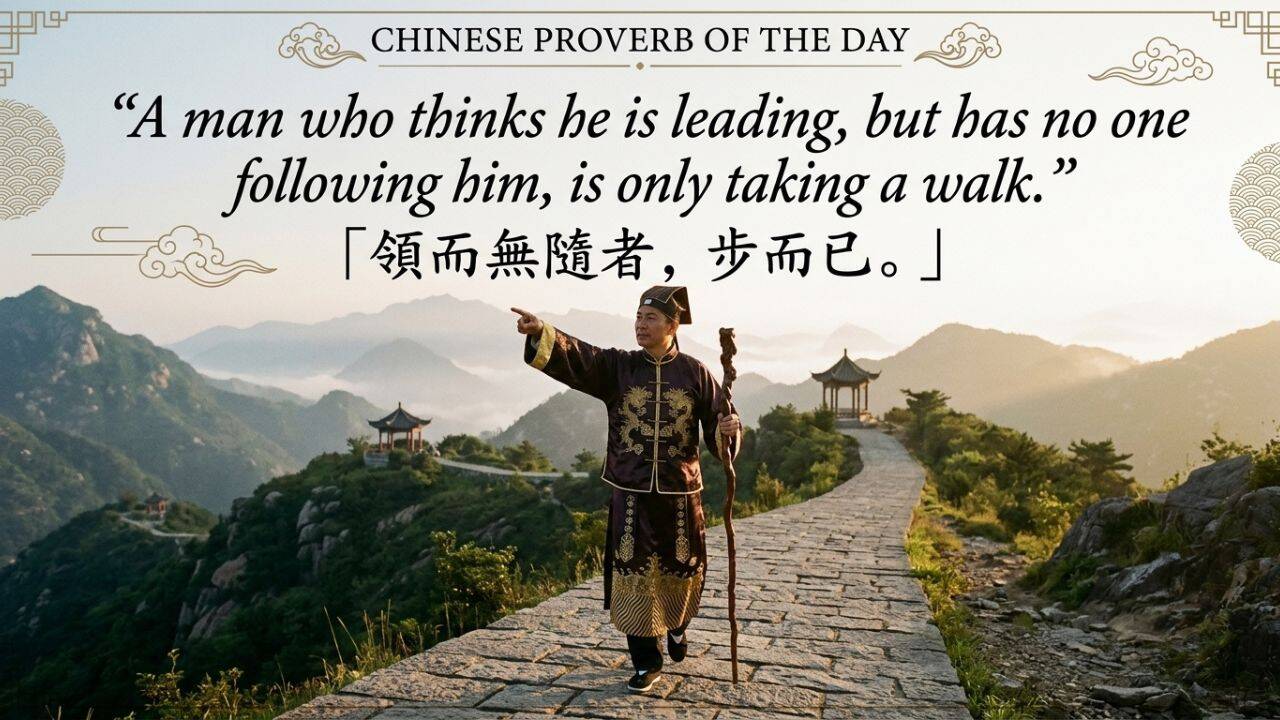
The corporate world loves a good proverb to paste over its lack of original thought.
You have likely heard the old line attributed to John Maxwell or some ancient text: "He who thinks he leads, but has no one following him, is only taking a walk." It sounds incredibly clever. It gets nods in boardrooms. It makes middle managers feel warm inside because they have a team of ten miserable subordinates checking boxes below them on the org chart.
It is also completely wrong.
This lazy consensus assumes that leadership is defined by the crowd behind you. It equates headcounts with impact. It mistakes bureaucratic compliance for genuine direction.
If you are leading a crowd of people down a dead-end street, you are not a leader. You are just the front car in a traffic jam. Conversely, the individual "taking a walk" alone toward a brutal, necessary truth is often the only real leader in the building.
Stop counting your flock. Let us talk about why the most valuable people in your organization are the ones walking alone.
The Flaw of the Flock
We have built a business culture that rewards the accumulation of human capital for its own sake. Managers fight for headcount because budget allocations and executive prestige are tied to how many people sit beneath them.
This creates a dangerous feedback loop. To keep a large group of people following you, you must constantly cater to the lowest common denominator. You have to minimize risk. You have to speak in vague, corporate platitudes that offend nobody and inspire nothing.
Look at the history of major corporate failures. The executives at Kodak, BlackBerry, and Nokia had thousands of followers. They had entire campuses of brilliant engineers, marketers, and operations experts hanging on their every word. They held town halls. They sent inspirational weekly emails.
They were leading massive crowds straight over a cliff.
When you prioritize the act of being followed over the destination itself, you stop looking at the road. You start looking backward to make sure everyone is still keeping up. That is not leadership. That is crowd control.
The Lone Wanderer Fallacy
Let us look at the other side of that flawed proverb. The person "only taking a walk."
Imagine a scenario where a senior engineer realizes that the company’s core software architecture is completely unsustainable. She spends three months building a prototype for a replacement in her spare time. She presents it to the executive team. They reject it because it disrupts current timelines. Her peers ignore it because it requires learning a new framework.
She is entirely alone. Nobody is following her.
By the logic of the traditionalists, she is failing. She is just taking a stroll.
But three years later, when the old system crashes permanently and the company is forced to adopt her architecture to survive, who was the actual leader? It was the person who had the clarity to see the future and the conviction to build it, regardless of whether anyone else was ready to walk with her.
True leadership is about alignment with reality, not alignment with a group. The crowd is almost always late to the party. If you wait for consensus before you move, you are already too late to make a difference.
Why Followers Are Highly Overrated
We need to define what a follower actually is in the modern corporate context.
Most of the time, a follower is just someone who needs a paycheck. They are not following your vision; they are following their direct deposit. Mistaking economic dependency for leadership authority is the quickest way to blind yourself to impending disaster.
Consider the mechanics of true innovation. It requires a radical departure from the status quo. By definition, the status quo is what the majority of your organization believes in and works on every day. If you propose something genuinely new, the majority will resist it.
- If everyone agrees with your new strategy immediately, it is not innovative. It is safe.
- If your team enthusiastically embraces your shift without friction, you did not change direction. You just rebranded the current path.
- If you have zero detractors, you are not leading anyone anywhere they haven't already been.
When I see a leader boasting about 100% buy-in across a large organization, I do not see a visionary. I see someone who has compromised their ideas down to a fine, gray paste that requires absolutely nothing from anyone.
The Cost of the Consensus Trap
I have watched companies burn through millions of dollars because executives were terrified of walking alone.
They hire expensive consultants to validate their choices. They form committees to study the committees. They conduct endless surveys to ensure that every layer of management feels included in the decision-making process.
This is cowardice disguised as collaboration.
The desire to have everyone behind you before you take a step is an abdication of responsibility. It allows you to distribute the blame when things go wrong. If the initiative fails, well, everyone agreed to it, right?
But greatness is never achieved by committee. The heavy hitters of industry—the people who actually change the trajectory of markets—are almost always profoundly uncomfortable to be around in the early stages of their projects. They are stubborn. They are certain. And they are perfectly willing to be viewed as crazy by the people who are still standing on the old path.
How to Tell if You are Leading or Just Popular
If you want a brutal assessment of your actual impact, stop looking at your LinkedIn follower count or the number of direct reports on your dashboard. Ask yourself these hard questions instead.
1. When was the last time you made a decision that caused someone to quit?
If your choices never cause friction, you are maintaining a status quo, not driving progress. True direction requires choosing one path and abandoning another. The people who loved the old path will leave. If no one leaves, your choices do not matter.
2. Can your vision survive a budget cut?
If people only follow you when resources are abundant and bonuses are guaranteed, they are following the money, not you. Strip away the perks. If the room empties out, you were just a concierge, not a leader.
3. Are you willing to be wrong alone?
This is the ultimate test. If your data tells you to go left, but the entire board says go right, do you stand your ground? Or do you fold so you can stay at the front of the line?
The contrarian approach to business requires recognizing that isolation is often a leading indicator of success, not a sign of failure. Being alone means you have broken away from the herd. It means you are finally operating in a space where real competitive advantage can be found.
The New Metric for Impact
We must replace the obsession with headcount with an obsession with velocity and direction.
It is infinitely better to be one person moving at maximum speed toward the correct destination than to be a manager of five hundred people standing completely still or marching efficiently into irrelevance.
Stop looking back to see who is behind you. Look forward at the market, the technology, and the brutal realities of your execution. If you are right, the followers will eventually appear because they will have no other choice to survive. And if they never show up, at least you didn't waste your life running a slow-motion circus for people who never wanted to move in the first place.
Pack your bags. Take the walk.