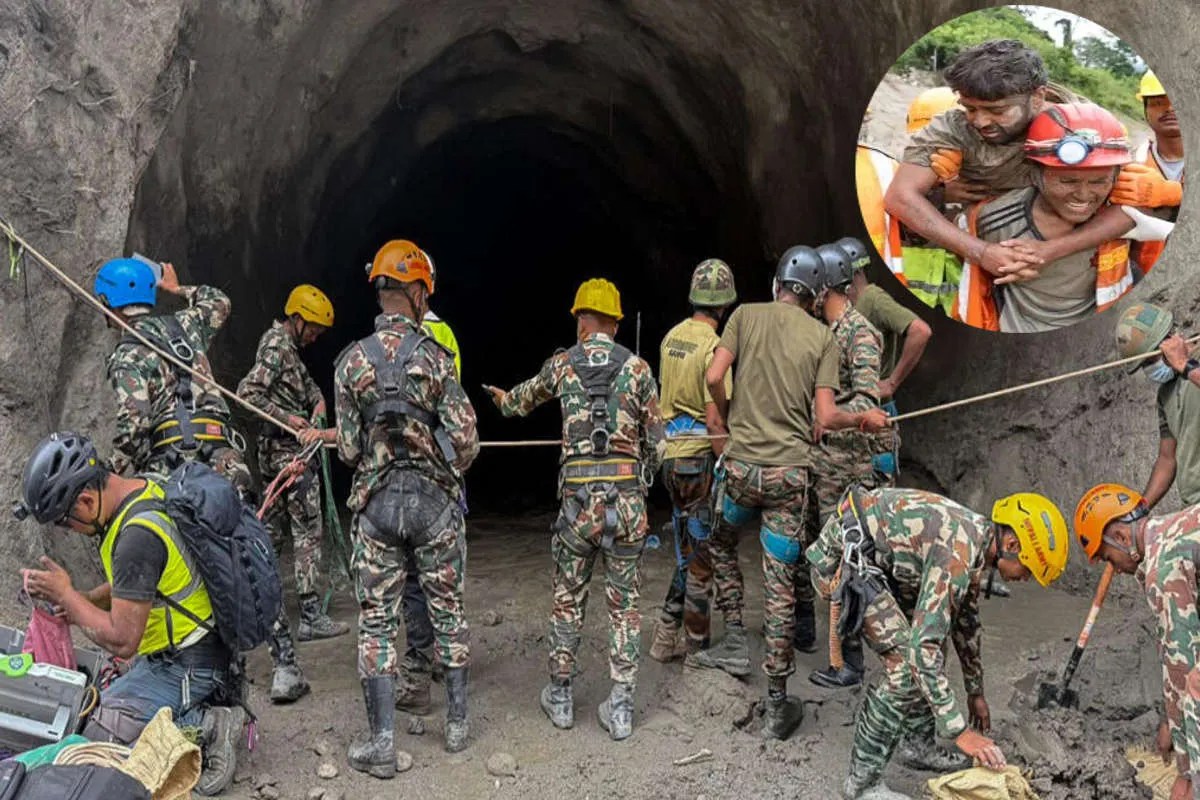
The earth does not negotiate. When a hillside gives way, it does not send an ultimatum or wait for a quorum; it simply collapses with the crushing finality of a falling sky, swallowing roads, rivers, and men in a single breathless second.
Ask Sanjay Sah what it sounds like when the world ends. He will tell you it starts with a roar that vibrates through the soles of your boots, a deep, guttural groan of rock and mud surrendering to gravity. Then comes the dust, thick and suffocating, followed by a silence so absolute it feels heavy enough to touch.
For nine days, that silence was Sanjay’s universe.
In a dark, concrete-lined tunnel nestled deep within the bruising geography of Nepal, time lost its shape. There were no clocks. There was no sun to mark the slow crawl of morning into afternoon, no fading amber light to signal that another day had slipped away. There was only the obsidian blackness, the damp chill biting through wet clothes, and the persistent, terrifying drip of water somewhere in the distance.
Outside, families wept near mounds of freshly churned earth. Rescue crews fought a desperate war against unstable mud and relentless rain, moving tons of debris with bare hands and heavy machinery, operating on the razor-thin margin between hope and recovery. Everyone assumed the worst. The mountain had taken its toll before, and it rarely gave back what it swallowed.
Inside, Sanjay was awake.
He was not alone at first. Panic is a contagious fire, and in the initial hours after the tunnel entrance sealed shut, the air crackled with it. Shouts bounced off the concrete walls. Prayers collided with frantic weeping. Men groped blindly in the dark, colliding with obstacles, searching for a way out that no longer existed.
Sanjay knew that if the panic took root, none of them would survive. Fear consumes oxygen faster than a trapped lung can spare.
So, he became an anchor.
He gathered the men around him, their hands touching in the dark, creating a fragile human chain of reassurance. When doubt threatened to drown them, he spoke softly, cutting through the weeping. He reminded them of their families, of the tea waiting at home, of the simple fact that they were breathing. He told stories. He forced their minds away from the crushing weight of earth above their heads and toward the light they refused to surrender.
Days bled together. Hunger gnawed at their ribs. Thirst made their tongues feel like sandpaper scraping against the roof of their mouths. They rationed every drop of moisture they could find, fighting the primal urge to give in to despair.
And when the others slept—exhausted, broken, slipping into troubled hallucinations—Sanjay stayed awake. In the pitch-black void, he did not dwell on the physics of their tomb. Instead, he turned upward. He whispered his prayers into the stone. Every waking hour became a silent conversation with the divine, a relentless plea not for his own life, but for the lives of the men huddled beside him. Take me if you must, the silent prayer went, but let them walk out.
Ninety-six hours passed. Then two hundred hours.
The human body is remarkably fragile, yet infinitely stubborn. It can survive without food for weeks, but the mind buckles much faster under the weight of isolation. In the dark, your own thoughts turn against you. Shadows take on faces. The silence becomes a physical weight pressing down on your chest.
Sanjay held the line. Whenever a companion stirred in terror, waking from a nightmare of suffocation, Sanjay’s voice was there. Steady. Low. Real. A tether to the world they had left behind.
When the breakthrough finally came, it did not arrive with fanfare. It started as a vibration, a faint, metallic clanging that rippled through the rock. Then, a beam of light—thin, yellow, and blindingly bright—sliced through the darkness.
Men screamed, shielding their eyes from a sun they had almost forgotten how to picture. Hands reached into the opening, pulling, dragging, lifting the living from the grave.
When Sanjay emerged into the blinding daylight of Nepal, blinking against the harsh reality of a world that had kept spinning without them, he could barely stand. His skin was pale, his eyes sunken, his body a map of endurance and deprivation.
The cameras flashed. Journalists swarmed. People wept.
Yet, as the medics wrapped thermal blankets around his shivering shoulders, Sanjay did not speak of his own suffering. He asked about the others. He looked around to make sure the men who had held his hand in the dark were breathing the same fresh air.
We measure disasters in statistics. We count the cubic meters of mud, the millions spent on infrastructure, the official death tolls released in evening bulletins. But history is not written in numbers. It is written in the stubborn refusal of an ordinary man to let go of his neighbor in the dark.
The tunnel is clear now. The earth has settled. But somewhere deep beneath the surface of the Himalayas, the memory of those nine days remains etched into the stone—a testament to what a human being can endure when he decides that hope is the only thing worth carrying.