The air in the southern foothills of the Alps does not usually feel like a wet woolen blanket in the early hours of June. It should crisp up as the sun dips behind the jagged peaks, carrying the scent of pine and cold stone down into the valleys.
But tonight, it stayed thick. Heavy. It tasted of copper and ozone.
Consider a fictional grape grower named Marco, standing on a terraced slope in Northern Italy. His family has tended these specific vines for four generations. He knows the rhythm of the seasons like the pulse in his own wrist. Yet, over the last forty-eight hours, every barometer in his house has plunged into free fall, and the local weather alerts on his phone have shifted from a cautious yellow to an ominous, flashing crimson.
Marco is not looking at his phone. He is looking at the horizon, where the darkness is beginning to flicker.
What rolled across Europe and East Asia this week was not a standard summer storm system. It was something far more volatile. A colossal atmospheric collision that turned standard weather tracking into a chronicle of chaos. Across two continents separated by thousands of miles of landmass, the sky broke open in near-simultaneous fury, shattering records and rewriting what we understand about seasonal volatility.
The mechanics behind this aren't just academic. They are visceral.
When a massive, slow-moving cold front slumps down from the Arctic and collides with an unprecedented ridge of tropical humidity pushing up from the Mediterranean, the result is a massive atmospheric engine. The technical term is a mesoscale convective system. Think of it as a thermodynamic factory. It takes warm, moisture-laden air, sucks it upward at terrifying speeds, freezes it into ammunition, and hurls it back down.
In Germany and France, the first signs were deceptively beautiful. A shelf cloud, dark as bruised iron, scraped across the sky, stretching from horizon to horizon like the hull of an alien mothership.
Then came the hail.
These were not the pea-sized pellets that bounce harmlessly off a windshield. These were jagged blocks of ice, some measuring over ten centimeters in diameter—the size of grapefruits. They fell with the terminal velocity of dropped bricks. In a matter of twenty minutes, suburban streets were stripped of their foliage. Tiled roofs that had stood since the mid-twentieth century were pulverized into orange dust. Cars looked as though they had been beaten with sledgehammers.
The financial toll of these events is easy to quantify in a spreadsheet. Insurance adjusters will spend months tallying the billions of euros in property damage.
But the human toll is counted in the sudden, sharp silence that follows the roar. It is the sound of a small-business owner surveying a fleet of shattered delivery vans, realizing their livelihood has been wiped out before breakfast. It is the sight of Marco standing in his vineyard, looking at a sea of stripped, broken stalks where a harvest worth a year of backbreaking labor stood just an hour ago.
The ice didn't just dent metal. It broke spirits.
Meanwhile, thousands of miles to the east, a terrifyingly similar script was playing out across East Asia.
In eastern China and parts of Japan, the atmospheric setup was slightly different, but the outcome was just as devastating. The annual monsoon front, injected with anomalously warm ocean moisture from the Pacific, locked into place. It didn’t pass over. It hovered.
Imagine pouring a bucket of water onto a sponge. For a while, the sponge absorbs it. But once the sponge reaches its absolute limit, every single drop that follows has nowhere to go. It sits on top. It rushes downward.
In Henan province, the sky emptied itself of a month’s worth of rain in less than six hours.
Flash flooding turned major metropolitan thoroughfares into raging, muddy rivers. Underground subway systems, usually miracles of modern urban transit, became subterranean traps as muddy water cascaded down the stairwells. Commuters who had left their offices thinking only of dinner found themselves wading through waist-deep water, holding their briefcases above their heads, watching empty vehicles float past them like plastic toys.
The sheer scale of these concurrent events points to a broader, more unsettling reality that meteorologists are struggling to articulate without causing panic.
The atmosphere is holding more energy than it used to. Every fraction of a degree of temperature increase allows the air to retain roughly seven percent more moisture. That is not a linear upgrade; it is an exponential compounding of force. When the conditions are right, that stored energy does not discharge in a gentle drizzle. It explodes.
We often treat weather tracking as a passive background note to our daily lives. We glance at the app on our smartwatches, decide whether to pack an umbrella, and move on.
But we are entering an era where the weather is no longer background noise. It is the lead actor. It is dictating where we can safely build homes, how insurance companies calculate risk, and whether global supply chains can deliver goods on time. A single severe thunderstorm cell in Belgium can delay a cargo flight, which delays a microchip delivery to a factory in Ohio, which halts production for a week.
Everything is tethered to the stability of the sky.
As the sun rose the following morning over the central plains of China and the battered valleys of Europe, the clouds finally began to splinter, letting through a pale, apologetic sunlight.
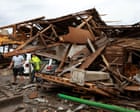
The immediate danger had passed, leaving behind a surreal landscape of mud-caked streets, shattered glass, and uprooted ancient oaks. Emergency crews worked through the exhaustion, their chainsaws buzzing in the quiet morning air, clearing roads so that life could resume its normal shape.
But the normal we are returning to is shifting beneath our feet.
In the wreckage of his vineyard, Marco picked up a jagged fragment of ice that had managed to survive in the shadow of a fallen stone wall. It was melting quickly in his palm, turning back into harmless water, dripping through his fingers onto the ruined earth. He looked up at the now-clear blue sky, knowing that the engine was already rebuilding itself, waiting for the next time the air grew too heavy to breathe.


