The rain in Poznań doesn’t just fall; it settles into the bones. It is a cold, rhythmic drumming that turns the Polish landscape into a blur of grey slate and slick mud. Most people are inside, shielded by double-paned glass and the hum of central heating. But on the edge of the city, where the suburban sprawl hits the ancient, stubborn press of the forest, a small group of people is standing in the dark.
They aren’t waiting for a bus. They are waiting for a heartbeat. If you liked this piece, you should read: this related article.
Under the glare of a headlamp, the wet road looks like a river of oil. Then, a movement. It is small—a low, rhythmic hop that looks like a trick of the light. But it isn’t light. It’s a Common Toad. To the casual observer, it’s a lump of cold-blooded biology. To the volunteers of the "Frog Patrol," it is a tiny, ancient traveler currently navigating a death trap.
This is the front line of an invisible war between human infrastructure and a biological clock that has been ticking for millions of years. For another perspective on this story, refer to the recent update from The Spruce.
The Genetic Command
Spring in Poland triggers a biological haunting. As the ground thaws, thousands of amphibians emerge from their winter burrows in the woods. They have one singular, desperate goal: reach the water. They need the ponds and marshes to lay their eggs, ensuring the next generation survives the thaw.
For a toad, this journey is an odyssey. They aren’t built for speed. They move with a slow, deliberate crawl, their skin absorbing the dampness of the night. In a world without humans, the only threats would be a hungry heron or a sharp-eyed fox. But we built a world of stone and speed. We laid down ribbons of asphalt—the "Black Death," as some conservationists call it—directly across their ancestral migration paths.
Imagine being three inches tall and trying to cross a six-lane highway. The wind from a passing sedan is enough to toss your body like a dry leaf. The vibration of the engines feels like an earthquake. And the heat—even at night, the asphalt retains a synthetic warmth that can desiccate a small creature before it reaches the white line.
The Human Wall
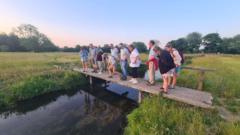
Enter the patrol. These aren't government officials or high-paid scientists. They are schoolteachers, retirees, and teenagers who should be at home playing video games. They wear neon vests that make them look like roadside construction crews, but their tools are different. They carry plastic buckets and flashlights.
Consider Marek. (This is a composite of the many faces seen on the Poznań outskirts). Marek is sixty-four. His knees ache in the damp, but he spends four hours every night bent double, scanning the gutter. He isn’t looking for lost change. He’s looking for the gold-flecked eyes of a Moor Frog or the bumpy skin of a toad.
"You hear the cars before you see them," he says, his voice low. "The sound of a tire hitting a wet patch of road is like a whip cracking. If you aren't fast enough, that crack is the sound of a life ending. It’s a small life, yes. But it’s a life that traveled miles just to get here."
The stakes are higher than a few dead frogs. Amphibians are the "canaries in the coal mine" for our ecosystem. They breathe through their skin. They are hyper-sensitive to pollution, temperature shifts, and habitat fragmentation. When the frogs stop moving, the silence that follows is a warning that the entire local environment is collapsing. They eat the pests that ruin crops; they provide the base of the food chain for birds and mammals.
When a road cuts a migration path in half, it doesn't just kill individuals. It severs the genetic flow of the entire species.
The Mechanics of Mercy
The work is repetitive and grueling. The volunteers walk the length of the "drift fences"—temporary plastic barriers erected along the roadside. The frogs hit the fence, can’t climb it, and begin to hop along the perimeter. Eventually, they fall into buckets buried at intervals in the ground.
Every few hours, the patrol empties the buckets. They count the inhabitants. They identify the species. Then, they carry them across the road in a bucket, releasing them safely into the reeds of the spawning pond.
It is a manual override of a systemic failure.
In some parts of Europe, permanent "toad tunnels" are built under highways. They are expensive, elegant solutions that allow nature to flow beneath the wheels of progress. But in many parts of Poland, the funding isn't there. The infrastructure is old. The only thing standing between a population collapse and a successful breeding season is the strength of a volunteer’s grip on a plastic handle.
Statistics tell a grim story, but a clear one. In areas where the Frog Patrol operates, the mortality rate for migrating amphibians drops from nearly 100% to less than 5%. In a single season, one local group might carry 5,000 toads across the road. That is 5,000 lives that would have been extinguished by a tire.
The Emotional Friction
Why do they do it?
Critics call it a drop in the ocean. They argue that in a world of climate change, rising seas, and mass extinction, spending a Friday night in the rain to save a handful of "slimy" creatures is sentimental nonsense.
But there is a psychological shift that happens when you pick up a toad. It is heavy for its size. You can feel its heart beating against your palm—a frantic, tiny pulse of pure will. In that moment, the abstract concept of "environmentalism" becomes a tangible, physical weight. You aren't saving "the planet." You are saving this specific, living thing that is trying its best to stay alive in a world that wasn't built for it.
There is a profound humility in the act. Humans are builders. We pave, we construct, we dominate. To stand in the mud and assist a creature that has no idea you exist—that will never thank you, and that represents a lineage far older than your own civilization—is an act of pure, unselfish grace.
It is also a confrontation with our own impact. Every car that speeds by, splashing the volunteers with cold puddle water, represents the velocity of modern life. We are always in a rush to get somewhere. The toad is in a rush, too. But the toad’s rush is for the survival of its kind. Ours is often just for a slightly better commute.
The Silent Night
As the clock nears midnight, the traffic thins. The rain turns to a fine mist. The buckets are nearly empty now. Marek stands by the edge of the pond, watching a large female toad crawl out of his bucket and disappear into the dark water.
A moment later, a low, melodic trill rises from the reeds. Then another. It’s a chorus—a sound that has echoed through the marshes since before the first road was ever paved.
The volunteers don't talk much on the walk back to their cars. They are wet, tired, and smelling of damp earth and pond weed. Their boots are ruined. But they have done something remarkable. They have held back the tide of human indifference for one more night.
The road is still there. The cars will return in the morning, roaring over the asphalt with renewed intensity. But in the pond, hidden beneath the surface of the water, thousands of eggs are being laid in long, gelatinous strings. They are safe. They are the future. And they only exist because a few people decided that a tiny heartbeat was worth a night in the rain.
The forest breathes a little easier tonight.
The light of a single headlamp catches a final toad, sitting right on the edge of the woods. It looks at the road. It looks at the humans. Then, with a sudden, powerful thrust of its legs, it turns away from the asphalt and toward the water, disappearing into the shadows where the wild things are still allowed to win.
The asphalt remains cold, but the pond is full of life.