When the first-ever European Amputee Football Federation (EAFF) Conference League kicked off in Bucharest, Romania, it didn't just mark the start of another soccer tournament. It signaled a massive shift in how adaptive sports scale globally. For too long, elite competition in amputee football was restricted to players fortunate enough to live in nations with established, fully funded domestic leagues. If your local club didn't have an infrastructure, you were out of luck.
The launch of this new European league changes that entirely. By introducing a competitive pathway modelled after traditional able-bodied European club competitions, the EAFF opened the door for teams from countries still building their domestic foundations. Four clubs from four different nations—FCSB from host nation Romania, Maccabi Haifa FC from Israel, Ayr United from Scotland, and Panathinaikos AC PwD from Greece—converged on Bucharest to battle for history.
If you've never watched a live match, throw away any assumptions you have about adaptive sports being slow or purely symbolic. Amputee soccer is fiercely fast, intensely physical, and technically brilliant.
Inside the Rules and Realities of Elite Amputee Soccer
Let's talk about the mechanics of the game because understanding how it's played reveals why elite players possess incredible athletic prowess. Played in a seven-versus-seven format on fields measuring roughly 60 meters by 40 meters, the sport demands staggering upper-body strength, core stability, and cardiovascular endurance.
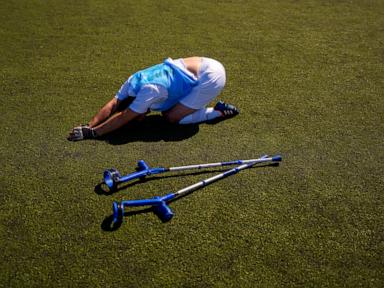
Field players compete with one leg and a pair of customized forearm crutches, using those crutches not just for mobility, but as an extension of their upper body to shield the ball, pass, and shoot. Goalkeepers face the opposite constraint, playing with both legs intact but missing an arm or a hand. There are no offside rules, but sliding tackles with crutches are strictly forbidden, and accidental contact between a crutch and the ball results in a foul.
When Maccabi Haifa FC claimed the inaugural trophy without conceding a single goal throughout the tournament, they didn't just win a piece of silverware. They demonstrated a level of defensive organization and tactical discipline that would impress any seasoned coach in traditional leagues. As Maccabi Haifa player Ben Binyamin noted after the final whistle, the sport acts as much more than a hobby: "Football itself for us is our physiotherapy, our life, and our second family".
Why This Expansion Matters for the Future of the Sport
Growth in niche sports doesn't happen by accident. It requires visibility, funding, and structural ambition. For countries like Romania and Scotland, hosting and participating in international cross-border competitions bridges a critical gap.
Local fans who had never witnessed top-tier adaptive athletics got a firsthand look at the intensity of European competition. FCSB player Ștefan Dogaru pointed out that the tournament serves as a powerful catalyst for public awareness, pulling local interest toward a sport that deserves prime-time attention. When kids with limb differences see athletes flying across a pitch, executing bicycle kicks, and scoring from distance, the psychological impact is profound. Representation moves from a poster on a wall to an active, breathing reality on the field.
Moreover, the competitive level exposed areas where developing programs need to catch up. Panathinaikos finished fourth, showing immense grit while highlighting the steep learning curve required to compete against seasoned continental powerhouses. That gap isn't a discouragement; it's the exact fuel national federations need to secure better training facilities, attract sponsorship dollars, and invest in youth pipelines.
Practical Takeaways for Supporters and Athletes
If you want to support the momentum of adaptive sports, stop treating them as charity cases and start treating them like elite athletics.
- Follow regional clubs: Check out local or national amputee football associations to find upcoming tournament streams and schedules.
- Support grassroots funding: Many clubs operate on shoestring budgets. Direct donations or corporate sponsorships help teams acquire specialized sports crutches, which can cost hundreds of dollars per pair.
- Attend live matches: If a tournament lands in your country, buy a ticket. The speed and skill on display will shatter any preconceived notions you carry about disability sports.
The success in Bucharest proved that international club competition in amputee soccer isn't an experiment anymore—it's a permanent fixture. The blueprint is set, the talent is undeniable, and the rest of the soccer world needs to pay attention.