Astrophysical observation has historically relied on a fundamental limitation: photons carry information, but they also carry baggage. Magnetic fields bend charged particles like protons and atomic nuclei, scrambling their trajectories across light-years and stripping them of directional memory. Photons—while traveling in straight lines—suffer from attenuation, scattering, and absorption by cosmic dust, gas clouds, and background radiation fields. To map the high-energy universe with absolute fidelity, physics required a messenger that interacts exclusively via the weak nuclear force and gravity: the neutrino.
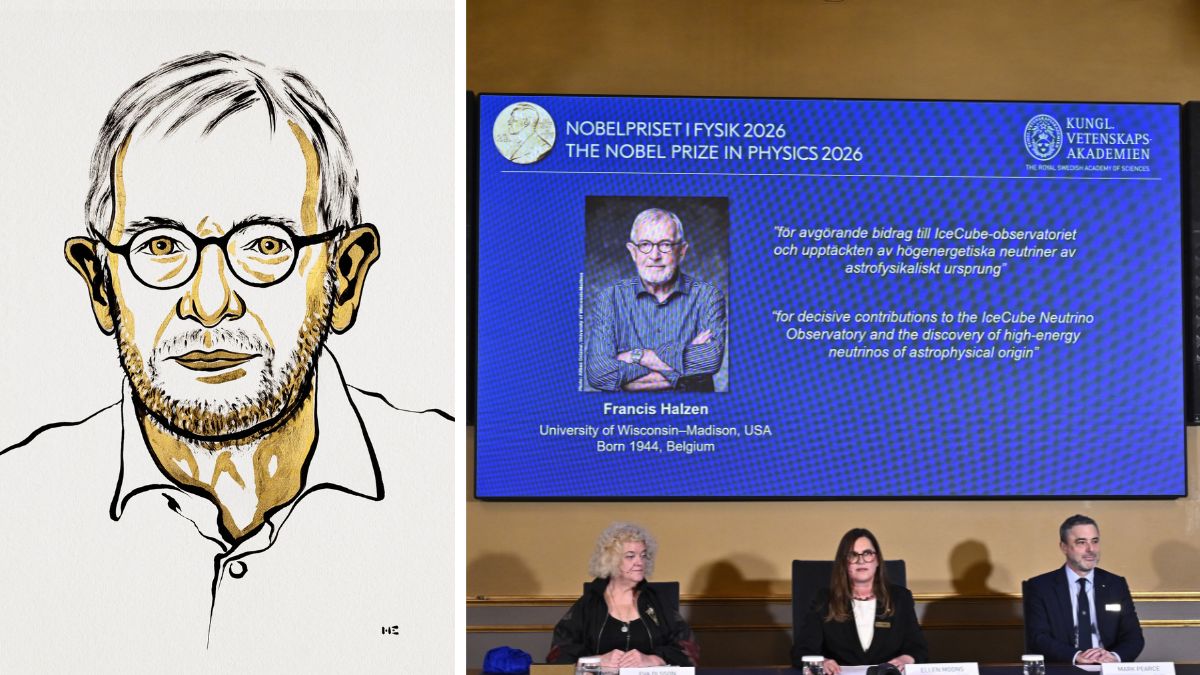
The award of the 2026 Nobel Prize in Physics to Francis Halzen for his decisive contributions to the IceCube Neutrino Observatory marks the formal transition of neutrino astronomy from a theoretical pursuit into a high-precision observational science. Resolving the neutrino puzzle required solving a brutal signal-to-noise ratio problem through extreme engineering and scaling.
The Signal to Noise Constraint of Cosmic Neutrinos
Neutrinos are functionally invisible under standard conditions. They possess an infinitesimally small mass and carry no electrical charge, allowing them to traverse stars, planets, and entire galaxies without collision. This property makes them pristine messengers, but it creates a severe measurement bottleneck: because they rarely interact with matter, capturing enough events to build a statistical distribution requires a detector of staggering proportions.
A detector with a small cross-sectional area will register zero high-energy astrophysical neutrinos over decades. To observe even a handful of these events, physicists needed a massive volume of transparent target material coupled to a dense grid of ultra-sensitive photodetectors.
The scale requirements introduced three core variables that governed the architecture of high-energy neutrino astronomy:
- Target Mass: The volume must span cubic kilometers to guarantee a statistically viable interaction rate.
- Optical Clarity: The medium must permit Cherenkov radiation—the faint blue light emitted when a relativistic secondary particle moves faster than the speed of light in that medium—to travel tens of meters without scattering.
- Background Suppression: The detector must be shielded from atmospheric muons and cosmic ray showers generated constantly in the upper atmosphere.
Architectural Trade Offs in Deep Medium Selection
Early attempts at high-energy neutrino detection, such as the DUMAND project off the coast of Hawaii, sought to utilize deep ocean water. While water is an exceptional Cherenkov medium, operating a permanent, complex electrical grid on the ocean floor introduces severe logistical failure modes. Saltwater currents stress cabling, marine biology fouls optical sensors with bioluminescence, and dissolved radioactive isotopes create an unmanageable baseline noise floor.
Francis Halzen identified that natural Antarctic ice resolved these operational bottlenecks. Deep glacial ice at the South Pole offers structural rigidity, complete absence of marine life, and an environment isolated from human interference.
The deployment strategy for IceCube leveraged pressurized hot-water drills to melt cylindrical holes nearly two and a half kilometers deep into the ice sheet. Into these fluid-filled columns, engineers lowered strings equipped with digital optical modules (DOMs) before the water refroze. Once refrozen, the sensors were permanently locked into an ultra-pure, ultra-stable crystalline matrix.
The optical properties of the ice, however, introduced a secondary physical complication. Impurities such as trapped air bubbles and dust layers from ancient volcanic epochs scatter photons, altering their propagation vectors. Accounting for these depth-dependent scattering and absorption coefficients required advanced calibration using in-situ LED flashers, transforming the glacier itself into a characterized optical instrument.
The Conversion Mechanics and Event Signatures
When an ultra-high-energy muon neutrino originating from an active galactic nucleus or a gamma-ray burst reaches the detector array, it interacts via a charged-current weak interaction with a nucleus in the ice or surrounding bedrock. This collision produces a high-energy muon alongside a hadronic cascade.
The resulting muon travels through the ice at relativistic speeds, emitting a continuous cone of Cherenkov radiation. IceCube's three-dimensional grid of optical sensors records the arrival time and photon count of these light flashes. By reconstructing the arrival front of the photons, computers calculate the trajectory of the muon with sub-degree angular precision.
Because high-energy cosmic neutrinos maintain their direction across billions of light-years, back-calculating this trajectory points directly back to the celestial accelerator that forged the particle. This methodology transitioned neutrino physics from isotropic counting—detecting diffuse background radiation without origin mapping—to point-source astronomy, exemplified by the identification of active galaxies like NGC 1068 as active neutrino emitters.
Scaling Vectors and Next Generation Instrumentation
The validation of the IceCube methodology has shifted the engineering focus toward volume expansion. Capturing rare, ultra-high-energy cosmic rays requires increasing the instrumented mass by an order of magnitude.
The planned deployment of IceCube-Gen2 scales the instrumented volume to approximately eight cubic kilometers. This expansion incorporates broader sensor spacing to catch extremely high-energy events alongside shallow radio-detection arrays designed to measure askaryan radiation from PeV-to-EeV neutrinos.
The strategic imperative for the next decade of astroparticle physics is clear. With the foundational proof of concept established and validated by the 2026 Nobel Prize, the field is moving away from discovery validation and toward high-resolution cosmic spectroscopy, utilizing the transparent medium of the Antarctic ice cap to map sources of particle acceleration that remain dark to traditional electromagnetic telescopes.