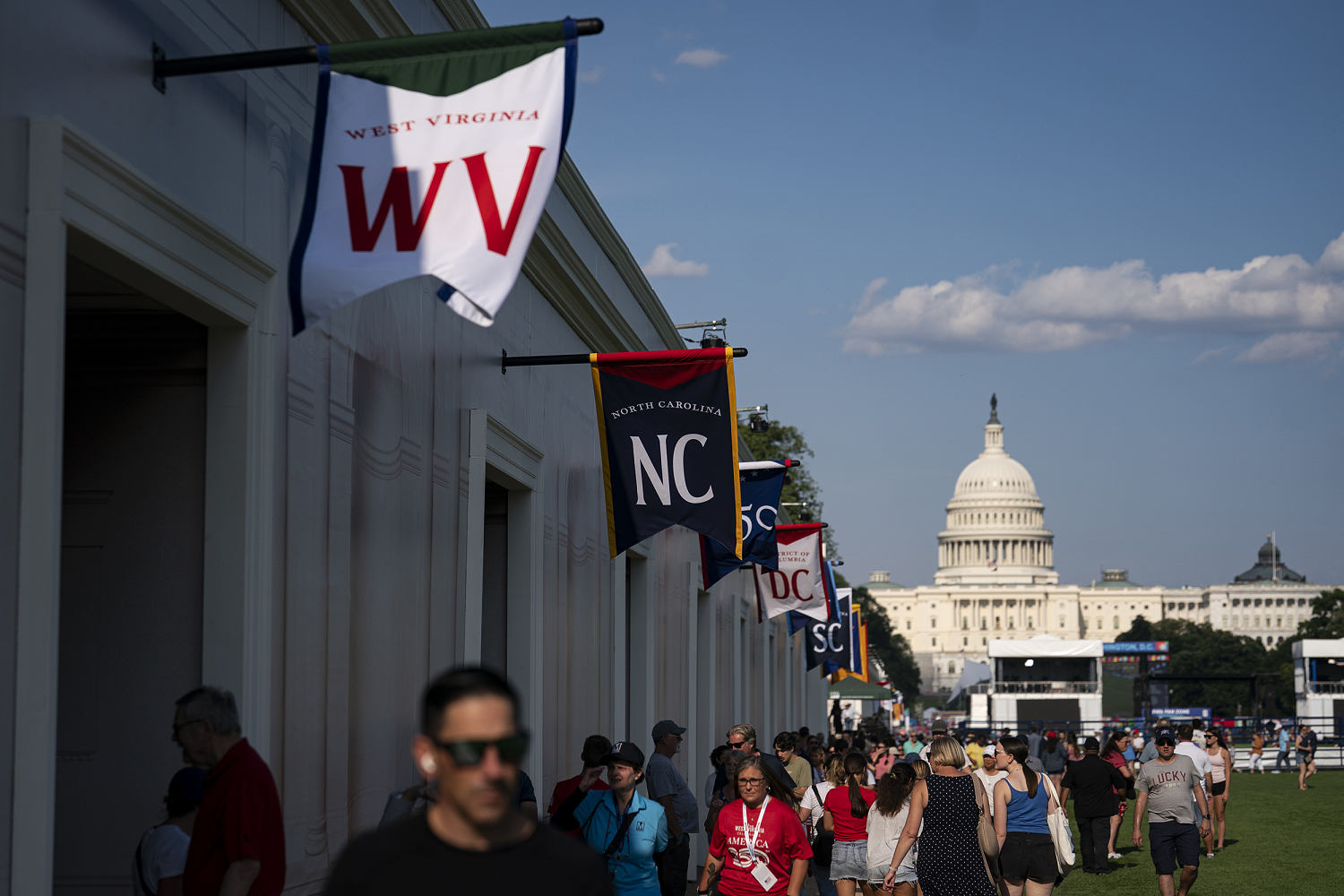
A digital display flashpoint at the Great American State Fair on the National Mall has exposed a bitter, subterranean warfare over who controls the narrative of American history. When a rogue Confederate battle flag image flickered across multiple video screens inside an unofficial North Carolina pavilion on Friday, it triggered immediate public outrage, executive condemnation, and the hasty exit of corporate sponsors like the Mt. Olive Pickle Company. While fair operators quickly pulled the unapproved imagery down after a viral social media video surfaced, the incident was far from a simple administrative blunder. It is the direct consequence of a hyper-politicized, privatized alternative to national milestone celebrations, where state governance has been bypassed entirely in favor of corporate and political interests.
The official state government of North Carolina, led by Democratic Governor Josh Stein, never sent a delegation to Washington, D.C. State officials consciously boycotted the event weeks prior, pointing to severe financial risks and intense concerns regarding partisan weaponization. With the official state apparatus completely absent, a vacuum formed. Private entities rushed in to fill the physical neoclassical booths constructed on the Mall, leaving critical questions about vetting, historical accuracy, and basic oversight completely unanswered.
The Anatomy of a Digital Provocation
The controversy exploded when a video posted by a local broadcast journalist began circulating across news platforms. Inside the makeshift North Carolina pavilion, twin monitors were displaying an image that superimposed Confederate battle markings over an unidentifiable layout, placed side-by-side with a portion of the actual, current North Carolina state flag.
Historically, the state flag of North Carolina has never contained Confederate battle insignia. A deep forensic dive into the digital footprint of the image reveals that the visual layout matches an orphaned "fantasy flag" file hosted on public domain servers—not a piece of actual state history. The individual or entity operating the media server inside the booth had deliberately or through extreme negligence selected a revisionist image from a basic web search, inserting it into a broadcast rotation meant to project an official state image to thousands of visitors on the Mall.
The political fallout was instantaneous. Governor Stein’s office fired back with an explicit denunciation, stating that the display does not represent the state and celebrating its removal. But removing a video file from a media loop does not erase the broader systemic collapse that allowed the image onto the National Mall in the first place.
Bypassing the States
To understand how a rogue symbol wound up inside an exhibition representing a sovereign U.S. state, one must trace the institutional fracturing of the nation's upcoming 250th anniversary celebrations.
Congress originally established a non-partisan framework called America250 to coordinate the semi-quincentennial milestone. However, a parallel organization named Freedom 250 emerged to execute rival events. The Great American State Fair is a product of this secondary track, leading directly to structural instability.
Fearing extreme partisanship and citing severe budgetary operational issues, a notable contingent of state governments flatly refused to participate or send official state employees. Instead of leaving those physical pavilion structures empty on the National Mall, event planners allowed independent third parties, corporate entities, and out-of-state volunteers to assume control of the vacant exhibition spaces.
The North Carolina booth was funded and organized by an ad-hoc coalition including:
- SPEVCO: A specialty vehicle and mobile marketing manufacturer.
- Richard Childress Racing (RCR): The veteran NASCAR organization.
- Operation Hello: A regional non-profit initiative.
- Mt. Olive Pickle Company: The prominent regional brand that pulled its financial backing immediately following the flag's exposure.
Corporate representatives present on-site indicated that they were completely blindsided by the digital presentation loop. Mt. Olive executives quickly disavowed the entire display and withdrew all association with the pavilion. The vacuum created by a lack of traditional state oversight meant that basic editorial control of historical media assets was left in the hands of third-party vendors who failed to verify the content spinning on their digital carousels.
Logistics in Freefall
The flag incident was a glaring symptom of an event plagued by severe foundational issues. For over forty-eight hours, the Great American State Fair has battled infrastructural failures along the National Mall. Major power outages left multiple state pavilions entirely dark or reliant on noisy, backup field generators. Torrential rains turned the open grass walkways into fields of deep mud, causing vendor equipment failures and spoiling perishable food exhibits before the crowds even arrived.
Turnout has been devastatingly low. Observers on the ground described rows of massive, classical-style booths staffed by skeleton crews, some containing little more than local coloring books or generic items brought in by out-of-state volunteers trying to save face for absent state delegations. It is a stark picture of what happens when central civic organizing principles are replaced by decentralized, highly partisan, and under-regulated production companies.
The Mirage of Oversight
The defensive line from the remaining booth coordinators points to a technical error—a low-level staffer grabbing the wrong graphic file from an unverified online search. In a standard corporate or state-sponsored setting, marketing assets go through multi-tiered compliance reviews to check for intellectual property violations, let alone highly combustible historical symbols.
Here, those layers of defense did not exist. The event organizers outsourced the physical architecture of public memory to private entities, creating an ecosystem where anyone with a flash drive could alter the public presentation of a state's heritage.
The swift removal of the digital asset pacified the immediate political storm in Raleigh, but it underscores a permanent reality. When public institutions step away from civic celebrations out of fear of political taint, the spaces they leave behind do not remain empty. They are occupied by fractured corporate coalitions, ideological actors, and chaotic technical operations that lack the historical expertise or the constitutional mandate to represent the public. The flag on the monitor was not a random glitch. It was the predictable output of an unvetted, outsourced system running entirely out of control on the national stage.