The headlines are breathless. "We are ready." "Back to the Moon." NASA is currently parading the Artemis program as the triumphant return of human ambition, a fifty-year-overdue sequel to Apollo. But if you look past the slow-motion footage of rocket engines and the patriotic swelling of orchestral scores, you see the truth.
Artemis is not a mission. It is a jobs program. It is a Frankenstein’s monster of legacy hardware, political compromises, and a fundamental misunderstanding of how the solar system actually works.
The consensus says we need the Moon as a "stepping stone" to Mars. That consensus is wrong. In fact, it’s worse than wrong; it’s a distraction that might actually prevent us from ever reaching the Red Planet.
The SLS Is A Relic In A New Suit
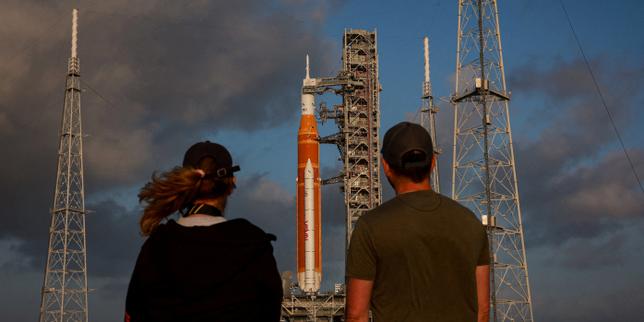
The Space Launch System (SLS) is the backbone of Artemis. NASA calls it the most powerful rocket ever built. What they don’t tell you is that it’s built from the scrap heap of the Space Shuttle era.
Those solid rocket boosters? They are modified versions of the ones that flew in the 1980s. The RS-25 engines? They are literally refurbished Shuttle engines. This isn’t innovation. It’s tax-funded taxidermy.
Each launch of the SLS costs roughly $4.1 billion. That is not a typo. For one single flight, we burn through a budget that could fund entire constellations of private-sector exploration. Because the SLS is expendable—meaning it drops into the ocean and disappears forever—every launch is a financial reset button.
I’ve watched aerospace firms bleed out over much smaller inefficiencies. In any other industry, a product that costs billions and can only be used once before being thrown away would be laughed out of the boardroom. But in the world of cost-plus government contracting, inefficiency is the feature, not the bug. It keeps the sub-contractors in every US state happy. It keeps the votes coming. It just doesn't get us to space effectively.
The Lunar Gateway Is A Toll Booth To Nowhere
The most baffling part of the Artemis architecture is the Lunar Gateway. NASA wants to build a small space station orbiting the Moon where astronauts will stop before heading to the surface.
Ask any orbital mechanist why we need a station in high lunar orbit, and they’ll struggle to give you a physics-based answer. It’s a solution looking for a problem.
- Extra Weight: Every kilogram of fuel used to stop at the Gateway is a kilogram you can't use to land or come home.
- Radiation Risk: Placing humans in a station outside the Earth's protective magnetosphere for months at a time exposes them to solar flares and cosmic rays with zero tactical advantage.
- Added Complexity: Every docking maneuver is a point of failure.
If you want to go to the Moon, go to the Moon. Don’t build a pit stop that adds years to the timeline and billions to the bill. The Gateway exists because NASA needs a way to make the SLS look necessary. Without a station to build, the SLS doesn't have a clear payload. It’s a circular dependency that serves the bureaucracy, not the science.
The Gravity Well Fallacy
"We need to learn to live on the Moon to learn to live on Mars."
This is the mantra. It sounds logical until you look at the chemistry. The Moon is a dry, dead rock. Mars has an atmosphere, frozen water, and CO2 that can be converted into methane fuel. The technologies required to survive on the Moon—dealing with jagged, electrostatic regolith that shreds seals and lungs—are almost entirely different from the technologies needed for Mars.
Imagine a scenario where you want to learn how to survive in the Sahara Desert, so you decide to practice by spending three years in the middle of the Pacific Ocean. Sure, they’re both "extreme," but the skills don’t transfer.
The Moon has 1/6th Earth's gravity. Mars has 1/3rd. The Moon has no atmosphere. Mars has enough to create aerodynamic heating but not enough to easily parachute. By the time we "master" the Moon, we will have spent the entire budget for Mars on a rock that taught us how to survive on... the Moon.
The Private Sector Is Already Eating NASA's Lunch
While NASA is arguing over the specs of a ladder for the Orion capsule, private entities are iterating at ten times the speed.
Look at the math:
- Cost per kilogram to orbit: NASA's SLS is estimated at nearly $60,000 per kg.
- Starship (SpaceX): Targeted at under $200 per kg once fully operational.
Even if the private sector is off by a factor of ten, they still win. The Artemis program actually relies on Starship to be the Lunar Lander because NASA couldn't build one in-house that worked within the budget or timeframe. Think about the irony: the "secondary" commercial partner is building a vehicle that is more capable, more reusable, and more ambitious than the primary government rocket it’s supposed to ferry.
NASA has become a glorified travel agency for hardware it no longer knows how to build efficiently.
The Myth Of "Readiness"
When NASA says "We are ready," they mean the paperwork is signed. They mean the safety reviews—which were bypassed or "streamlined" for the first Artemis I uncrewed flight—are checked off.
But readiness is a state of mind, not a press release. True readiness would mean having a sustainable, repeatable architecture. Artemis is brittle. If one SLS fails, the program shuts down for years. There is no backup. There is no "Plan B" rocket in the government's hangar.
We are betting the next thirty years of human spaceflight on a single-string architecture that relies on 1970s technology. That isn't being ready; that's being desperate for a win.
The Actionable Truth
If we actually wanted to be a multi-planetary species, we would stop obsessing over flags and footprints. We would:
- Cancel the SLS immediately: Shift those billions into "Space Tugs" and orbital fuel depots.
- Incentivize Fuel Production: Offer a fixed price for oxygen and methane delivered to orbit. Let the market figure out how to get it there.
- Ignore the Gateway: Focus on direct-to-surface missions that build actual infrastructure—habitats, not tin cans in orbit.
The Moon should be a commercial outpost, a place for mining and telescopes, run by companies that have to worry about a balance sheet. Human exploration should be aimed at Mars, where the biological and geological stakes are actually worth the risk of a human life.
Artemis isn't the beginning of a new era. It’s the expensive final gasp of the old one. We aren't going back to the Moon to stay; we’re going back because we don’t know how to do anything else.
Stop cheering for the rocket because it’s big and painted with a logo. Start asking why we are paying for a horse and buggy when the jet age has already arrived.