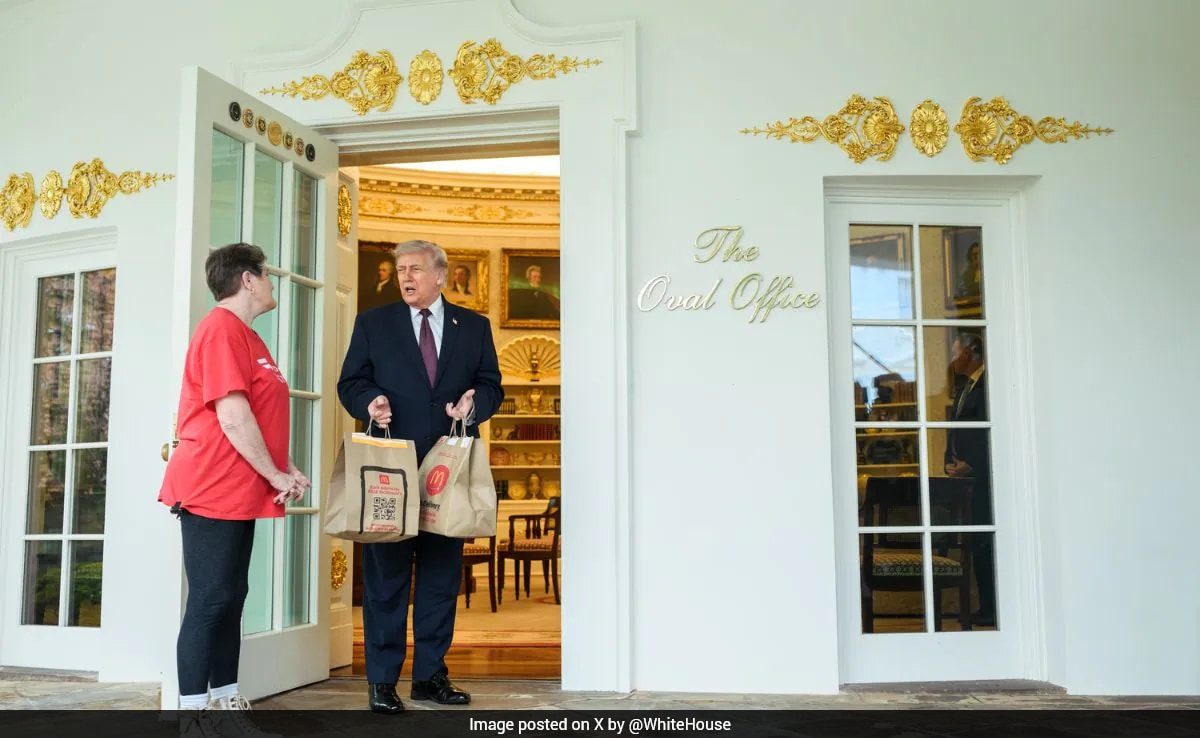
A hundred dollars is not a tip. It is a stage prop.
When the news cycle latches onto a story about a former president handing a C-note to a grandmother delivering McDonald’s to the White House, the media performs its usual dance. Half the outlets swoon over the "generosity," while the other half nitpicks the optics of fast food in a five-star residence. Both sides are missing the point. They are arguing about the wrapping paper while the box is empty.
The obsession with these micro-gestures of wealth reveals a fundamental misunderstanding of how labor, value, and political theater actually function in a digital economy. We are being trained to value the performance of charity over the mechanics of prosperity.
The Tip as a Transactional Weapon
In the world of high-stakes political branding, every dollar spent in public has a Return on Investment (ROI) calculation attached to it. That $100 tip wasn't for the driver. It was for the camera phone.
To the casual observer, it looks like a moment of human connection. To a brand strategist, it is a low-cost acquisition of positive sentiment. If you spend $100 to generate $1,000,000 in earned media coverage across every major news network, you haven't performed an act of kindness. You have executed a brilliant marketing arbitrage.
The "lazy consensus" argues that this is about a man being "of the people." Real economic insiders know that being "of the people" is a luxury brand sold to those who can't afford the actual product. A $100 tip on a bag of burgers is a statistical anomaly that does nothing to address the structural reality of the gig economy. It provides a momentary dopamine hit for the recipient and a week of content for the donor.
The Grandma Narrative and the Death of Dignity
Notice how every headline emphasizes that the recipient was a "grandma." This isn't accidental. It’s designed to tug at a specific set of heartstrings, framing the delivery driver as a vulnerable figure saved by a benevolent benefactor.
This framing is an insult to the workforce.
By focusing on the "sweet grandmother" trope, we ignore the grim reality: why is a grandmother delivering burgers to the White House in the first place? If we were serious about economic health, we would be discussing the failure of pension systems or the rising cost of living that forces retirees back into the gig meat-grinder. Instead, we cheer for the "King" throwing a gold coin from his carriage.
In my years analyzing corporate optics, I have seen this "Savior Complex Marketing" sink more brands than it saves. It creates an expectation of luck rather than an expectation of fair compensation. It tells the worker, "If you are lucky enough to serve a billionaire, you might get a windfall."
That is not an economic system. That is a lottery.
Dismantling the People Also Ask Fallacy
People often ask: "Is a $100 tip good for a delivery?"
This is the wrong question. It assumes that the value of the labor is tied to the mood of the customer. When we praise "over-tipping," we are inadvertently justifying a sub-minimum wage system that relies on the whims of the elite.
A "good" tip is a predictable, sustainable percentage that reflects the service rendered. A "performative" tip is an ego-stroke. If the goal were truly to help the driver, the $100 would be given privately, without the social media fanfare. The moment the camera comes out, the tip becomes a business expense.
Another common query: "Why do politicians use fast food to connect with voters?"
They do it because they want to appear "uncultured" in a way that feels safe. It’s "relatable" to eat a Big Mac. It’s "elitist" to eat poached salmon. It’s a cheap trick that works every time. They are eating the food of the masses to mask the fact that their policies rarely serve the masses. It is the culinary equivalent of wearing a hard hat at a factory for five minutes and pretending you understand the assembly line.
The Economics of the White House McDonald’s Run
Let’s look at the actual physics of this event.
The White House has a world-class kitchen. It is staffed by elite chefs who can cook anything on the planet. Ordering McDonald’s is a deliberate choice to bypass excellence in favor of a brand. It is an act of defiance against the "establishment" of fine dining.
But here is the counter-intuitive truth: it is also a logistical nightmare.
Every delivery to the White House involves Secret Service screening, security sweeps, and massive coordination. To order a $20 meal and tip $100 is to ignore the thousands of dollars in taxpayer-funded security time required to let that delivery driver through the gate.
If we applied a true P&L (Profit and Loss) statement to that burger, it would be the most expensive meal in human history. But we don't talk about that. We talk about the hundred bucks. We focus on the penny on the sidewalk while the building behind us is on fire.
Why We Love the Lie
The reason this story goes viral is that it fits into our collective desire for a "benevolent dictator" or a "generous boss." We want to believe that if we just work hard enough and stay "sweet," someone powerful will notice us and change our lives with a single gesture.
This is a dangerous fantasy.
True economic power isn't found in the $100 bill given to a driver. It’s found in the interest rates, the trade policies, and the labor laws that determine whether that driver has to work at age 70 or not.
I’ve seen executives at Fortune 500 companies pull this stunt a thousand times. They’ll cut the benefits of 5,000 employees and then hand a $500 bonus to one "employee of the month" in front of a camera. The internet cheers. The 4,999 others lose their dental insurance.
We have to stop falling for the micro-gesture.
The Professional Price of "Generosity"
There is a downside to this kind of contrarian view: it makes you look cynical. People want to believe in the "nice story."
But as a professional who has spent decades looking at how power is wielded, I can tell you that cynicism is often just another word for "observation."
When you see a high-profile figure doing something "charitable" that is perfectly timed for a news cycle, ask yourself three things:
- Who is filming this?
- What bad news is this story meant to bury?
- Does this action scale?
If the action doesn't scale—meaning, if the person isn't tipping every driver $100—then it’s not a policy. It’s a lottery. And you can’t run a country, or an economy, on a lottery.
Stop Cheering for Table Scraps
The $100 tip to the grandma is a distraction. It’s a shiny object meant to keep you from asking why the delivery fees are so high, why the wages are so low, and why the political class treats the working class like a backdrop for their latest TikTok.
The next time you see a story about a "surprising" act of generosity from a billionaire or a politician, don't share it. Don't like it. Don't comment on it.
Ask for the data on their tax filings. Ask about their stance on collective bargaining. Ask about the cost of housing.
If you want to help a grandmother, support a system where she doesn't have to deliver fries in her seventies. Anything else is just theater. And the tickets are far more expensive than $100.
The $100 tip isn't a sign of a healthy society. It’s a symptom of a broken one where we’ve traded systemic justice for the hope of a high-status handout.
Stop being a fan of the performance. Start being a critic of the system.



